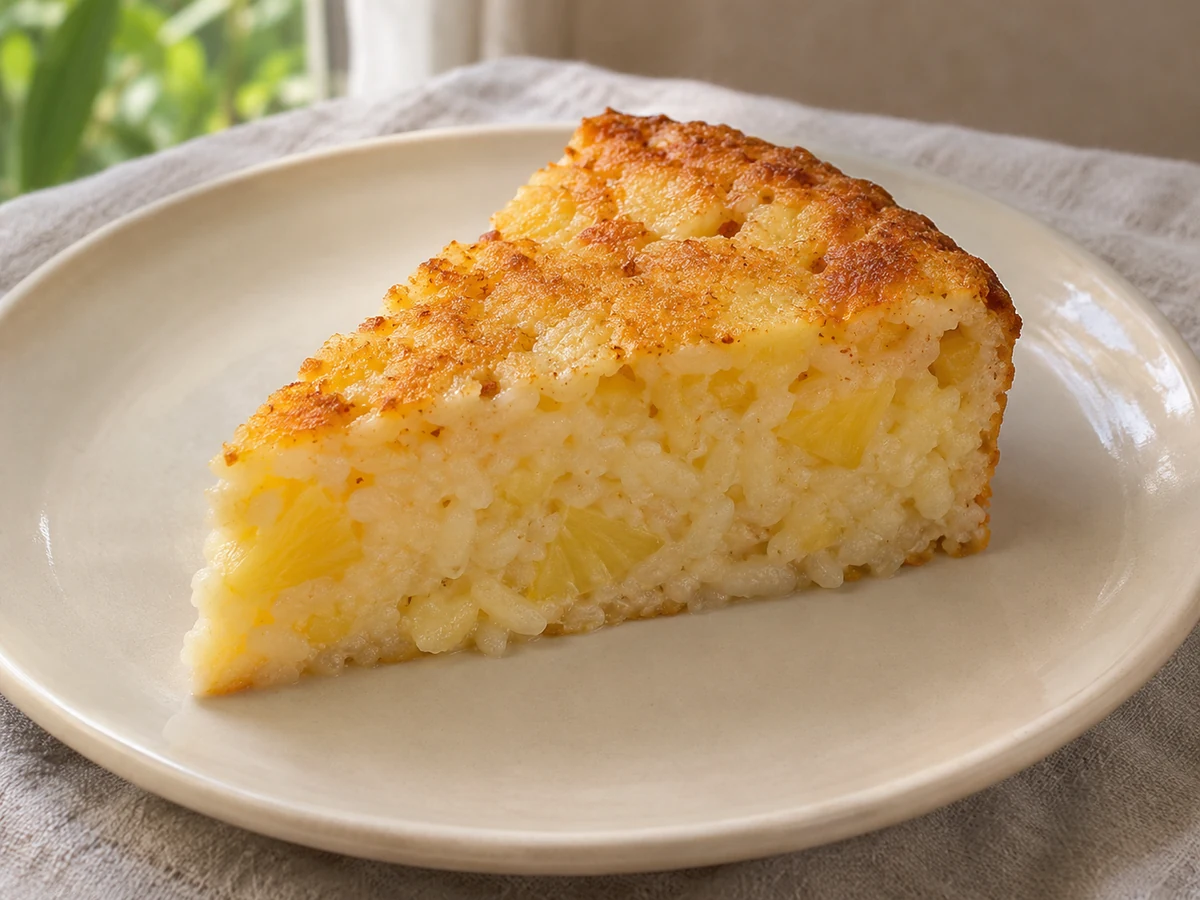
Pineapple and lemon rice cake
A tender round-grain rice, pineapple and coconut milk cake, bound with eggs and flavoured with lemon juice and zest.
Ingredients
- 120 g raw round-grain white rice
- 300 ml drinking water, plus a small reserve if needed to finish cooking the rice
- 200 g unsweetened coconut milk
- 200 g fresh pineapple flesh, without skin or fibrous core
- 100 g raw egg without shell, approximately 2 eggs
- 35 g white sugar
- 15 g pure strained lemon juice
- 1 g finely grated washed lemon zest, yellow part only
- 1 g salt
Preparation
Rinse 120 g round-grain rice; cook covered with 300 ml water for 18 to 22 minutes until tender, with a little extra water if needed.
Add 200 g stirred coconut milk, 35 g sugar and 1 g salt; cook for 5 to 8 minutes while stirring.
Spread rice in a clean shallow container to cool quickly to lukewarm.
Dice 200 g usable pineapple to 5 to 8 mm; cook in a dry pan for 5 to 7 minutes, then cool to lukewarm, keeping all remaining juice.
Preheat the oven to 170 °C and line a round 16 cm mould of at least 1 litre capacity with baking paper.
Beat and weigh 100 g egg without shell; measure 1 g lemon zest and 15 g strained lemon juice.
Mix lukewarm rice with eggs, juice, zest and pineapple, then pour into the mould.
Bake for 35 to 45 minutes; check 74 °C at the centre and extend by 3 minutes as needed.
Release steam for 20 to 30 minutes then refrigerate promptly, ideally within an hour, without exceeding 2 hours at room temperature.
After at least 2 hours in the refrigerator, lift with the paper, divide into four and eat within 24 hours, stored at no more than 4 °C.
Introduction
This cake sits between firm rice pudding and baked custard: grains remain recognisable, while eggs bind the mixture so it can be divided into four portions after cooling. Pineapple provides small fruity pockets rather than a layer of slices beneath a caramelised mould. Lemon is used as both juice and zest, in distinct quantities to distinguish acidity from aroma.
This is a contemporary dessert creation inspired by ingredients associated with African cuisines, without claiming an attested Angolan tradition. Rice starts cooking in water and finishes with coconut milk before baking. This first stage is essential: raw grains mixed into an egg mixture would stay hard. Plan quick cooling after baking and short storage, because cooked rice must not wait for hours on the table.
Cultural context
Rice, pineapple and coconut build an original dessert within a collection devoted to Angola. Their precise combination, mould and proposed timings are contemporary editorial decisions. The text invents no ancient lineage or regional name. Diverse rice uses cannot be reduced to this cake, and a fruit’s presence alone does not establish a formula’s national origin.
The FAO profile supplies an institutional reference for country context: https://www.fao.org/angola. It does not validate this dessert. Estimation data come from Anses’s Ciqual table: https://zenodo.org/records/4770600. Generic raw white rice represents round-grain rice; this composition approximation does not predict every variety’s culinary behaviour.
Tips
Zest the lemon before squeezing to make grating easier and avoid working with flattened skin.
Baking paper replaces greasing here but must cover the base well to avoid tearing the cake.
Taste rice before adding eggs to check tenderness without eating raw egg mixture.
The small water reserve only finishes cooking the grains; it must not leave soup in the mould.
Measure the mould’s internal diameter: a much wider one gives an overly thin layer that cooks faster.
Planning
Choose plain round-grain white rice, not precooked. Rinse briefly in a fine sieve, then put in a heavy-based saucepan with 300 ml water. Bring to the boil, cover and reduce to low heat. Cook for 18 to 22 minutes until water is almost absorbed and the grain tender. Check a grain cooled on a clean spoon; it must have no hard centre. If needed, extend with a little drinking water added gradually instead of baking incompletely cooked rice.
Stir coconut milk before weighing 200 g. Add it to the rice with sugar and salt. Cook over low heat for another 5 to 8 minutes, stirring, until creamy with no pool of liquid surrounding the grains. Do not let rice dry into a block; eggs will bind it later. Remove from heat and spread in a clean shallow container to cool quickly to lukewarm rather than waiting hours in the hot pan.
Prepare pineapple while the rice cooks. Carefully remove eyes, skin and fibrous core, then weigh 200 g usable flesh. Dice to 5 to 8 mm so fruit distributes without large wet pockets. Put in a dry nonstick frying pan and cook over medium-low heat for 5 to 7 minutes, stirring. Most released juice should evaporate without burning the fruit. Transfer everything, including the small juice residue, to a clean plate and cool to lukewarm.
Preheat a conventional oven to 170 °C. Line a round 16 cm mould of at least 1 litre capacity with baking paper covering base and sides. Leave two paper strips projecting to help lift it once cooled. No butter or oil is included. The mixture does not rise like a sponge; keep thickness moderate so the centre sets without drying the edges.
Wash the lemon and grate 1 g very fine zest, avoiding bitter white pith. Separately squeeze and strain 15 g juice. Beat eggs in a bowl and weigh 100 g without shell. When rice is only lukewarm, mix in eggs, then juice, zest and pineapple cubes. Stir gently to avoid crushing all the grains. If rice is still hot, wait a few minutes while stirring; eggs must not coagulate before baking.
Pour into the mould, level and bake for 35 to 45 minutes. Edges should be set with no free liquid in the centre. Use a clean probe to check 74 °C at the centre; extend by 3-minute intervals if needed. A small uniform wobble is compatible with tenderness, but a liquid wave means insufficient setting. Surface colour alone does not show that eggs have cooked at the centre.
Set the mould on a rack and release steam for about 20 to 30 minutes, then refrigerate promptly, ideally within an hour of leaving the oven. Never exceed 2 hours at room temperature. Chill for at least 2 hours before lifting the cake with its paper and dividing into four. Cooling firms the binding; unmoulding while very hot risks breaking the deliberately soft structure.
Serving
Serve chilled in four soft portions cut with a clean knife. Wipe the blade between cuts to avoid tearing grains and small pineapple cubes. A rice cake without flour does not have a sponge cake’s dry crumb; a tender slice is expected. Add no coulis, cream or surface sugar if keeping the stated quantities. A little separation of grains when cutting does not by itself indicate undercooking.
Storage
Keep covered at no more than 4 °C and eat within 24 hours. Rice particularly requires care: cooking does not make slow room-temperature cooling acceptable. Use a clean container, do not stack still-hot portions in a deep box, and remove only what will be eaten. This version is served cold; reheating is not suggested as a way to extend storage artificially. Discard leftovers kept out of refrigeration beyond the stated limit.
Variations
For a more uniform texture, lightly mash a small portion of rice before adding eggs without blending the whole mixture. Pineapple can be diced finer, but its 200 g are still weighed after trimming and before pan cooking. Do not add baking powder seeking conventional cake volume; the recipe relies on moist binding, not aerated batter. Long-grain rice would require reassessing grain behaviour and does not guarantee the same slice.
Nutrition notes
The estimate represents one quarter of the cake without accompaniments. Rice is counted at raw weight, pineapple as raw trimmed flesh and eggs without shell. All stated sugar, juice, zest and salt are included. Ciqual’s generic raw white rice represents round-grain rice; its coconut milk or cream entry may differ from the chosen product. Water adds no macronutrients. Mixture left in containers or uneven cutting changes actual portions; these values are not an analysis of the baked cake.
Conclusion
Fully cooked grains before eggs are added, evenly diced pineapple and a checked centre temperature provide the preparation guides. Quick cooling matters as much as cooking. This contemporary editorial formula is not claimed to be kitchen-tested.
Enjoy your meal
Enjoy your meal!