Roasted bananas with ginguba cream
Ripe but firm bananas roasted without oil, with a warm roasted peanut and coconut milk sauce finished with lime.
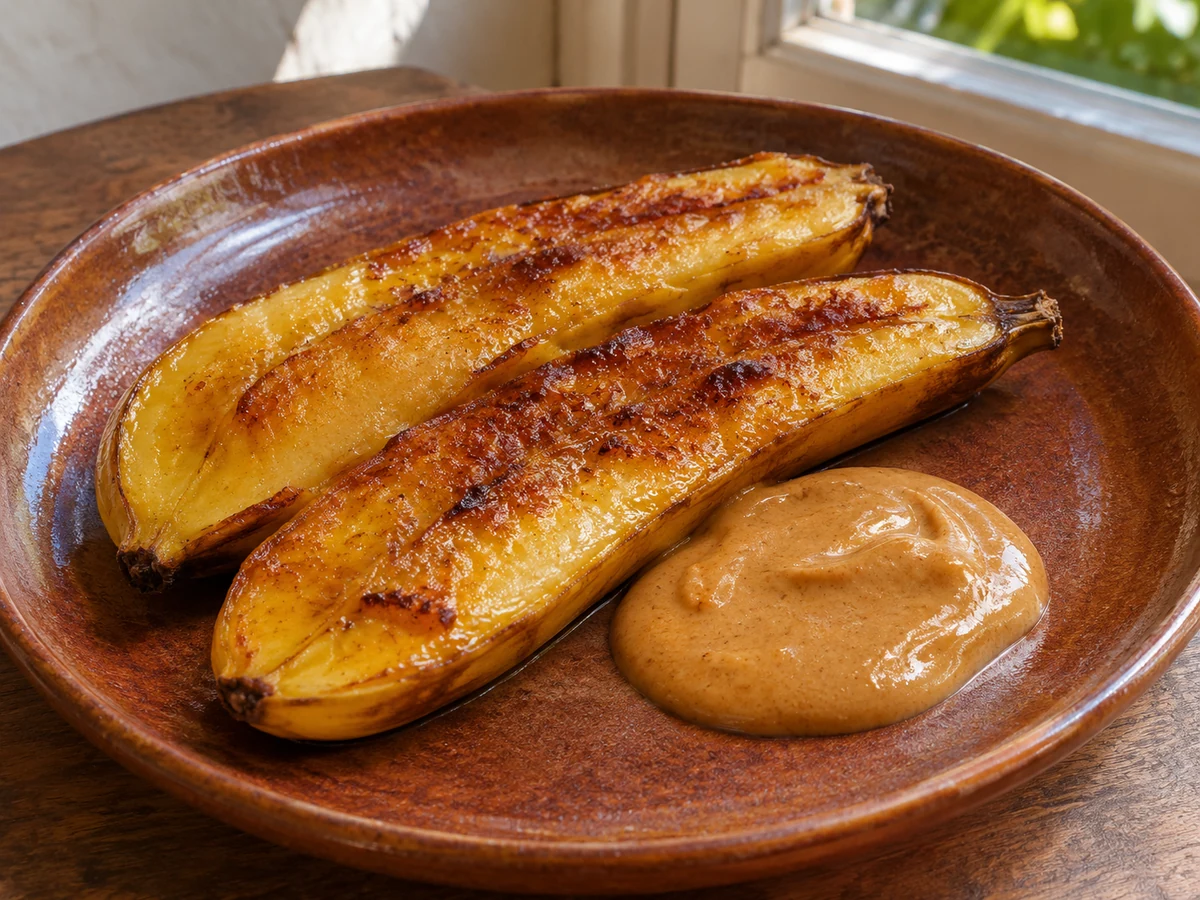
Ingredients
- 600 g ripe but firm dessert banana, peeled weight
- 40 g shelled roasted unsalted peanuts
- 150 g unsweetened coconut milk
- 15 g white sugar
- 15 g freshly squeezed filtered lime juice
- 80 ml drinking water, divided into 40 ml for the baking dish and 40 ml for the sauce
- 1 g salt
Preparation
Preheat the oven to 190 °C and weigh 600 g peeled banana.
Halve lengthways and arrange in one layer, cut-side up, over 40 ml water in a shallow dish.
Roast for 15 to 20 minutes until tender but still whole.
Finely blend 40 g peanuts with part of the 150 g stirred coconut milk.
Place in a saucepan with the remaining coconut milk, 40 ml water, 15 g sugar and 1 g salt.
Gently simmer for 4 to 5 minutes while stirring to obtain a pourable sauce that coats a spoon.
Off the heat, stir in 15 g strained lime juice.
Divide bananas and all the sauce among four plates and serve warm without uncounted additions.
Introduction
A ripe banana tolerates a short oven bake when its flesh is still fairly firm. It becomes tender at the edges while staying whole in the centre. Ginguba, meaning peanut, gives the sauce a denser texture and roasted flavour contrasting with the fruit’s sweetness. Coconut milk loosens the blended peanuts; a little lime added after cooking prevents the result from being only sweet and rich.
This recipe uses dessert bananas, not plantains. They cannot be exchanged here with the same cooking time. Each of four portions contains one quarter of the 600 g peeled banana and one quarter of the sauce. This is a contemporary ingredient-inspired creation, not a claim of a traditional dessert attested under this name in Angola. No caramel or additional cooking fat is needed.
Cultural context
Ginguba here refers to peanut, used as the sauce’s base rather than just a crunchy addition. Moving from an ingredient to a precise formula still requires explanation: Angolan uses of peanut do not prove that these oven-baked bananas and this coconut milk ratio constitute an old dessert. This preparation is identified as a contemporary creation and is not assigned to a festival or region through unsupported claims.
The institutional FAO profile places the national context: https://www.fao.org/angola. It does not document this particular recipe. Composition values use Anses’s Ciqual table: https://zenodo.org/records/4770600. The peanut reference specifically concerns roasted unsalted peanuts, not sweetened or salted peanut butter.
Tips
Support the fruit’s length with a broad spatula rather than tongs that would mark the flesh.
Stir coconut milk before weighing 150 g for a fat proportion more representative of the tin.
A small blender handles 40 g peanuts better than a large bowl whose blades would pass above them.
Make the sauce while the fruit roasts to serve both warm without unnecessary waiting.
If the sauce waits a few minutes, cover it off the heat and stir before serving rather than keeping it at a hard boil.
Planning
Choose yellow bananas with a few small brown spots but no waterlogged flesh. Very soft fruit would collapse while being moved to the plate. Still-green banana would remain floury in the stated time. Peel, remove thick strings and weigh 600 g flesh. This does not necessarily mean four fruits because sizes vary. Halve lengthways; cut very long halves across to distribute them without stacking.
Preheat a conventional oven to 190 °C. Choose a shallow dish that holds the banana halves in one layer with little empty space between them. Pour 40 ml water into the base and arrange the fruit cut-side up. This water protects the underside at the start; it is not a sweet sauce. Add no extra oil. In an oversized dish the water evaporates too quickly before the fruit becomes tender.
Bake for 15 to 20 minutes, checking from 15 minutes. The surface should look shinier, the edges may colour lightly and a knife tip should enter the centre easily. A dark colour is not essential: ripeness and oven humidity affect browning. Do not use the grill to force colour; the banana tips would burn before the whole fruit warms evenly.
Meanwhile, check that roasted peanuts contain no salt or sugar and have no rancid smell. Weigh 40 g after removing shells and, if needed, easily detached skins. Grind finely in a suitable small appliance. Gradually add part of the 150 g previously stirred coconut milk to bring particles under the blades. Stop the appliance before scraping the sides with a spatula. Aim for a fine paste, not simply chopped peanuts.
Transfer the paste to a small saucepan. Add the remaining coconut milk, the 40 ml water reserved for the sauce, 15 g sugar and 1 g salt. Bring to a gentle simmer while stirring. Cook over low heat for 4 to 5 minutes without allowing a crust on the base. The sauce should coat a spoon while staying pourable. Hard boiling can bring oil to the surface; lower the heat and stir to reunite the mixture.
Turn off the heat, mix in 15 g strained lime juice and taste a small spoonful once cooled slightly. Lime should balance the fruit rather than make the sauce an acidic dressing. Remove the dish from the oven and lift bananas with a broad spatula to avoid breaking them. Divide fruit and sauce among four plates. Spoon sauce beside and partly over the bananas, keeping their outlines visible rather than drowning the warm flesh.
Serving
Serve straight from the oven while the fruit remains easy to move. Divide all the sauce as evenly as possible because it contains a substantial share of the peanuts and coconut milk. Peanuts are an essential ingredient, not merely decoration, and are an allergen to declare. Avoid extra nuts, cream or biscuits if keeping the calculated values for the basic formula.
Storage
Texture is best immediately after cooking. Cool leftovers quickly in shallow containers and refrigerate within 2 hours at room temperature. Keep at no more than 4 °C for 48 hours. Reheat only once until hot throughout, adding just a little water if the sauce has thickened; water does not remedy improper storage. Do not refrigerate leftovers that have already been reheated and served.
Variations
Banana can be cut into thick sections instead of long halves if kept in one layer and checked earlier for firmness. For a finer sauce, blend the same peanuts longer rather than replacing them with a sweetened commercial spread. A peanut-free sauce would be a different formula and should no longer be called ginguba. Substitution is not something to improvise when a guest has an allergy.
Nutrition notes
The estimate represents one quarter of the bananas and all the sauce, without decorative additions. Banana is counted raw and peeled; cooking changes water content rather than the initial quantity used for the portion calculation. Roasted unsalted peanuts, sugar, juice and salt are counted in full. Coconut milk uses a generic Ciqual coconut milk or cream entry, which may differ from the actual product. The 80 ml water add no macronutrients. Sauce left in the pan or uneven portions change actual intake.
Conclusion
Choosing ripe but firm bananas avoids compensating for unsuitable texture with overcooking. Keep the sauce warm, smooth and pourable, with discreet acidity added last. This contemporary proposal is not presented as kitchen-tested.
Enjoy your meal
Enjoy your meal!