Mango glasses with corn cream
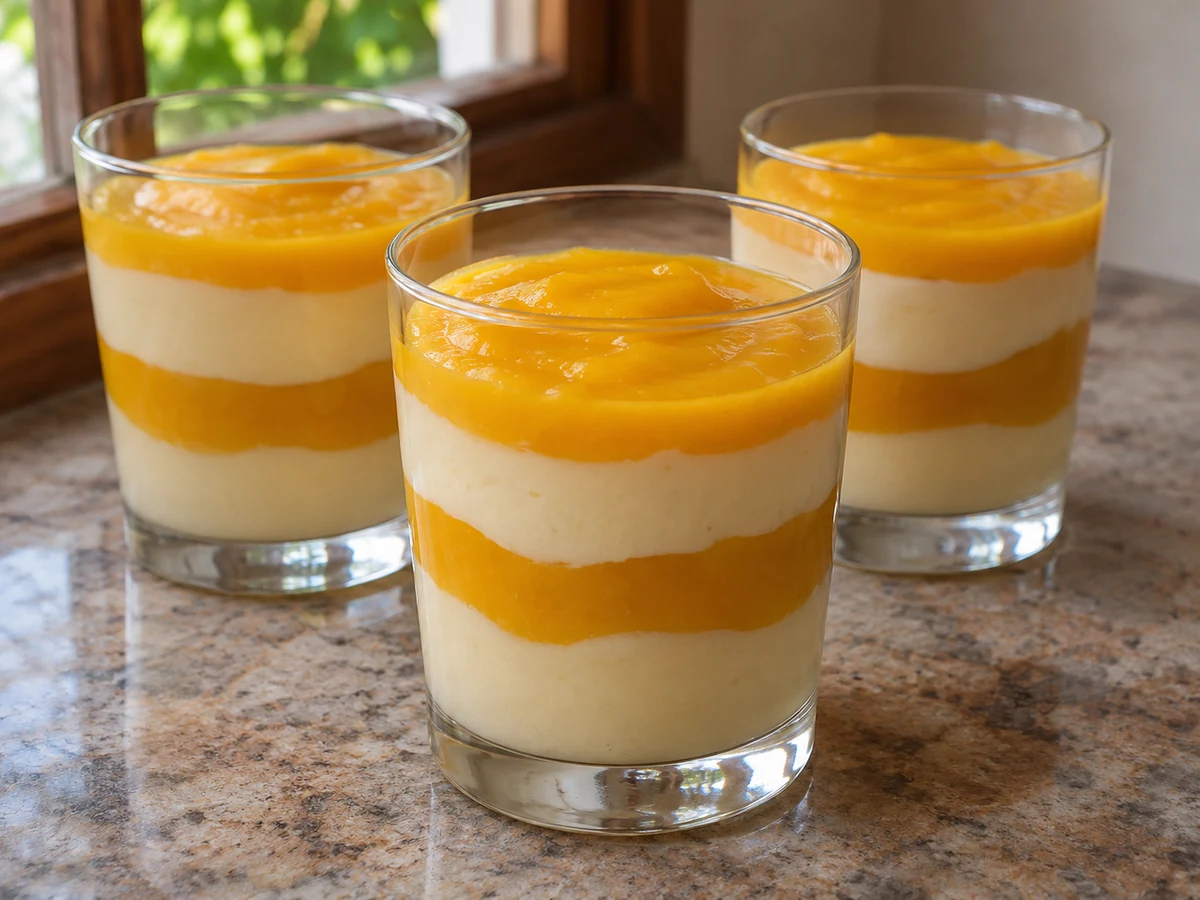
Fresh mango purée over cooked corn flour and coconut milk cream, served chilled in four large glasses.
Ingredients
- 500 g ripe mango flesh, without skin or stone
- 300 g unsweetened coconut milk
- 40 g fine corn flour, not cornstarch
- 150 ml drinking water
- 25 g white sugar
- 15 g freshly squeezed filtered lime juice
- 1 g salt
Preparation
Mix 40 g corn flour with 150 ml water while cold.
Add 300 g stirred coconut milk, 25 g sugar and 1 g salt.
Heat while stirring, then gently bubble for 7 to 10 minutes.
Transfer to a clean shallow container, release steam, cover the surface and cool quickly.
Let steam disperse and refrigerate within 2 hours at room temperature.
Wash, peel and stone the mangoes; weigh 500 g flesh.
Mash the flesh and mix with 15 g lime juice.
In the four 300 ml glasses, divide half the cold cream, then half the mango; repeat with the remainders to make four alternating layers. Cover and chill for at least 2 hours in total after cooking the cream.
Introduction
This dessert combines two separate textures: a soft corn cream thick enough to support the fruit layer, and mango purée with a little texture remaining. Use finely ground corn flour, not pure cornstarch and not coarse cornmeal. This distinction determines cooking time and mouthfeel. Coconut milk gives body; water prevents an excessively rich cream and allows the flour to hydrate without toasting.
The mango stays raw and goes into the glasses only when the cream has cooled. Lime juice is mixed into the fruit rather than the boiling saucepan. Assembly therefore involves simple stages that can fit within the same preparation period if their order is respected. This contemporary proposal makes four generous portions and is not presented as a traditional Angolan speciality. Allow at least 2 hours of refrigeration after cooking the cream.
Cultural context
Corn, mango and coconut provide an ingredient vocabulary here, not evidence of a recipe handed down under this name in Angola. Layering in glasses is a contemporary editorial choice that separates textures and portions. Assigning this dessert to a precise region or ceremony without a document describing that use would be misleading.
The FAO country profile places Angola’s agricultural setting: https://www.fao.org/angola. It does not certify this particular combination. Anses’s Ciqual table supplies composition references: https://zenodo.org/records/4770600. These resources have different functions. Neither replaces checking purchased products, particularly coconut milk richness, or assessing the texture obtained with each grind.
Tips
Prepare the glasses before assembly and stir the cold cream to distribute its two layers evenly.
Taste a little cooled cream on a spoon without returning that spoon to the batch.
Weigh lime juice after straining; discarded seeds and pulp are not part of the 15 g.
If mango is very fibrous, sieve before weighing the usable 500 g rather than counting removed fibres.
Choose clear straight-sided glasses to show the four alternating layers without changing quantities.
Planning
First check the flour packet: it should contain finely ground corn flour. Cornstarch would give a more translucent gel with different thickening strength; a coarse grind would remain gritty in the stated time. Prepare a heavy-based saucepan, whisk and flexible spatula. Measure 150 ml water before starting and set aside a clean container for cooling the cream. This avoids searching for a bowl while the pan needs constant stirring.
Stir the coconut milk in its container to reunite fat and liquid, then weigh 300 g. In the cold saucepan, mix corn flour with the 150 ml water. Break small lumps with a whisk before adding coconut milk, sugar and salt. Starting cold disperses the grains; pouring flour into very hot liquid would quickly produce lumps that are hard to remove.
Heat over medium heat, stirring continuously and reaching into the base’s corners. When the first thick bubbles appear, reduce the heat. Maintain gentle bubbling for 7 to 10 minutes, stirring with the spatula. The mixture thickens, becomes even and loses its raw-flour texture. It should fall slowly from the spatula; it firms further when cool. If it catches, lower the heat rather than scraping a browned layer into the dessert.
Transfer hot cream to a clean shallow container. Let steam disperse, cover the surface with suitable food-contact material, then refrigerate promptly: room-temperature cooling must not exceed 2 hours. Once fully cooled, stir the cream with a spatula to soften it without adding liquid. Prepare four clean 300 ml glasses; assembly takes place cold, without thermal shock to the containers.
Wash the mangoes before cutting to avoid transferring impurities from skin to flesh. Remove skin and stones, discard damaged parts and weigh 500 g flesh. Ripe mango yields slightly to finger pressure and smells fruity, without a fermented smell. Cut into small pieces, then mash or blend briefly. Slightly textured purée contrasts with the cream better than a very liquid juice.
Add 15 g lime juice to the mango purée and mix. Do not add unmeasured sugar to the fruit; the recipe counts it only in the cream. Divide half of all the cream among the four glasses, then half of all the mango. Repeat with the remaining cream, then finish with the remaining mango: each glass has four alternating layers. Keep the spoon close to the surface when adding each layer to avoid gouging the one below. Cover and refrigerate; allow at least 2 hours of total chilling after cooking the cream.
Serving
Serve chilled with a spoon long enough to reach all four layers. Take a little mango and cream in each spoonful rather than mixing the whole glass. A very thin skin can form while the cream cools; surface covering limits it and stirring with a spatula softens it before assembly. Add no decorative biscuits or nuts if keeping the exact quantities and allergens of the stated formula.
Storage
Keep covered at no more than 4 °C and eat within 48 hours. Raw mango requires clean hands, knife and board after washing the whole fruit. Use a clean spoon and do not return a partly eaten glass to a batch intended for sharing. Transport in an insulated bag with a cold source; cooking the cream does not make the assembled dessert stable at room temperature.
Variations
For a more rustic fruit layer, mash the mango with a fork instead of blending, keeping the same 500 g. Fine yellow or white corn flour works; the cream’s colour changes without warranting a different speciality name. Do not substitute cornstarch gram for gram; it needs its own formulation. Sugar cannot ripen a hard mango: postpone the dessert rather than disguise unsuitable fruit.
Nutrition notes
Estimated values cover one quarter of the preparation, including fruit and no extra topping. Mango is counted as raw flesh, flour at dry weight, and all sugar and salt are included. Ciqual’s coconut milk or cream reference is generic; purchased products can vary considerably. Water adds no macronutrients. Pan residues and portion differences limit precision; the result is not a laboratory analysis of the finished dessert.
Conclusion
Cold dispersion of the flour, continued cooking after thickening and assembly over cooled cream define this dessert’s method. Mango then provides its own uncooked flavour. This contemporary formula is not claimed to be kitchen-tested.
Enjoy your meal
Enjoy your meal!