Sweet potato and coconut custard pots
Four individual sweet potato, coconut milk and egg custards, gently baked in a water bath and served chilled, without caramel.
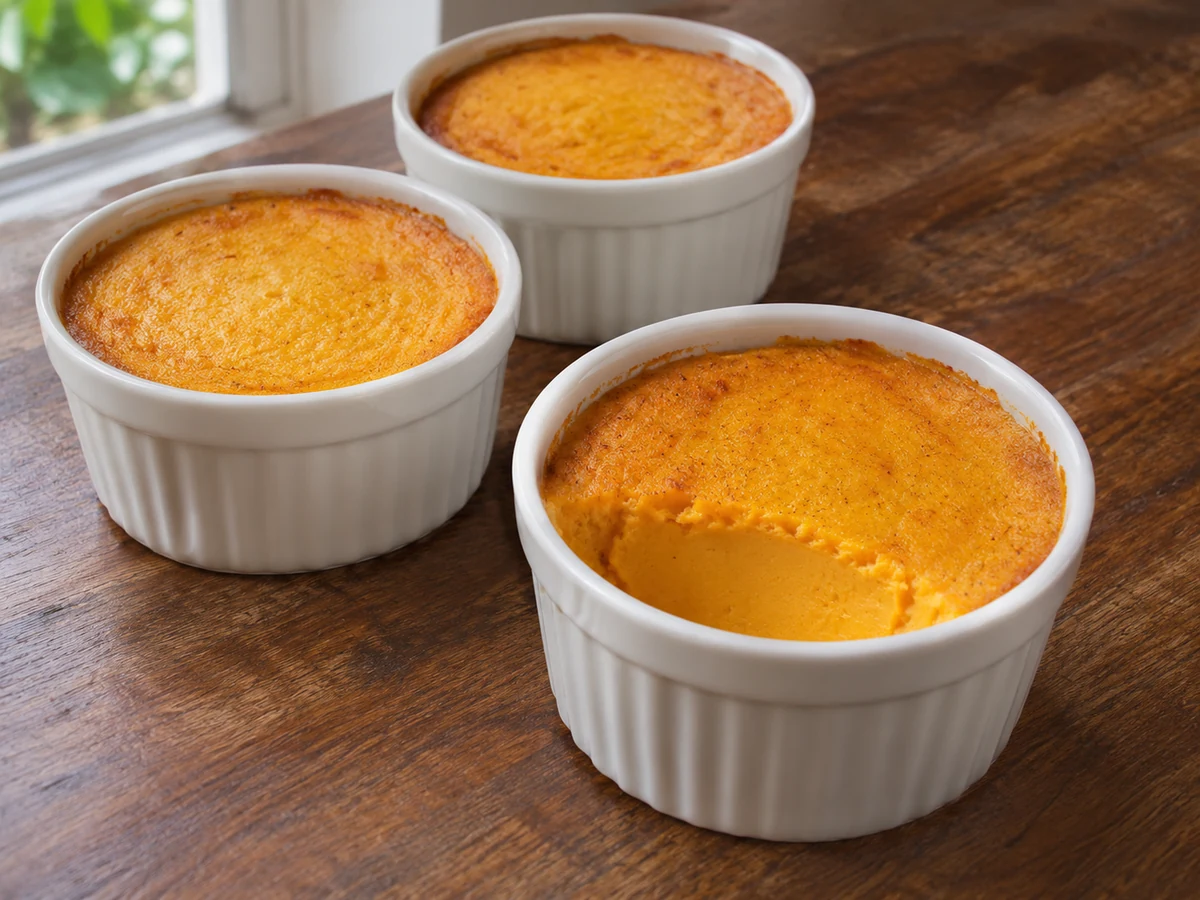
Ingredients
- 500 g raw sweet potato, peeled weight
- 200 g unsweetened coconut milk
- 100 g raw egg without shell, approximately 2 eggs
- 35 g white sugar
- 20 g unsweetened dried grated coconut
- 1 g salt
- Drinking water to boil the sweet potato and fill the water bath, not incorporated
Preparation
Wash, peel and weigh 500 g sweet potato; cut into 2 cm cubes.
Cover with water and gently boil for 20 to 25 minutes until fully tender.
Drain, release steam off the heat for 5 minutes, mash and cool to lukewarm.
Preheat the oven to 160 °C and set four 250 ml ramekins in a deep dish.
Mix 100 g egg with 35 g sugar and 1 g salt without making foam.
Mix in 200 g coconut milk, the lukewarm purée and 20 g dried coconut.
Divide among ramekins; pour hot water around them to halfway up the sides.
Bake for 30 to 40 minutes; check 74 °C in the centre and extend by 3 minutes as needed.
Remove from the water, cool quickly and refrigerate within 2 hours; chill for at least 2 hours before serving.
Introduction
Sweet potato provides the main structure; eggs bind a purée loosened with coconut milk. The intended result is a tender dessert eaten with a spoon from its ramekin, rather than a cake unmoulded into slices. A small quantity of dried coconut mixed into the custard gives fine texture without a separate topping. The measured sugar leaves the root’s flavour recognisable.
This contemporary creation makes four similar portions. It involves two cooking stages: boiling the sweet potato, then baking the egg mixture in a water bath. Keeping these stages separate avoids relying on the oven to soften a still-firm root. Allow cooling time and at least 2 hours in the refrigerator as well; this belongs in the schedule even though it requires no active work.
Cultural context
Choosing sweet potato and coconut connects this proposal with ingredients found in African food repertoires without assigning a precise village origin. Angola has varied agricultural and culinary settings; an individual water-bath dessert cannot summarise them. This text therefore explicitly identifies a contemporary creation, not an attested traditional recipe or a family preparation collected locally.
The institutional FAO country profile is a starting point for placing the country: https://www.fao.org/angola. It concerns national agricultural context, not authentication of this custard. Composition data come from Anses’s Ciqual table: https://zenodo.org/records/4770600. Separating cultural context, food composition and formula development avoids claiming a source documents something it does not.
Tips
Weigh beaten eggs to obtain 100 g even when their size varies.
Avoid vigorous whipping: abundant foam leaves holes and makes setting harder to judge.
Pour water into the bath with the dish already in the oven to reduce hazardous movement.
If one ramekin is fuller, check its centre separately; four identical containers make even cooking easier.
Do not try to unmould these custards: their ungreased ramekins and purée proportion are intended for eating directly from the container.
Planning
Choose a firm, orange-fleshed sweet potato without damp patches. Wash before peeling, then weigh 500 g of sound flesh. Cut into roughly 2 cm cubes: regular pieces cook together and make an even purée. Put in a saucepan, cover with water and bring to a gentle boil. Cook for 20 to 25 minutes, until a fork passes through without resistance. The precise time depends on the variety, not just cube size.
Drain thoroughly, then leave the pieces in the empty pan off the heat for 5 minutes to release steam. Keep no cooking water in the mixture; it would alter an already soft texture. Mash finely with a potato masher. If fibres remain, push through a fine sieve using a spatula. Let cool until no longer hot before adding eggs; very hot purée would coagulate them in patches.
Preheat a conventional oven to 160 °C. Choose four heatproof ramekins, each holding 250 ml, and a deep dish large enough to hold them without crowding. Leave the ramekins ungreased because the dessert is served in its container. Prepare a kettle of hot water. Avoid fragile or chipped vessels that might not withstand handling in the water bath.
Stir the coconut milk in its tin to reunite the fatty and watery phases, then weigh 200 g. Beat eggs in a bowl and weigh 100 g without shell. Mix the sugar and salt into the eggs without whipping to a foam. Add coconut milk, lukewarm purée and dried coconut. Mix until evenly coloured. Scrape the bowl’s base so no pocket of purée remains beneath a more liquid surface.
Divide evenly among the four ramekins, leaving a little space below the rim. Set them in the deep dish. Place that dish on the oven rack, then pour hot water around the ramekins to halfway up their sides without splashing the mixture. This avoids carrying an already heavy dish filled with scalding water. The water moderates heat around the sides but does not remove the need to monitor the centre.
Bake for 30 to 40 minutes. The edges should set while the centre still wobbles slightly, with no liquid wave when a ramekin is moved gently. Use a clean probe to check that the centre reaches 74 °C; extend in 3-minute intervals if necessary. Visual cues indicate texture but do not replace checking egg cooking. A swollen, cracked surface indicates excessive heat or overcooking. Remove the ramekins from the water using suitable protection.
Serving
First let steam escape on a rack, then refrigerate the ramekins without exceeding 2 hours at room temperature. Cover once cooled. Serve directly in the ramekins after at least 2 hours of chilling. A spoon should enter easily while the custard holds a soft shape. No caramel or additional fruit is included; adding either means the nutritional calculation no longer describes the plate exactly.
Storage
Keep covered at no more than 4 °C and eat within 48 hours. Do not leave portions on a buffet awaiting another serving; take out only what will be eaten. Use clean spoons and do not put a utensil already used for eating into a ramekin being stored. Freezing is not preferred because it can separate water from the egg structure; this concerns texture and does not extend refrigerator storage.
Variations
For a smoother texture, grind the 20 g dried coconut very finely before mixing it in; the quantity stays the same. White-fleshed sweet potato also works, but its moisture and flouriness change the result: work the purée carefully rather than adding unplanned liquid. Do not omit the eggs expecting the same custard. An egg-free version would need a different formula, cooking method and calculation.
Nutrition notes
The estimate represents one quarter of the complete mixture, without sides or caramel. Sweet potato is counted at its raw peeled weight; discarded cooking water adds no macronutrients. Coconut milk uses Ciqual’s generic coconut milk or cream entry, whose richness may differ from the chosen brand. Eggs, sugar, dried coconut and salt are counted in full. Cooking losses and actual products limit precision; these values are not an analysis of the finished custard.
Conclusion
Well-drained purée, eggs added at moderate temperature and monitored water-bath baking are the three key guides. Chilling finishes stabilising the dessert. This editorial formula is not presented as kitchen-tested.
Enjoy your meal
Enjoy your meal!