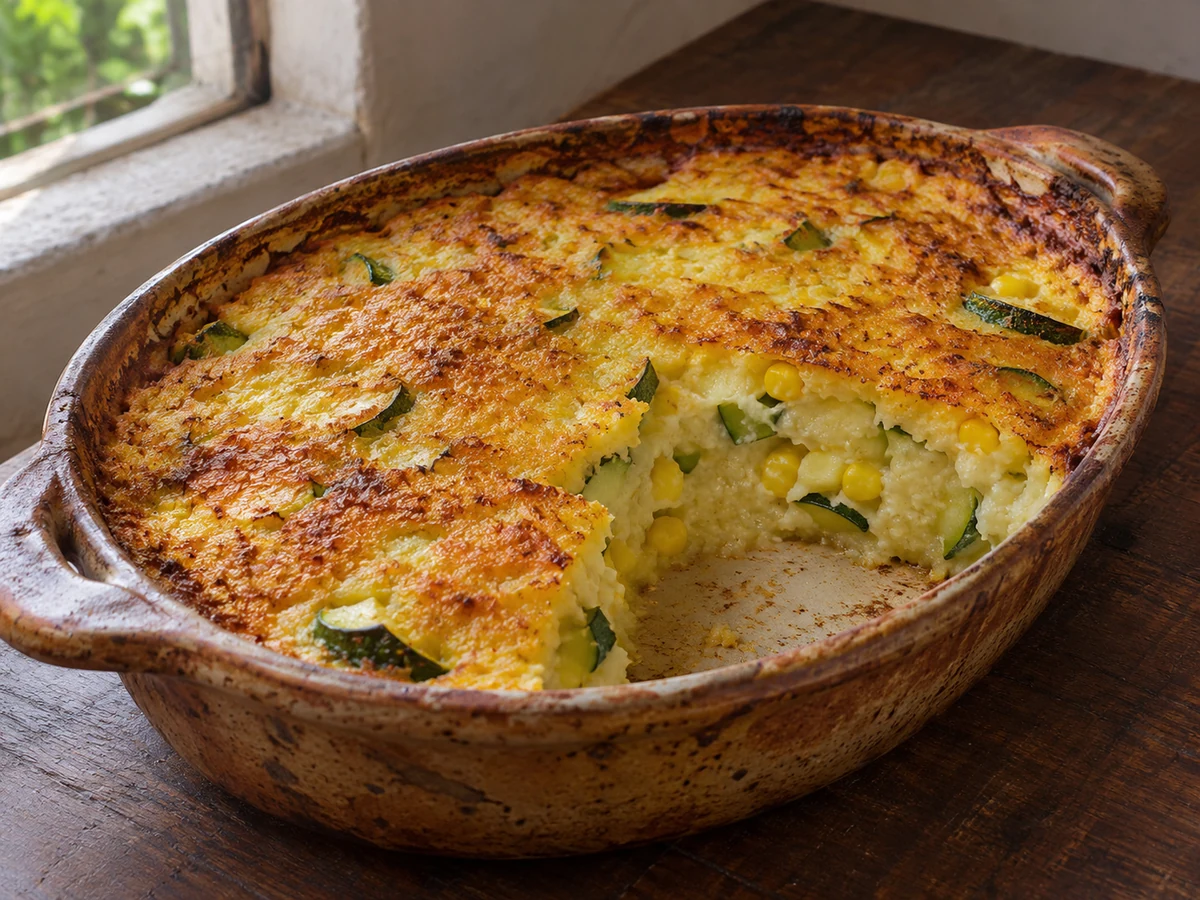
Courgette and sweetcorn gratin with cassava flour
A cheese-free gratin bound with cassava flour and egg in a coconut milk base, retaining all the courgette juices.
Ingredients
- 800 g raw courgettes, weighed after trimming the ends
- 300 g canned sweetcorn, drained weight
- 150 g peeled onion
- 200 g plain unsweetened coconut milk
- 60 g food-grade cassava flour, not tapioca starch
- 100 g raw egg without shell, about 2 medium eggs checked by weighing
- 25 g olive oil, including 20 g for the pan and 5 g for the dish
- 100 ml drinking water
- 3 g salt
Preparation
Wash and cut 800 g courgettes into 5 mm slices. Finely slice 150 g onion; drain and weigh 300 g sweetcorn.
Preheat the oven to 190 °C. Oil a 2-litre dish with 5 g oil.
Soften the onion for 6 minutes in 20 g oil, add courgettes and 3 g salt, then cook for 10 to 12 minutes, retaining all juices.
Blend 60 g cassava flour into 100 ml cold water, add 200 g coconut milk and pour into the pan. Stir over low heat for 3 to 4 minutes.
Remove from the heat and cool to lukewarm. Beat 100 g egg, temper with a spoonful of mixture, then stir into the vegetables with the corn.
Pour into the dish and bake for 30 to 35 minutes until the centre sets. Rest for 10 minutes before dividing into four servings. Check a central temperature of at least 74 °C with a clean probe.
Introduction
This gratin brings together courgette slices and sweetcorn kernels in a mixture bound with coconut milk, egg and cassava flour. There is no cheese: the surface firms through cooking the binder, without seeking a thick crust. The courgette should remain recognisable and the corn provide little firm bites. Serve by spoon after a short rest rather than in rigid slices like a tart.
The main challenge is controlling the courgettes’ water. They are precooked in a pan, then all their juices go into the preparation. They are not salted for squeezing and their liquid is not discarded: this method keeps the weights used for nutrition consistent. The quantities suit four servings of a vegetarian dish and include no additional accompaniments.
Cultural context
Using cassava flour to bind a courgette and sweetcorn gratin is a contemporary creation. It does not seek to rename a traditional Angolan dish. To situate the country’s crops and food, the institutional FAO profile offers context without attesting this particular combination: https://www.fao.org/angola.
Tips
Use a whisk to disperse flour in cold water before heating; adding it directly to the vegetables would easily create lumps.
Check that the product is cassava flour: tapioca starch does not have the same composition or exactly the same binding properties.
Prioritise setting in the centre over browning: a pale gratin can be cooked, and a golden edge can surround a still-liquid centre.
Keep coconut milk homogeneous by stirring its contents before weighing, as the fat phase can separate.
Scrape the binder bowl into the pan: leaving much flour at the bottom would change the gratin’s intended cohesion.
Planning
Choose firm, medium-sized courgettes with small seeds. Wash them, trim the ends and weigh 800 g. Cut into 5 mm slices; halve the largest rounds to distribute them more easily. Finely slice the onion. Drain the sweetcorn in a sieve and weigh 300 g after the liquid has run off. Do not make up the weight with liquid from the can.
Preheat a conventional oven to 190 °C. Oil a roughly 2-litre dish with the 5 g oil reserved for that purpose. An overly deep dish would delay setting in the centre, while a very wide surface would dry out the mixture. Put the dish on a stable tray to make moving it easier and catch any overflow without directly touching the oven’s heating element.
Heat the remaining 20 g oil in a wide sauté pan and soften the onion for 6 minutes. Add the courgettes and 3 g salt, then cook over medium heat for 10 to 12 minutes, stirring gently. The slices should soften without disintegrating into purée. Keep all the released juice in the pan. Cooking should stay gentle: heavy browning would dry some slices before others became tender.
In a bowl, blend the 60 g cassava flour with the 100 ml cold water until no visible lumps remain. Add the 200 g coconut milk and mix. Pour into the pan with the courgettes, then stir over low heat for 3 to 4 minutes. The binder starts thickening but should not become a dry mass. Scrape the bottom gently with a spatula to stop the flour sticking.
Remove from the heat and cool to lukewarm for a few minutes before adding the eggs. Crack them into a clean container, weigh out 100 g without shell and beat briefly. First stir a small spoonful of lukewarm mixture into the eggs, then return everything to the pan while stirring. This precaution reduces immediate coagulation into small pieces. Finally add the 300 g sweetcorn and spread everything into the oiled dish.
Bake for 30 to 35 minutes. The centre should be set, with no visible liquid egg; the surface may remain fairly pale. A knife inserted into the centre should meet a soft but bound texture, not a pocket of liquid. If the edges colour too quickly, cover loosely with baking paper and continue until the centre sets. Rest for 10 minutes before serving, as the gratin continues stabilising while it loses some heat. Check a central temperature of at least 74 °C with a clean probe.
Serving
Let the gratin rest before spooning out four servings. Distribute corn and courgettes as evenly as possible without seeking neat tart-like edges. Warn that the dish is hot. No accompaniment, sauce or extra oil is included in the stated values.
Storage
Divide leftovers between shallow containers and refrigerate at no more than 4 °C within 2 hours of cooking. Eat within 48 hours. To reheat, transfer only the amount needed into a small dish and heat until the centre is very hot; a hot surface is not enough. Avoid repeated cooling and reheating cycles. Freezing may produce a more watery texture after thawing.
Variations
No-added-salt corn can replace ordinary canned corn, but the salt estimate should then be adjusted to its label. Coconut milk varies greatly in fat content; retain the planned 200 g while recognising that energy depends on the brand. An egg-free version would require a different binder: simply removing the eggs would give a more fragile result and would no longer match this formulation.
Nutrition notes
Corn and flour supply carbohydrates; eggs contribute protein and coconut milk contributes fats. Cassava flour is referenced in the FAO 2010 table, code 02_004: https://www.fao.org/4/i1755e/i1755e00.pdf ; distinct from tapioca starch. Canned corn and coconut milk vary between brands, so their labels may give values different from this estimate. Coconut milk explicitly uses the generic Ciqual entry “coconut milk or coconut cream” as an approximation for the chosen product.
Conclusion
The binder should hold the juices without turning vegetables into a compact block. Precooked courgettes, well-dispersed flour and an oven-set centre produce a soft gratin that stabilises while resting.
Enjoy your meal
Enjoy your meal!