Rice and pumpkin patties with coconut
Twelve oven-baked patties combining cooked rice, pumpkin, grated coconut and cassava flour for a soft, cohesive texture.
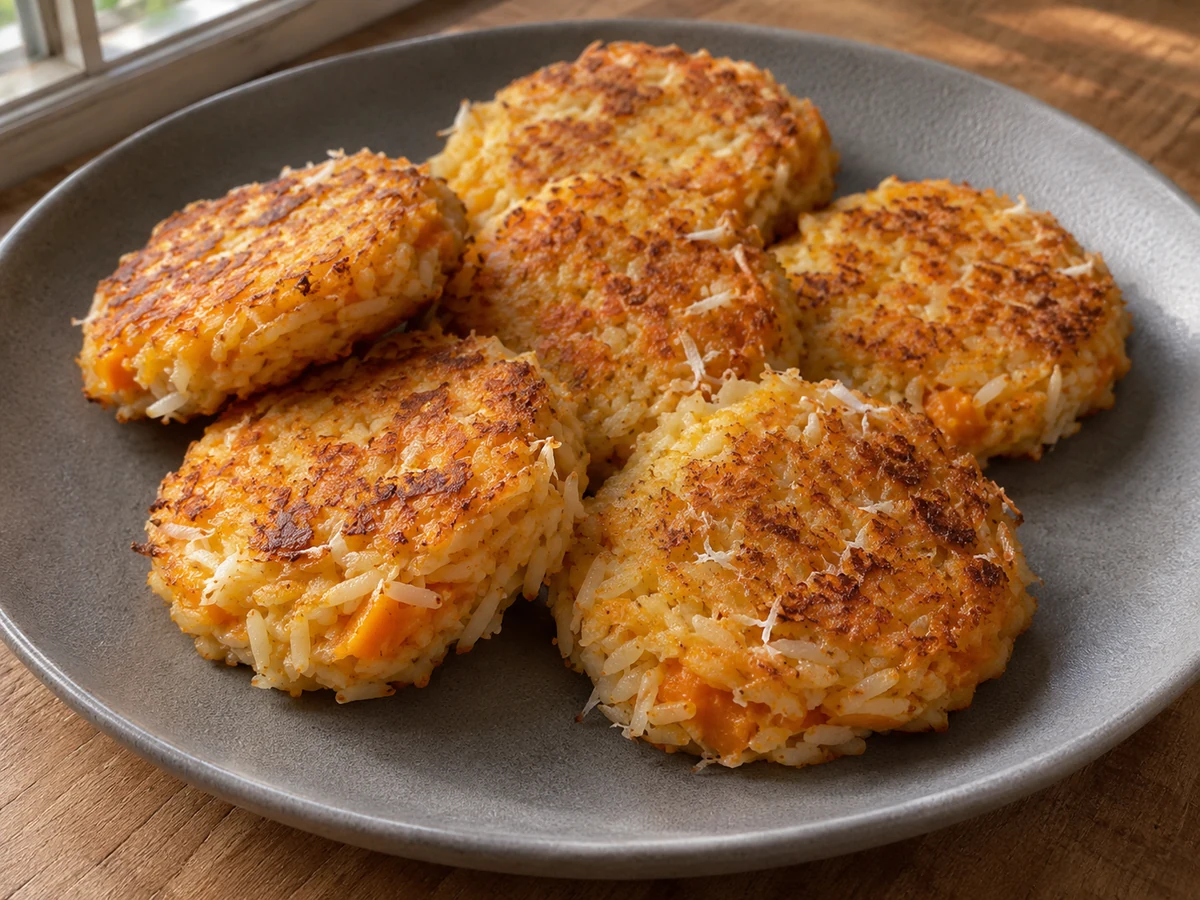
Ingredients
- 400 g white rice already cooked without salt
- 500 g raw pumpkin, peeled and deseeded weight
- 100 g peeled onion
- 100 g raw egg without shell, about 2 medium eggs checked by weighing
- 80 g food-grade cassava flour, not tapioca starch
- 30 g unsweetened dried grated coconut
- 25 g olive oil, including 10 g for the onion and 15 g for brushing
- 3 g salt
- Drinking water to generate steam, without contact with the pumpkin
Preparation
Steam the 500 g pumpkin for 15 to 20 minutes. Drain and allow steam to escape for 5 minutes, then mash with a fork.
Soften the 100 g chopped onion in 10 g oil for 6 to 8 minutes. Let it cool to lukewarm with the pumpkin.
Preheat the oven to 200 °C. Beat the 100 g egg, mix into pumpkin and onion, then fold in 3 g salt and 400 g cooked rice.
Add 80 g cassava flour and 30 g grated coconut. Allow to hydrate for 10 minutes.
Shape twelve discs on a baking-paper-lined tray. Brush with half the reserved 15 g oil and bake for 12 minutes.
Turn, distribute the remaining oil and bake for another 12 to 15 minutes until the centre is set. Serve three patties per portion. Check a central temperature of at least 74 °C with a clean probe.
Introduction
These patties use rice for texture and pumpkin as a soft binder, reinforced by egg and cassava flour. The coconut remains visible in small fragments; it should not overpower the pumpkin. Baking allows a measured amount of oil to be spread over both sides without deep-frying. The intended result is golden outside, soft in the centre and stable enough to move with a spatula.
The 400 g rice is weighed cooked, not dry. Cook fresh rice beforehand or use rice that was cooled quickly and stored correctly, never a pan forgotten at room temperature. The preliminary rice cooking is not included in the stated time. The quantities make twelve patties, three per serving, with no sauce or salad counted in the nutrition.
Cultural context
Rice and cassava flour are used here to build an explicitly contemporary pumpkin and coconut patty. This combination is not presented as a traditional Angolan recipe. National agricultural context can be consulted through FAO: https://www.fao.org/angola ; it does not certify the origin of this preparation.
Tips
Weigh the cooked rice before adding it; an identical amount of dry rice would produce far too much mixture.
Shape the discs with two spoons or clean, slightly damp hands without adding unmeasured shaping oil.
Cassava flour and tapioca starch are different products: check the packet name before preparing the mixture.
If a patty tears as you lift it with the spatula, wait a little longer before turning the others.
Use a clean probe in a thick patty to check its central temperature rather than judging only the surface.
Planning
Choose a firm-fleshed pumpkin, remove skin, seeds and fibres, then weigh 500 g. Cut into 2 cm cubes and steam for 15 to 20 minutes until they crush easily. The pumpkin must not touch the reservoir water. Let the pieces drain and release steam for 5 minutes, then mash with a fork. Do not blend at length: an overly fluid purée would make the patties difficult to shape.
Chop the onion finely enough not to create large weak points. Soften it in 10 g oil for 6 to 8 minutes over medium heat without browning heavily. Allow the onion and pumpkin to become lukewarm before introducing the eggs, so they do not set in patches. Meanwhile, preheat a conventional oven to 200 °C and line a large tray with baking paper.
Crack the eggs into a clean bowl and weigh out 100 g without shell. Beat briefly, then mix with the lukewarm pumpkin, onion and 3 g salt. Fold in the 400 g cooked rice, separating any small clumps. Add the 80 g cassava flour and 30 g coconut. Use properly processed, food-grade flour sold for cooking; do not substitute raw grated cassava root.
Rest the mixture for 10 minutes so the flour hydrates. It should be moist but form spooned mounds that do not immediately spread. If it looks excessively liquid, spread the mixture out a little in the bowl and wait a few more minutes; do not keep adding flour without weighing it and subsequently adjusting the nutritional estimate. The maturity of the pumpkin and its draining account for some consistency variations.
Divide all the mixture into twelve comparable parts, then shape discs 7 to 8 cm across and about 1.5 cm thick directly on the tray. Leave gaps between them so air can circulate. Brush about half the reserved 15 g oil over the top surfaces. Bake for 12 minutes, turn carefully with a spatula and brush with the rest of that oil.
Continue for 12 to 15 minutes. The centre should be fully set, with no liquid egg mixture, and the edges lightly golden. Check a central patty, as the tray edges sometimes cook faster. Let the patties firm up briefly before lifting them. Do not press them down to speed cooking: even thickness and a genuinely preheated oven give more reliable cooking than strong surface browning. Check a central temperature of at least 74 °C with a clean probe.
Serving
Allow three patties per person to divide the preparation into four servings. Lift them without immediately stacking them to preserve the lightly golden surfaces. Serve hot after checking the centre, and offer any sauce separately: it is not included in the stated values.
Storage
If the patties are made with freshly cooked rice, cool leftovers rapidly in a single layer and refrigerate at no more than 4 °C within one hour of cooking. Eat within 24 hours and reheat once only until steaming in the centre. If made with rice that had already been cooled and then reheated by this baking, eat them immediately and do not plan another reheating cycle.
Variations
The pumpkin can be mashed very finely or left with a few small, tender pieces for a different texture. Keep the same weight and controlled moisture, however. Another flour cannot automatically replace it gram for gram: absorption and cohesion change. For an egg-free version, the binder needs reformulating; simply removing the 100 g egg cannot guarantee patties that can be handled.
Nutrition notes
Cooked rice and cassava flour contribute carbohydrates, while egg contributes protein. Dried coconut and oil are counted in full. Flour uses the FAO 2010 table, code 02_004: https://www.fao.org/4/i1755e/i1755e00.pdf. This reference concerns cassava flour, not tapioca starch. Values are estimated for three patties, without sauce or accompaniments.
Conclusion
The right balance is a mixture moist enough to remain tender but bound enough to turn over. Resting the flour, maintaining even thickness and checking the centre are more useful than excessive browning.
Enjoy your meal
Enjoy your meal!