Turkey simmered with black-eyed peas and carrots
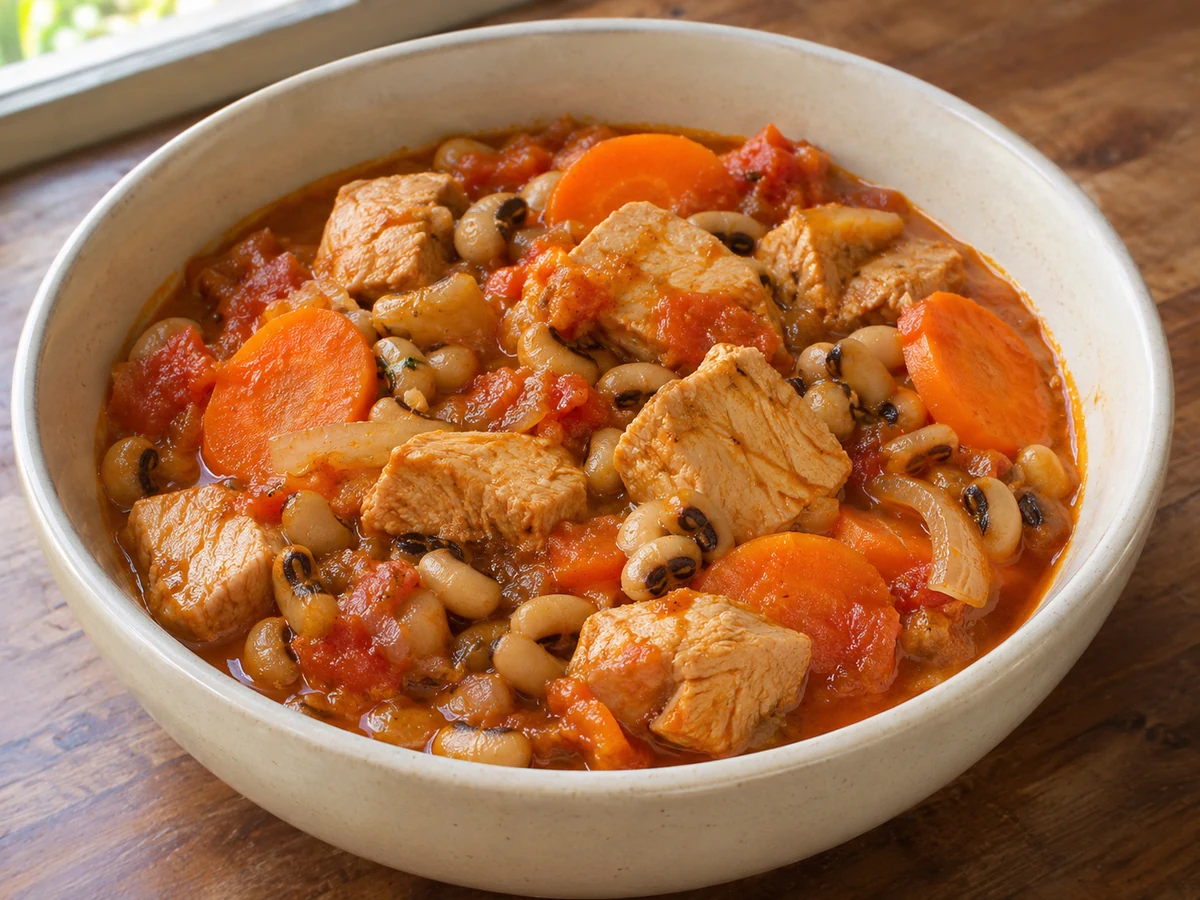
Turkey cubes are added late to carrots and cooked black-eyed peas in a light tomato and ginger cooking liquid.
Ingredients
- 550 g raw skinless turkey breast
- 500 g black-eyed peas cooked without salt, drained weight
- 500 g peeled raw carrot
- 350 g raw tomato
- 150 g peeled onion
- 10 g peeled garlic
- 10 g usable fresh ginger
- 25 g olive oil
- 400 ml drinking water
- 4 g salt
Preparation
Weigh 500 g already cooked, unsalted, drained black-eyed peas; prepare all vegetables.
Cut turkey into 3 cm cubes and keep chilled during the first cooking stage.
Sweat onion in 25 g oil for 6 minutes. Add garlic and ginger for 1 minute, then carrots for 3 minutes.
Add tomatoes, salt and 350 ml water. Simmer partially covered for 15 to 20 minutes.
Add beans for 5 minutes, then turkey. Cook gently, covered, for 8 to 12 minutes, to at least 74 °C at the centre.
Rest off the heat for 3 minutes. Adjust juices with the reserved 50 ml water and divide into four portions.
Introduction
Black-eyed peas form the base of this dish: cooked in advance, they are warmed with carrots and tomatoes before the turkey is added. This timing protects lean meat from unnecessarily long simmering. The aim is whole beans, tender carrots and turkey cubes that remain supple, connected by juices fluid enough to share among four portions. The sauce contains no cream, flour or stock cube.
This contemporary creation uses black-eyed peas as an identified ingredient, not an interchangeable substitute for every pulse. The stated 500 g is the weight of already cooked, well-drained beans with no added salt. Do not replace it with 500 g dried beans: yield and cooking time would be completely different. The recipe is not presented as an attested traditional formula or as kitchen-tested.
Cultural context
This recipe belongs to a contemporary collection devoted to Angola. It brings together ingredients found in different culinary repertoires without claiming to reproduce a documented family or regional speciality. The FAO country profile provides an institutional starting point for Angola’s agricultural and food environment; it is not historical evidence for this formula. The proportions and method are editorial choices. Context source: https://www.fao.org/angola
Tips
Weigh black-eyed peas after cooking and draining, never dried.
Cut carrots evenly so they cook together.
Add turkey after the vegetables and beans.
Keep the reserved 50 ml water available to adjust the juices.
Check 74 °C in several cubes before serving.
Planning
If preparing black-eyed peas from dried beans, cook separately according to the supplier’s instructions, then weigh 500 g after draining. Soaking and precooking are not included in this recipe’s times. The beans must be tender right through, without a hard floury centre. Very split beans would make a thicker sauce; handle as little as possible to preserve those still whole.
Prepare all vegetables before touching the meat. Cut carrots into 8 mm half-rounds, tomatoes into dice and onion into small pieces. Chop garlic and grate ginger. Thick carrot pieces would need longer cooking, while very thin slices would break when the beans are added. Use a wide, lidded casserole of about 3 litres so the food can be turned without crushing it.
Cut turkey into 3 cm cubes, removing thick membranes. Pat dry without washing the meat. Keep chilled until needed, then wash hands, knife and board. The pieces are added only near the end: boiling them for the entire carrot cooking time would dry out this lean cut. A clean thermometer remains the way to confirm the centre is cooked.
Heat the 25 g oil over medium heat. Sweat onion for 6 minutes, add garlic and ginger for 1 minute, then carrots for 3 minutes. Stir in tomatoes, 4 g salt and 350 ml of the 400 ml water. Reserve the remaining 50 ml for adjustment if needed. Bring to a simmer, partially cover and cook for 15 to 20 minutes, until the carrots yield to a knife point but remain slightly firm.
Add black-eyed peas and warm for 5 minutes at a gentle simmer. Then place turkey cubes in the juices, stir carefully once and cover. Cook gently for 8 to 12 minutes, turning pieces halfway through. Measure inside several thick cubes: they must reach at least 74 °C. Continue briefly if necessary without sharply increasing the heat. The colour of the flesh alone cannot confirm this temperature.
Once turkey is cooked, remove from heat and rest covered for 3 minutes. Check consistency: juices should surround the beans without flooding them. Add some or all of the reserved 50 ml water if the beans have thickened the liquid too much. If there is too much liquid, remove the cooked meat, briefly reduce the base and return it off the heat. This correction avoids unnecessarily extending its cooking.
Serving
Divide turkey cubes first, before serving beans and vegetables, to balance portions. Take juices from the bottom of the casserole rather than serving only solids. The dish already contains a pulse; a side dish is not necessary to make a substantial volume. If offering rice, serve it separately and count it in addition. Do not add oil or salt at the table without accounting for those additions.
Storage
Quickly divide leftovers into small, shallow containers, without leaving them at room temperature for more than 2 hours. Refrigerate at 4 °C or below and eat within 48 hours. Take only the portion needed with a clean utensil. Reheat once only, to 74 °C in the centre, checking several places. Add a little water if necessary to prevent the food from drying out. Do not return leftovers from a partly eaten plate to the container. If the time spent out of refrigeration is unknown, do not rely on reheating to restore safety.
Variations
Canned black-eyed peas may work if their composition and existing salt are taken into account; this recipe’s values do not automatically apply to them. Another pulse will hold its shape and absorb liquid differently. Replacing turkey with chicken requires a nutritional reference for the cut and an appropriate temperature check. For a thicker sauce, mash a small portion of the already weighed peas rather than adding unplanned flour.
Nutrition notes
The values are estimates per quarter of the preparation, without side dishes or additional garnish. They add up the weighed ingredients in their stated condition, including all the added oil and salt. Water supplies no macronutrients; evaporation changes the final weight but not the theoretical sum of nutrients. The amount actually eaten depends on how the pieces are divided and how much sauce remains in the dish. Food composition data are averages, not a laboratory analysis of this recipe. A different cut, brand or ingredient substitution requires a new calculation.
The composition of cooked black-eyed peas uses World Agroforestry record P0008 for soaked and boiled beans: https://apps.worldagroforestry.org/products/nutrition/index.php/food/food_item_details/P0008 Their intrinsic sodium is not reported; it remains unquantified and is not treated as zero. Estimated salt includes added salt and known contributions from the other foods but may underestimate the actual total.
Conclusion
Gentle, staggered simmering lets carrots soften without giving turkey the same cooking time. Black-eyed peas should remain recognisable and juices should flow between pieces. Stop once the safe temperature is reached rather than simmering for a long time as a matter of principle.
Enjoy your meal
Enjoy your meal!