Squid braised with cabbage and tomatoes
Squid rings become tender in a ginger and tomato sauce; cabbage joins the casserole during the second part of simmering.
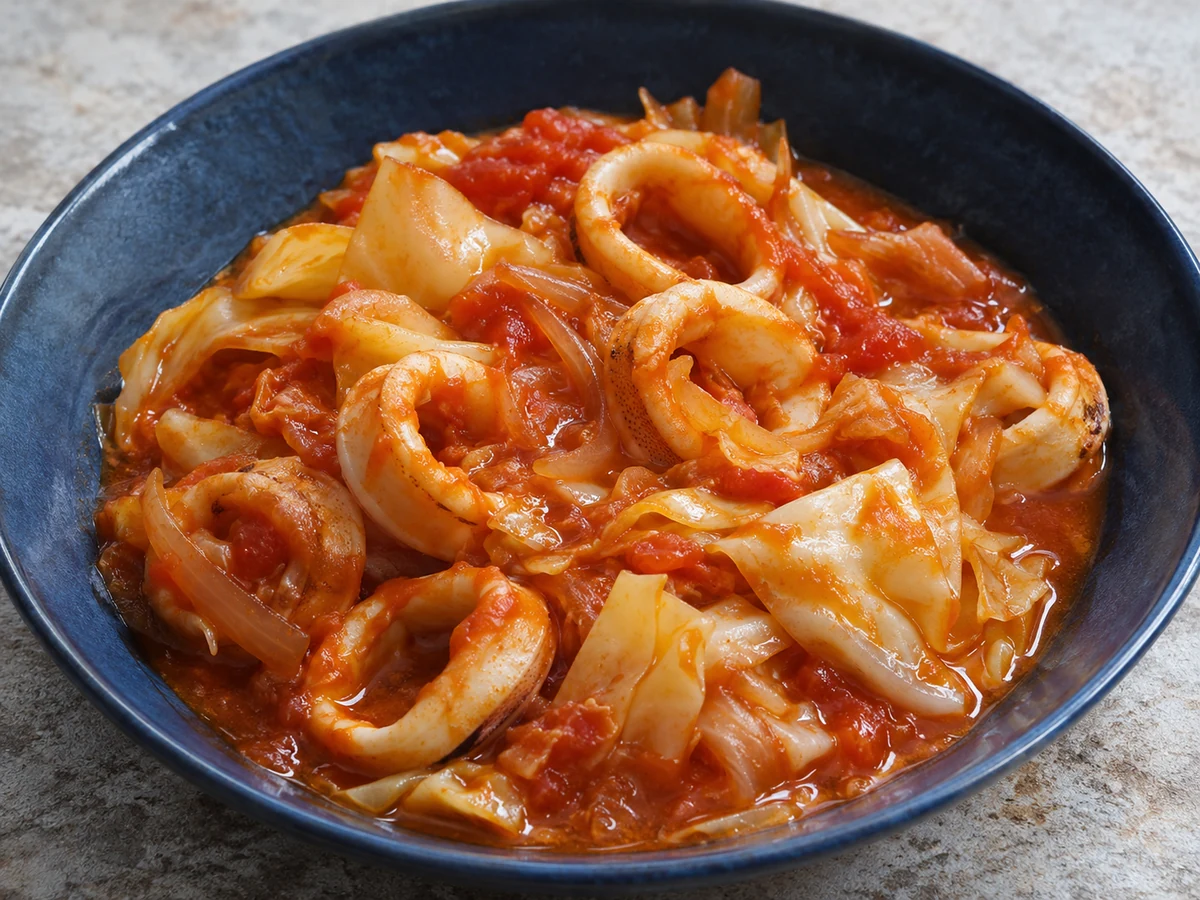
Ingredients
- 700 g cleaned raw squid, edible bodies and tentacles
- 700 g trimmed raw white cabbage
- 600 g raw tomatoes
- 150 g peeled raw onion
- 10 g peeled raw garlic
- 15 g prepared fresh ginger
- 20 g olive oil
- 20 g lemon juice
- 300 ml drinking water
- 3 g salt
Preparation
Clean squid and weigh 700 g edible parts; cut bodies into 2 cm rings.
Prepare 700 g cabbage in 1 cm ribbons and prepare the other vegetables.
Soften onion in oil for 5 minutes; add garlic and ginger for 1 minute.
Add tomatoes and salt, then cook for 8 to 10 minutes.
Add squid and 300 ml water; simmer partially covered for 25 minutes.
Stir in cabbage in two batches and continue covered for 15 to 20 minutes.
Check squid tenderness and continue in 5 minute increments if needed.
Reduce juices uncovered for 2 to 3 minutes if needed; add lemon off the heat and serve in 4 portions.
Introduction
Squid can be seared very briefly or simmered long enough to become tender again. This recipe chooses the second route: gentle, moist cooking in tomato. Accept a stage when the rings seem firmer, then continue without suddenly increasing the heat. The cabbage is added later so it softens without dissolving into the juices.
This contemporary dish uses a casserole and a short ingredient list. Ginger remains a background aromatic, while lemon finishes the sauce after cooking. The 4 portions contain 175 g trimmed raw squid per person and a generous quantity of vegetables. The aim is a stew in which rings and cabbage ribbons remain recognisable, with enough sauce to coat them but without turning everything into broth.
Cultural context
This recipe chooses long simmering rather than a brief squid sear. That texture decision belongs to the creative work of volume 2; it does not justify assigning the casserole to a specific tradition. The combination with cabbage and tomato is presented under a descriptive title, without giving it the name of a heritage dish or claiming it summarises Angolan coastal practices.
Food resource issues can be explored through the FAO Angola profile: https://www.fao.org/angola. The link offers an institutional introduction to the country, not evidence of the origin of this braised squid. Maintaining that boundary is useful when comparing the recipe with other seafood preparations.
Tips
The dish contains molluscs.
Do not boil vigorously in an attempt to speed up tenderising.
Weigh cabbage after removing its tough core.
Cabbage shrinks: adding it in two batches makes mixing easier.
A partially closed lid releases some steam without drying the base.
Planning
Use an approximately 4 litre casserole with a lid. Have the squid cleaned by the fishmonger, or carefully remove the innards, transparent quill, beak and eyes. Weigh only the edible parts, then cut the bodies into rings 2 cm wide. Divide large clusters of tentacles into smaller portions. Drain and keep chilled. For a frozen product, thaw in the refrigerator, never at room temperature, then weigh after draining.
Remove damaged outer cabbage leaves and the tough core. Wash, drain and weigh 700 g of leaves and tender ribs. Cut into 1 cm ribbons. Cutting too finely would produce soft threads; thick wedges would require much longer cooking. Dice tomatoes, slice onion, chop garlic and grate ginger. Keep lemon juice for the end.
Heat the 20 g oil over medium heat. Soften onion for 5 minutes, add garlic and ginger for 1 minute, then tomatoes and the 3 g salt. Cook for 8 to 10 minutes, stirring, until tomatoes release their juice and start to collapse. Add squid and the 300 ml water. Bring to a simmer, partially cover and cook gently for 25 minutes. The liquid should barely move, without violent boiling.
Add cabbage in two batches so it fits in the casserole, stirring between additions. Continue for 15 to 20 minutes, covered, until a ring yields easily when bitten and the cabbage is tender. Taste only a fully cooked piece. If squid still resists, continue in 5 minute increments with a little water if necessary. Size and species may extend the time: tenderness matters more than the timer.
Once both elements are ready, uncover for only 2 to 3 minutes if there seems to be too much juice. Remove from the heat and stir in the 20 g lemon juice. Mix gently and divide into 4 portions. Do not add oil at the end to make the sauce shine: the planned 20 g is sufficient and included in the nutritional calculation.
Serving
Lift squid rings and cabbage ribbons together with a large spoon. Distribute the tentacles when present so they do not all end up on the same plate. Add the ginger and tomato sauce afterwards. Cabbage should remain mixed with the squid rather than pushed aside as a secondary garnish: it represents an important share of each planned portion’s volume.
Serve in deep plates after incorporating lemon. A little juice at the bottom is desirable; it prevents ribbons sticking together as they cool. An accompaniment can be offered separately, but it is not included in the stated values. Do not add chilli or oil to the casserole at the last moment without saying so: the result would no longer correspond exactly to the preparation described.
Storage
Preferably prepare only the quantity that will be eaten at the same meal: reheating changes the texture of fish and seafood. If leftovers need to be kept, promptly divide them among clean, shallow containers. Refrigerate at no more than 4 °C within 2 hours of the end of cooking; do not leave the whole pan cooling on the worktop. Eat within 24 hours.
Reheat only the portion needed in a small covered saucepan, with a little water to protect the sauce. The food must be thoroughly hot in the centre; stir gently to distribute the heat. Reheat only once and discard leftovers from that portion. Do not rely on smell alone to judge whether food is safe. These storage instructions assume fresh ingredients, complete cooking and an uninterrupted cold chain.
Variations
You may use bodies only or a mixture of bodies and tentacles at the same trimmed weight. Their size remains decisive for cooking time. Replacing white cabbage with another vegetable changes both the timing and nutritional composition: recalculate rather than retaining the values for this version.
Nutrition notes
Squid weight refers only to edible bodies and tentacles: neither innards nor removed cartilage is included in the reference weight. The calculation also includes the 700 g trimmed cabbage, tomatoes and aromatics. Squid supplies protein and cabbage contributes fibre; their contributions remain distinct even after long simmering.
Water loss concentrates the sauce without increasing the casserole’s total energy. To obtain per-portion figures, the whole dish is divided by 4, including juices. The 20 g oil and 3 g salt are fully counted; some remaining in the dish can change actual intake. Salt naturally present in the food references is added to that introduced during cooking. The figures include no external starchy food and do not replace an analysis of the finished product.
Conclusion
Simmering time gives this dish its logic. Adding cabbage after the squid preserves two distinct textures in the same sauce. Lemon at the end brightens the juices without changing this patient method.
Enjoy your meal
Enjoy your meal!