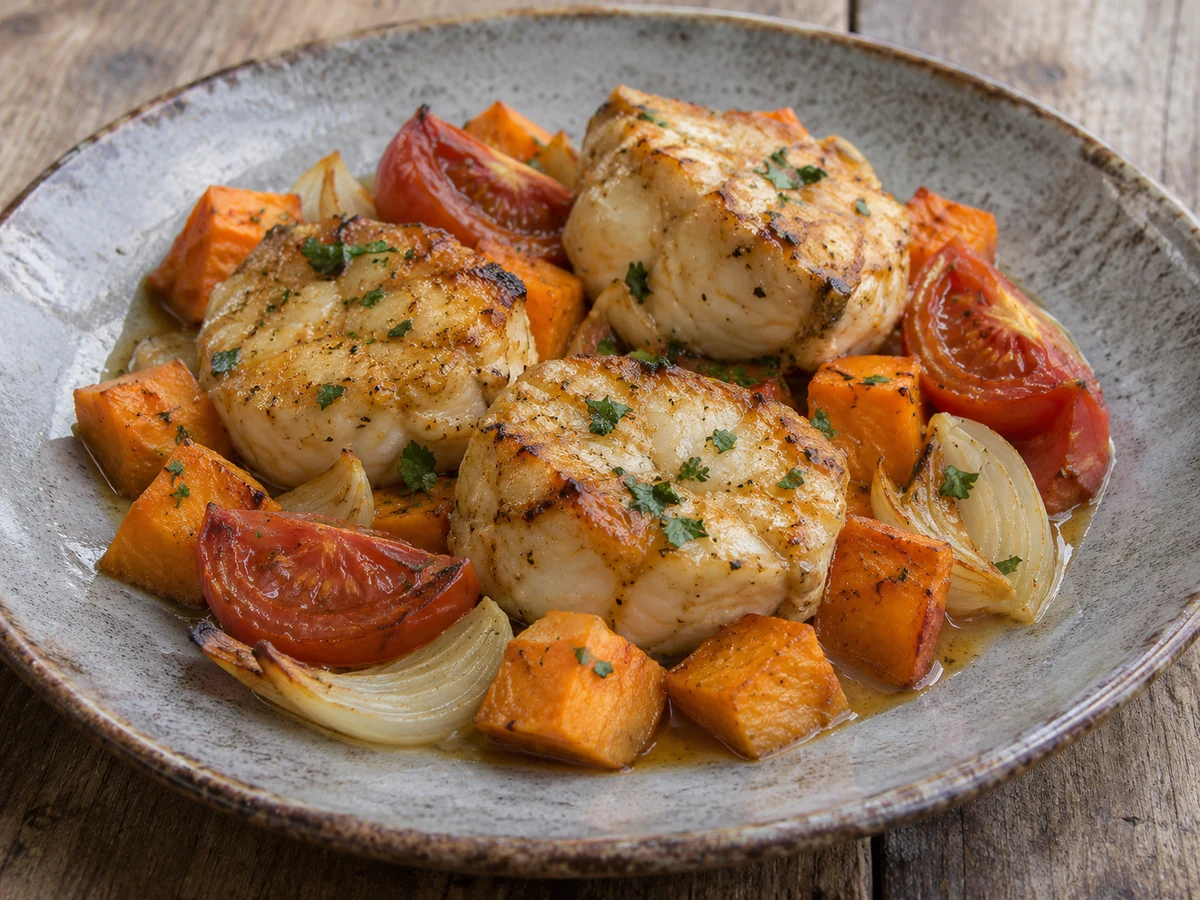
Roasted monkfish with tomatoes and sweet potato
Sweet potato starts roasting on its own before monkfish and tomatoes join the dish for a short, moist finish.
Ingredients
- 700 g raw monkfish flesh, bones and membrane removed
- 800 g peeled raw sweet potato
- 500 g raw tomatoes
- 150 g peeled raw onion
- 10 g peeled raw garlic
- 30 g olive oil
- 20 g lemon juice
- 10 g fresh parsley
- 100 ml drinking water
- 3 g salt
Preparation
Preheat oven to 200 °C and prepare all trimmed weights.
Mix sweet potato and onion with 20 g oil and 2 g salt.
Roast for 25 to 30 minutes, turning halfway, until cubes are almost tender.
Add tomatoes, garlic and 100 ml water.
Position 4 monkfish medallions and add the 10 g oil and final 1 g salt.
Cook for 12 to 18 minutes, until flesh is opaque and at least 63 °C in the centre.
Add lemon and parsley out of the oven; rest for 3 minutes.
Serve in 4 portions with the vegetables and juices.
Introduction
Monkfish has firm flesh that can be cut into medallions, but it is still vulnerable to drying out. This dish therefore avoids putting all the ingredients into the oven at the same time. Sweet potato receives an initial cooking stage that colours its edges and makes it almost completely tender. The fish goes in afterwards, with tomatoes whose juice protects the second stage. The result is both roasted and lightly sauced, without frying.
This contemporary creation combines a portion of fish, a starchy vegetable and tomatoes in one baking dish. The 4 portions include all of this garnish; no additional rice is needed to follow the recipe. Choosing a sufficiently wide dish matters more than multiplying the aromatics: the pieces must receive heat without being piled up.
Cultural context
The presence of monkfish is not enough to define a recipe as an Angolan speciality. In this volume 2 proposal, the fish was chosen primarily because it holds its shape as medallions and can be cooked briefly in the oven. Sweet potato and tomato structure the garnish; no traditional dish name is borrowed to give this combination an artificial antiquity.
The FAO profile of Angola broadens the reading to agricultural and food issues: https://www.fao.org/angola. This institutional framework accompanies discovery of the country without attesting that this monkfish method belongs to its heritage. The distinction between general documentation and a created recipe is maintained in the title and presentation.
Tips
Monkfish membrane shrinks: remove it before weighing.
A single layer of sweet potato promotes even cooking.
Add fish only after checking the cubes for tenderness.
Keeping parsley until the dish leaves the oven preserves its fresh appearance.
Split the 3 g salt into 2 g for the first stage and 1 g for the second.
Planning
Preheat the oven to 200 °C conventional heat. Prepare an approximately 30 × 25 cm baking dish whose base is oven-safe. Wash the vegetables. Cut peeled sweet potato into 2 cm cubes, onion into thin wedges and tomatoes into larger wedges. Chop garlic and parsley separately. Weigh the fish flesh after completely removing the central bone and tough membranes; ask the fishmonger to prepare it if needed. Cut 4 medallions of comparable thickness and keep chilled.
In the dish, mix sweet potato, onion, 20 g of the oil and 2 g of the salt. Spread without overlapping the cubes and bake for 25 to 30 minutes. Turn halfway through. Test a cube with a knife tip: it must be almost tender before adding the monkfish. If the edges brown while the centre remains resistant, lower the temperature slightly and extend this first stage rather than adding the fish early.
Distribute tomatoes and garlic between the cubes. Add 100 ml water, position the medallions and brush them with the remaining 10 g oil. Distribute the final 1 g salt over the fish and tomatoes. Return to the oven for 12 to 18 minutes, depending on thickness. The juices should simmer and the flesh become opaque to the centre. A clean probe inserted into the thickest part must reach at least 63 °C; continue if needed.
Remove the dish, stir lemon juice and parsley into the cooking juices, then rest for 3 minutes. Lift each medallion with a spatula to preserve its shape. Do not wait for all the liquid to disappear: a layer of juices forms the sauce. If the tomatoes release a lot of water, serve with a sauce spoon rather than continuing to cook fish that is already ready.
Serving
Lift each monkfish medallion with a spatula, then share the sweet potato cubes and tomato wedges among the plates. Pour the lemon and parsley juices over the vegetables rather than directly onto the fish surface: the roasted outlines remain visible. The garnish is part of the dish and its stated portions.
The tender cubes should hold their shape when lifted; crushing them into the juices would erase the contrast with the monkfish. Collect the softer onions from the bottom of the dish and share them too. This preparation already contains sweet potato: offering bread or rice is an additional choice whose nutritional contribution is not included. Serve after the planned rest, without unnecessarily returning the dish to the oven to keep it warm.
Storage
Preferably prepare only the quantity that will be eaten at the same meal: reheating changes the texture of fish and seafood. If leftovers need to be kept, promptly divide them among clean, shallow containers. Refrigerate at no more than 4 °C within 2 hours of the end of cooking; do not leave the whole pan cooling on the worktop. Eat within 24 hours.
Reheat only the portion needed in a small covered saucepan, with a little water to protect the sauce. The food must be thoroughly hot in the centre; stir gently to distribute the heat. Reheat only once and discard leftovers from that portion. Do not rely on smell alone to judge whether food is safe. These storage instructions assume fresh ingredients, complete cooking and an uninterrupted cold chain.
Variations
The same method suits another firm white fish, with the time adjusted to its thickness. Squash can replace sweet potato, but the water content and nutritional values change. Do not retain the displayed figures for that variation.
Nutrition notes
Sweet potato is included in the main dish calculation here, rather than added as an external accompaniment. Its carbohydrate complements the monkfish protein; tomatoes, onion and parsley are also counted by edible weight. The estimate therefore does not assume a plate of fish alone. Dividing the vegetables equally is necessary to approximate the stated portion.
The 30 g oil is the total for both cooking stages, and the 3 g salt is the total of its two allocations: neither should be counted a second time. Added water provides no energy, while vegetable juices retain some of the recipe’s constituents. The figures assume these juices are served. A portion supplemented with bread, rice or extra oil requires a new estimate; cooking losses are not measured individually.
Conclusion
This dish is built in two stages to respect each ingredient’s texture. Sweet potato supplies roasted edges, tomatoes give juice and monkfish stays in medallions. Serve promptly to preserve that balance.
Enjoy your meal
Enjoy your meal!