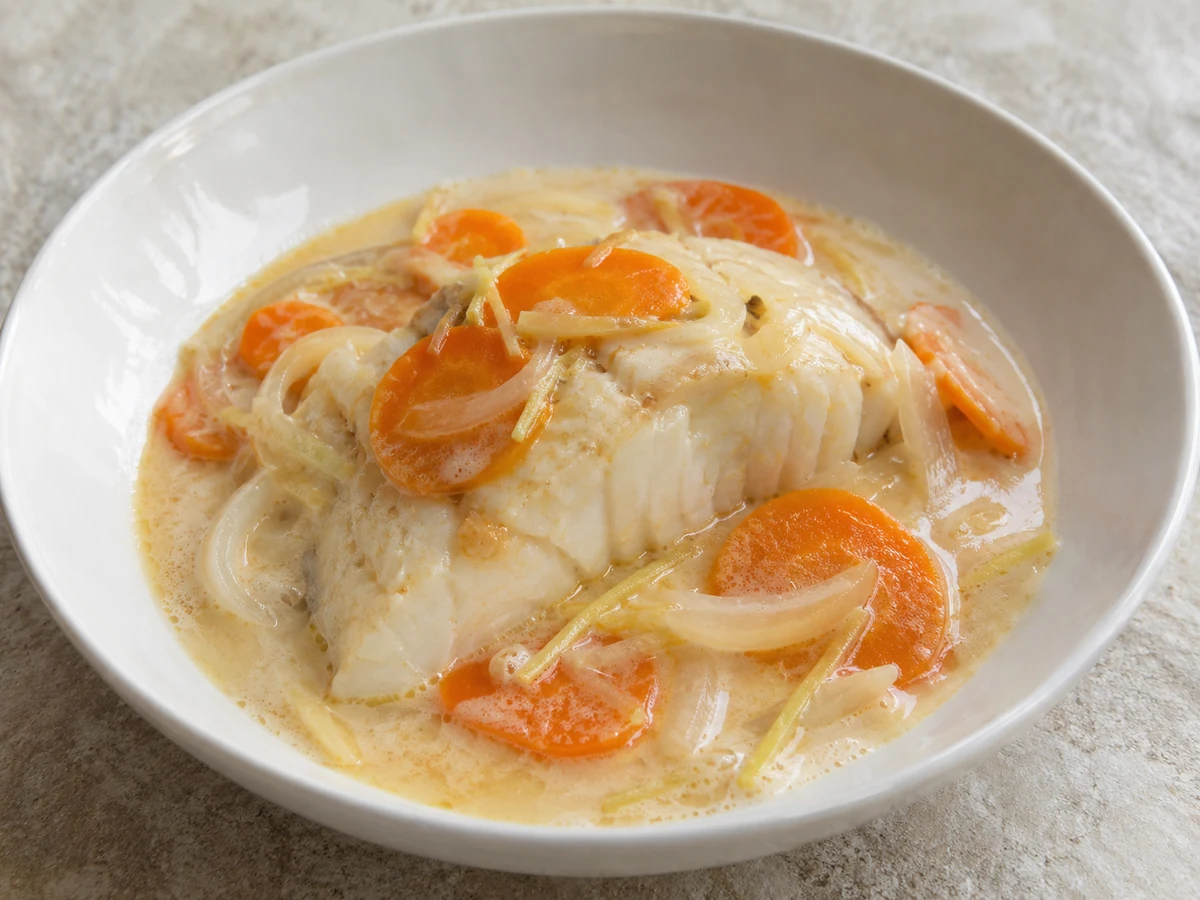
Cod poached in coconut milk with carrots
Thick cod portions cook without a hard boil in a coconut milk sauce with carrots and fresh ginger.
Ingredients
- 700 g raw skinless, boneless cod
- 400 g unsweetened coconut milk
- 400 g peeled raw carrots
- 150 g peeled raw onion
- 10 g peeled raw garlic
- 15 g prepared fresh ginger
- 20 g olive oil
- 20 g lime juice
- 250 ml drinking water
- 3 g salt
Preparation
Weigh the trimmed ingredients and prepare 4 comparable cod portions.
Slice carrots into 3 mm rounds and prepare the aromatics.
Soften onion in oil for 5 minutes, then garlic and ginger for 1 minute.
Add carrots, water and salt; cover and simmer gently for 12 to 15 minutes.
Add coconut milk and heat gently for 3 minutes.
Add fish, spoon over sauce and cook covered for 8 to 12 minutes, until fully cooked and at least 63 °C in the centre.
Remove from heat, add lime juice around the portions and rest for 2 minutes.
Divide into 4 portions and serve immediately.
Introduction
Gentle poaching suits thick cod portions particularly well: low heat cooks them without tossing them around in bubbling sauce. Here the carrots are almost tender before the fish is added. That head start is essential, because a root vegetable that is still hard would require cooking long enough to dry out the fish. Coconut milk makes a supple, slightly sweet sauce; lime juice added off the heat brightens the finish without introducing an acidic marinade.
The recipe makes 4 portions of a sauced main course, with 175 g raw fish per person. It is a contemporary creation whose success depends on the order of operations rather than a long list of spices. The colours remain ivory and orange. The aim is recognisable carrot slices and fish that separates into large flakes, not a uniformly blended soup.
Cultural context
The title deliberately describes a technique and ingredients rather than naming a speciality: cod, carrots and coconut milk are combined here for volume 2. Gentle poaching was chosen to protect the fish portions; that culinary decision is not evidence of a method particular to an Angolan family or province. The dish therefore remains explicitly a contemporary creation inspired by the collection.
To place this proposal within a broader exploration of the country’s food issues, consult the FAO Angola profile: https://www.fao.org/angola. This institutional source concerns the national context. It does not attest to the history of this combination, and the book does not assign it that function.
Tips
Keep the portions chilled until cooking.
The sauce should simmer gently; violent boiling breaks the fish.
Add lime only after stopping the cooking.
Stir coconut milk before weighing to distribute its fat.
Remove the portions before any further reduction of the sauce.
Planning
Prepare a 28 cm sauté pan with a lid, a small scale and a wide spatula. Pat the fish dry with clean paper, feel for bones and remove any remaining ones with tweezers. Cut 4 similarly sized portions. Their thickness should be comparable even if their shapes differ; a very thin piece will need to be removed earlier. Keep chilled while preparing the vegetables.
Wash the carrots before peeling, then weigh 400 g of trimmed flesh. Slice into 3 mm rounds: this thinness lets them cook in a limited volume of liquid. Slice the onion, chop the garlic and grate the ginger. Do not use powdered ginger at the same weight, because its concentration is different. Stir the coconut milk in its container to combine the thick and liquid parts before weighing it.
Heat the 20 g oil over medium heat. Soften the onion for 5 minutes without colouring, then add garlic and ginger for 1 minute. Stir in the carrots, 250 ml water and 3 g salt. Cover and simmer for 12 to 15 minutes. A slice should bend under a spoon while retaining slight resistance. If the pan dries before this stage, add a spoonful of water and reduce the heat.
Pour in the coconut milk and heat for 3 minutes without vigorous bubbling. Place the fish portions on the carrots, spoon sauce over them and cover. Cook gently for 8 to 12 minutes depending on thickness. Do not stir between the portions with a spoon: gently shaking the pan is enough. Check for opaque flesh that separates into flakes, with no translucent centre; a clean probe should read at least 63 °C in the thickest part. Continue gently if needed.
Remove from the heat and distribute the lime juice through the sauce, pouring around the fish. Rest for 2 minutes, covered, before serving. If the sauce seems too thin, first remove the fish and briefly reduce the vegetables alone; never try to thicken it by boiling already cooked fish for a long time. Times are guidelines: the thickness and starting temperature of the portions are decisive.
Serving
Place a cod portion in each deep plate using a wide spatula. Distribute the carrot rounds around the fish, then add the coconut sauce in small ladlefuls. This keeps the flakes intact and gives each diner a comparable share of carrots and liquid. Do not bury the fish beneath a mound of vegetables.
Serve after the stated short rest, just after the lime juice has been incorporated. If plain rice is offered, present it separately: it readily absorbs the sauce but increases the meal’s starchy component. This optional rice is not included in the nutritional estimate. Do not finish with grated coconut, because that garnish would change the intended smooth texture and the stated nutritional intake.
Storage
Preferably prepare only the quantity that will be eaten at the same meal: reheating changes the texture of fish and seafood. If leftovers need to be kept, promptly divide them among clean, shallow containers. Refrigerate at no more than 4 °C within 2 hours of the end of cooking; do not leave the whole pan cooling on the worktop. Eat within 24 hours.
Reheat only the portion needed in a small covered saucepan, with a little water to protect the sauce. The food must be thoroughly hot in the centre; stir gently to distribute the heat. Reheat only once and discard leftovers from that portion. Do not rely on smell alone to judge whether food is safe. These storage instructions assume fresh ingredients, complete cooking and an uninterrupted cold chain.
Variations
For another version, replace cod with the same trimmed weight of firm white fish. Adapt the time to its thickness without changing the cooking order. A substitution changes the nutritional composition and must be noted. Do not replace coconut milk with sweetened coconut cream: the result would be a different dish.
Nutrition notes
Cod is the main protein source in this preparation, while carrots supply some of the carbohydrate and fibre. The sauce is an important part of the calculation: coconut milk and oil should not be treated as cooking liquid with no energy contribution. The estimate assumes all the sauce is shared among 4 people.
Fish and carrot weights refer to raw edible parts, without skin, bones or peel. The 3 g added salt is counted in addition to salt present in the composition references. Sauce left in the pan or coconut milk with a different fat content changes the amounts actually consumed. Optional rice remains excluded from the figures. These values describe the stated recipe and are neither an analysis of the served dish nor an individual prescription.
The composition uses the generic Ciqual entry “coconut milk or coconut cream”. Its fat content may differ from the unsweetened coconut milk used; the commercial brand is not analysed separately.
Conclusion
Success depends on two successive cooking stages: soften the carrots, then gently poach the cod without disturbing the sauce. Lime supplies the final touch at serving time. Keeping these landmarks makes the dish reproducible, clear in its flavours and complete within its stated ingredients.
Enjoy your meal
Enjoy your meal!