Carrot and mango salad with coconut
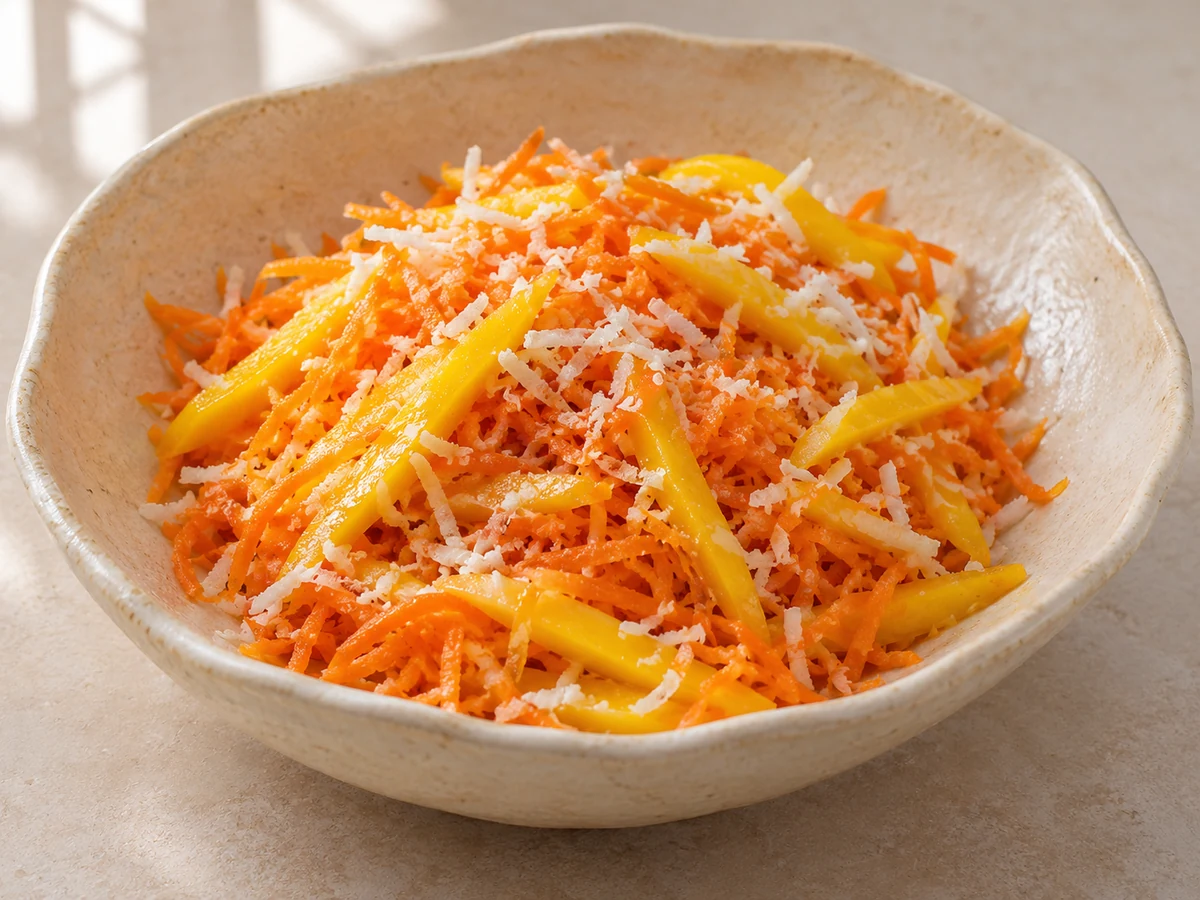
A raw salad of grated carrot and firm mango, with dried coconut, fresh ginger and lime.
Ingredients
- 600 g raw carrot, peeled weight
- 400 g raw mango, flesh weight without skin or stone
- 50 g unsweetened dried grated coconut
- 40 g lime juice
- 20 g olive oil
- 10 g fresh ginger, edible part
- 2 g salt
Preparation
Wash, peel, dry and weigh the carrots; grate on a medium grater.
Remove and weigh 400 g mango flesh, then cut into 1 cm dice, keeping any released juice.
Check and weigh the 50 g unsweetened dried grated coconut.
Mix lime juice and salt, then whisk with the oil and finely grated ginger.
Coat the carrots and coconut, then gently fold in the mango and its juice.
Refrigerate for 10 minutes, stir gently and divide into 4 portions.
Introduction
Carrot supplies crunch, mango brings softer flesh and coconut adds a dry note moistened by the lime juice. Success depends above all on the fruit’s ripeness: an overly soft mango would collapse into a sauce before the salad was mixed. Choose fragrant flesh that still holds under the knife, without seeking a hard green fruit.
This contemporary creation needs no cooking and makes 4 starter portions. The ginger is deliberately weighed after preparation to avoid turning a small aromatic note into an overpowering quantity. The dressing adds neither sugar nor honey: sweetness comes from the mango. Coconut goes into the salad rather than becoming an uncounted decorative extra.
Cultural context
This salad brings together grated raw carrot, ripe but firm mango and dried coconut. In the Angola à table collection it belongs to contemporary creations: its exact combination and presentation are not assigned to a documented Angolan tradition. The title names the main ingredients rather than inventing a local name or giving it an unverified age.
The FAO country profile provides an institutional framework for approaching the national agricultural context: https://www.fao.org/angola. This resource does not attest to the salad’s origin. Preparing it without cooking is a choice about texture and meal organisation. It requires distinguishing perceived freshness, linked to lime and fruit, from raw produce safety, which also depends on washing, utensils and storage.
Tips
A very ripe mango does not suit dicing; reserve it for another preparation.
Weighing fruit without skin or stone avoids overestimating the amount in the portions.
Adding mango after dressing the carrots limits crushing and preserves distinct pieces.
Coconut absorbs liquid during resting; mix a second time before deciding the salad lacks dressing.
Dissolving salt in the lime juice before adding oil helps distribute it evenly without isolated salt grains.
Planning
Wash the carrots before peeling, then trim their ends. Weigh 600 g usable flesh. Dry them so that washing water is not added to the dressing. Grate on a medium grater: very fine grating would quickly make a wet mass, whereas large strips would dominate the mango. If using a mandoline, work with its hand guard and keep fingers away from the blade.
Wash and dry the mango before cutting, even though its skin is not eaten. Cut the cheeks from either side of the stone, remove skin and fibrous areas, then weigh 400 g flesh. Cut into 1 cm dice on a clean board. Keep any juice that flows naturally during cutting and add it with the fruit: the aim is not to squeeze the mango or purée it.
Check the grated coconut: it should smell fresh, without rancidity or added sugar. Weigh it before use. Large flakes and very fine powder do not have the same effect: this recipe uses dried grated coconut that is easy to distribute. It need not be toasted. Toasting would change the flavour and require an extra step not planned here.
Finely grate the 10 g ginger after removing hard or damaged skin. Measure the 40 g lime juice and remove the seeds. Stir the juice with the 2 g salt until dissolved, then whisk in the 20 g oil. Stir in the ginger. This dressing may separate after a few minutes; simply whisk again just before use, without adding an emulsifier.
First mix the carrots and coconut with the dressing to distribute the seasoning without damaging the fruit. Then add the mango dice and their juice, lifting the preparation with two spoons. Rest for 10 minutes in the refrigerator so that the coconut moistens. Taste a complete bite before serving. Do not extend the wait at room temperature: lime changes flavour but does not disinfect raw ingredients.
Serving
Present the salad in a shallow dish so that the mango dice stay visible instead of disappearing beneath a compact layer of carrot. Share the fruit pieces between the 4 portions using a wide spoon. Gently bring juice up from the bottom so that the first plate does not receive all the dry ingredients. Serve chilled without leaving the dish on a buffet for several hours. No extra coconut is needed to finish the presentation.
Storage
Immediately store unserved portions in a closed container in the refrigerator at a maximum of 4 °C. Eat within 24 hours. The carrots will release a little juice and the mango soften; stir gently rather than draining, since the dressing is part of the calculated quantities. Do not keep salad that has stood somewhere warm for a long time. Use clean utensils and do not return leftovers from an already used plate to the shared container.
Variations
To get ahead, keep grated carrots, mango and dressing in separate chilled containers, then assemble close to serving. The coconut remains dry until mixing. Slicing mango into thin strips changes appearance without changing composition, provided the planned 400 g is retained. Replacing dried coconut with fresh flesh, however, changes its moisture and nutrients; the values would need recalculating rather than keeping the same figures.
Nutrition notes
Carrot and mango make up most of the edible weight, while dried coconut and oil concentrate more energy into a small mass. Fruit sweetness does not mean an absence of carbohydrate; it simply explains why no extra sugar is planned. The calculation covers all 50 g coconut distributed through the mixture, not a decorative pinch per plate.
Mango weight excludes stone and skin: buying a 400 g fruit therefore does not supply the requested 400 g flesh. Lime and salt are also weighed. The values correspond to 4 comparable portions including dressing. Draining juice after resting or adding honey at serving would depart from this composition. These estimates describe neither a vitamin analysis nor a therapeutic effect.
Conclusion
Assembly is complete when the carrots are coated, coconut moistened and mango dice still distinct. Mix gently after the 10-minute chilled rest, then share the fruit and dressing between 4 portions. There is no point compensating for excessive standing with more lime: acidity does not replace refrigeration. Precise weights and a firm mango reproduce the intended contrast without crushing everything into a purée.
Enjoy your meal
Enjoy your meal!