Cassava-flour biscuits with coconut
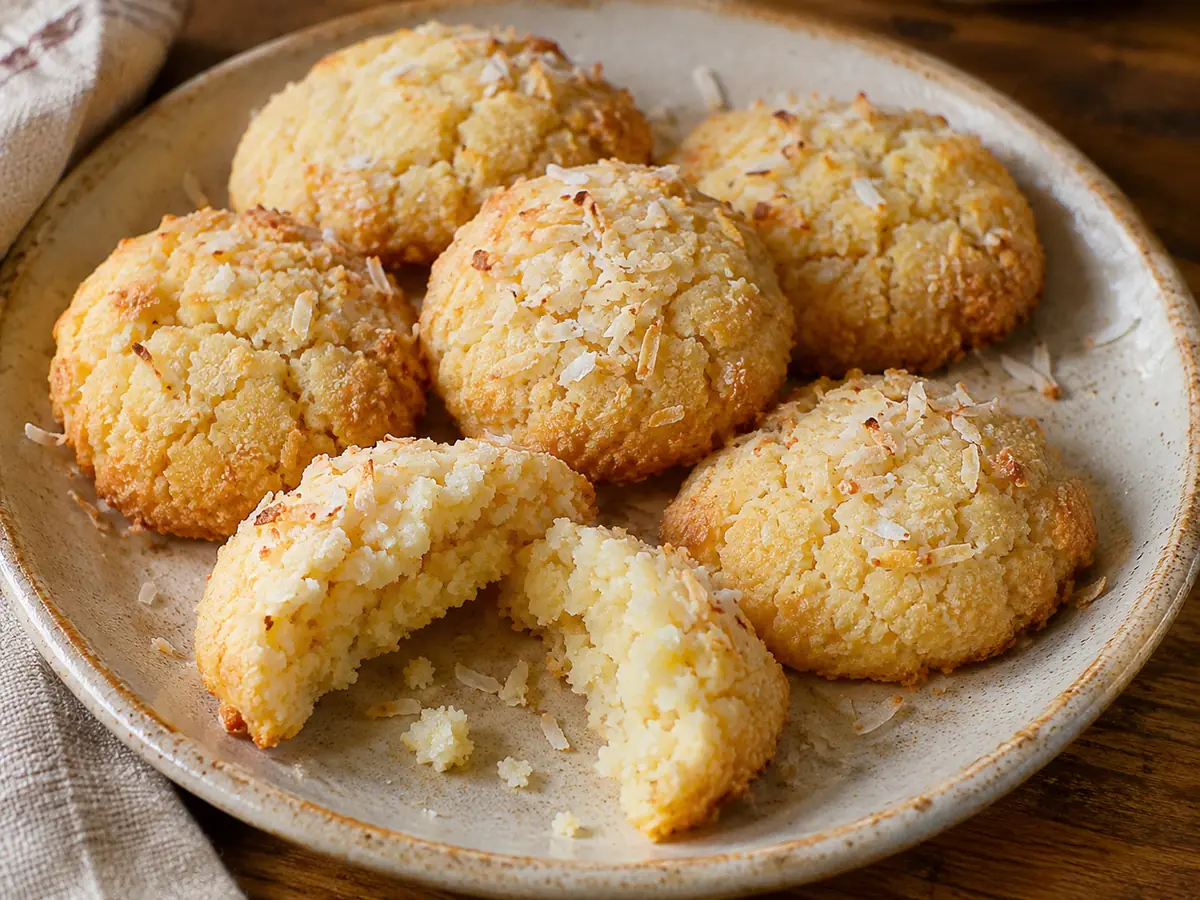
Twenty small round, crumbly biscuits made with cassava flour and coconut, pale in the centre with lightly golden edges.
Ingredients
- 150 g food-grade cassava flour, not tapioca starch
- 40 g finely desiccated unsweetened dried coconut
- 80 g softened unsalted butter, not melted
- 60 g white sugar
- 50 g raw egg without shell, about 1 medium egg
- 1 g salt
Preparation
Weigh all six ingredients. Line two baking trays with baking paper and check that the flour is labelled food-grade cassava flour rather than tapioca starch.
Briefly work the 80 g softened butter with the 60 g sugar and gram of salt. Gradually incorporate the 50 g egg weighed without its shell, without aiming for a large foam.
Separately mix the 150 g cassava flour and 40 g coconut. Fold into the butter mixture with a spatula, then bring the dough together without prolonged kneading.
Cover and refrigerate the dough for 30 minutes at 4 °C or below. During this rest, preheat a conventional oven to 170 °C.
Divide into 20 comparable portions of roughly 19 g, then shape discs about 5 cm across and 8–10 mm thick. Space them out on the baking paper.
Bake for about 18–22 minutes, watching towards the end: edges should turn lightly golden and centres should be set without wet raw dough. Check the first tray before deciding on timing for the second.
Rest the biscuits on the tray for 5 minutes, then transfer carefully to a rack. Cool completely before closing their container. Refrigerate remaining biscuits at 4 °C or below and eat within 48 hours.
Introduction
These biscuits combine genuine food-grade cassava flour with dried coconut, butter and weighed egg. They do not rely on a wheat-flour blend or tapioca starch. The dough is mixed briefly, chilled and shaped into small discs: the intended result is crumbly, with lightly golden edges and a cooked centre that stays pale.
The quantities make twenty biscuits, divided here into four servings of five for nutritional calculations. This serving definition does not replace an individual's decision about how much to eat. The recipe is a contemporary Angola collection creation; it claims neither an attested traditional pastry nor a kitchen-tested formula. The nature of the flour and its actual behaviour matter more than promising identical texture from every brand.
Cultural context
The FAO/WFP report of 6 August 2004 on Angola describes cassava's place in the country's food and agricultural systems at that time. It supplies historical context, not evidence of these biscuits, their butter-and-coconut combination or their presence in a particular region. Shaping twenty small discs and oven baking are contemporary editorial choices, distinct from a collected tradition. Context source: https://www.fao.org/4/j2771p/j2771p00.htm
Tips
Check for cassava flour, not tapioca starch.
Weigh egg without shell rather than relying on size.
Keep butter soft but not melted.
Make 20 biscuits of even thickness.
Wait for complete cooling before closing the container.
Planning
Buy flour clearly identified as food-grade cassava flour and follow its preparation instructions. This recipe uses no raw cassava roots and does not propose making flour at home. Flour and tapioca starch are not automatically interchangeable: composition, fineness and liquid absorption can differ. Reject damp or torn packaging or flour with an abnormal smell. Weigh the flour as it will be incorporated, without adding an unmeasured handful later to make shaping easier.
Choose dry, finely grated, unsweetened coconut. Large flakes distribute less evenly in small biscuits and may brown before the centres. Moist fresh coconut supplies additional water and is not a direct replacement for the stated forty grams. Mix coconut with flour before adding to butter. This avoids dry-fibre-heavy areas and others with almost no coconut. Break up clumps with a spoon or clean fingers, leaving no foreign material in the dry mixture.
Butter should be soft but still hold a creamy, spreadable consistency. Take it out just early enough to work, without leaving it for a long time near heat. Melted butter would make a different dough with less predictable cooling and spreading. Use unsalted butter to keep the declared salt quantity. Combine butter, sugar and salt evenly without seeking a very airy cream. A hand whisk or spatula is sufficient; the proportions do not assume a powerful mixer.
Break the egg into a separate container and weigh fifty grams without shell. One medium egg is a practical approximation, not a reliable weight unit. Remove any shell fragment with a clean utensil. Add egg to butter in several additions to limit splitting, scraping the sides between additions. Flour can bring the mixture together, but cannot correct an arbitrarily increased egg quantity. Do not taste this raw dough, which contains both egg and flour intended for cooking.
Fold in the dry ingredients with a spatula and stop once the dough comes together. Prolonged working as for bread dough is unnecessary. It may seem more crumbly than wheat biscuit dough, which does not justify automatically adding water or butter. First allow the stated refrigerator rest: flour hydrates and butter firms again. If the chosen product still makes dough impossible to bring together, review the formulation instead of presenting an improvised addition as already validated by this recipe.
After thirty minutes chilled, divide into twenty portions. The theoretical weight is close to nineteen grams before baking; slight variation due to material left in the bowl is normal. Make evenly thick discs, gently pressing cracked edges together. Thin and very thick pieces would not bake together. Do not heavily flour the worktop: shape directly on paper or between clean hands using only the measured quantities. Leave a little space around each disc to observe its edge.
Bake only when the oven has actually reached one hundred and seventy degrees, preferably one tray at a time in the centre. Centres must be cooked and edges lightly golden; strong brown colouring is not the aim. Coconut can colour quickly, so start watching towards the end of the stated time. Biscuits are fragile on leaving the oven. Wait five minutes before moving them with a broad spatula, then let the rack finish cooling. Closing a container while steam is still escaping would soften the surface and make storage less controlled.
Serving
Serve completely cooled biscuits, once their structure has firmed and the crumb breaks cleanly. Five of twenty biscuits make the serving used for estimates, while everyone can adapt consumption. Offer with an uncounted drink or separately prepared fruit if desired. Crumbliness does not mean a raw centre. Declare butter, and therefore milk, egg and coconut; the absence of wheat among ingredients does not guarantee that commercial products contain no traces of gluten.
Storage
After complete rack cooling, put biscuits in a clean closed container and refrigerate at 4 °C or below. This recipe uses a 48-hour consumption window without promising prolonged room-temperature storage for dry biscuits. Take out only those needed and let them lose their chill for a few minutes in a clean place. Do not enclose hot biscuits or mix a fresh batch with older ones. A damp container or unknown storage conditions justifies not serving affected biscuits; sugar and butter are not a preserving method.
Variations
The first adaptation is size alone, while tracking total weight and keeping comparable thickness. Smaller biscuits need earlier checking; large thick pieces need different timing. Another brand of food-grade cassava flour may absorb differently: read its packaging and adjust a future formulation rather than silently substituting starch. Added chocolate chips, zest or seeds must be weighed and declared and nutrition recalculated. None of these toppings is part of the base recipe.
Nutrition notes
Estimates are for one quarter of the recipe, or five of twenty biscuits, without accompaniments. Cassava flour is represented by FAO 2010 entry 02_004; this is not tapioca starch. The moisture and composition of purchased commercial flour can differ from that reference. All butter, shell-free egg, sugar, coconut and salt are counted. Baking water loss and actual yield change values per served weight. These are not an analysis of the baked biscuits or a promise of health benefit. Sources: Anses. 2020. Ciqual French food composition table. FAO 2010: https://www.fao.org/4/i1755e/i1755e00.pdf
Conclusion
Identifying the right flour, weighing egg and keeping evenly shaped discs are the essential guides. Rack cooling lets you assess crumbliness without confusing hot fragility with insufficient baking. This contemporary proposal claims neither a precise traditional origin nor a previous kitchen trial.
Enjoy your meal
Enjoy your meal!