Pineapple compote with ginger
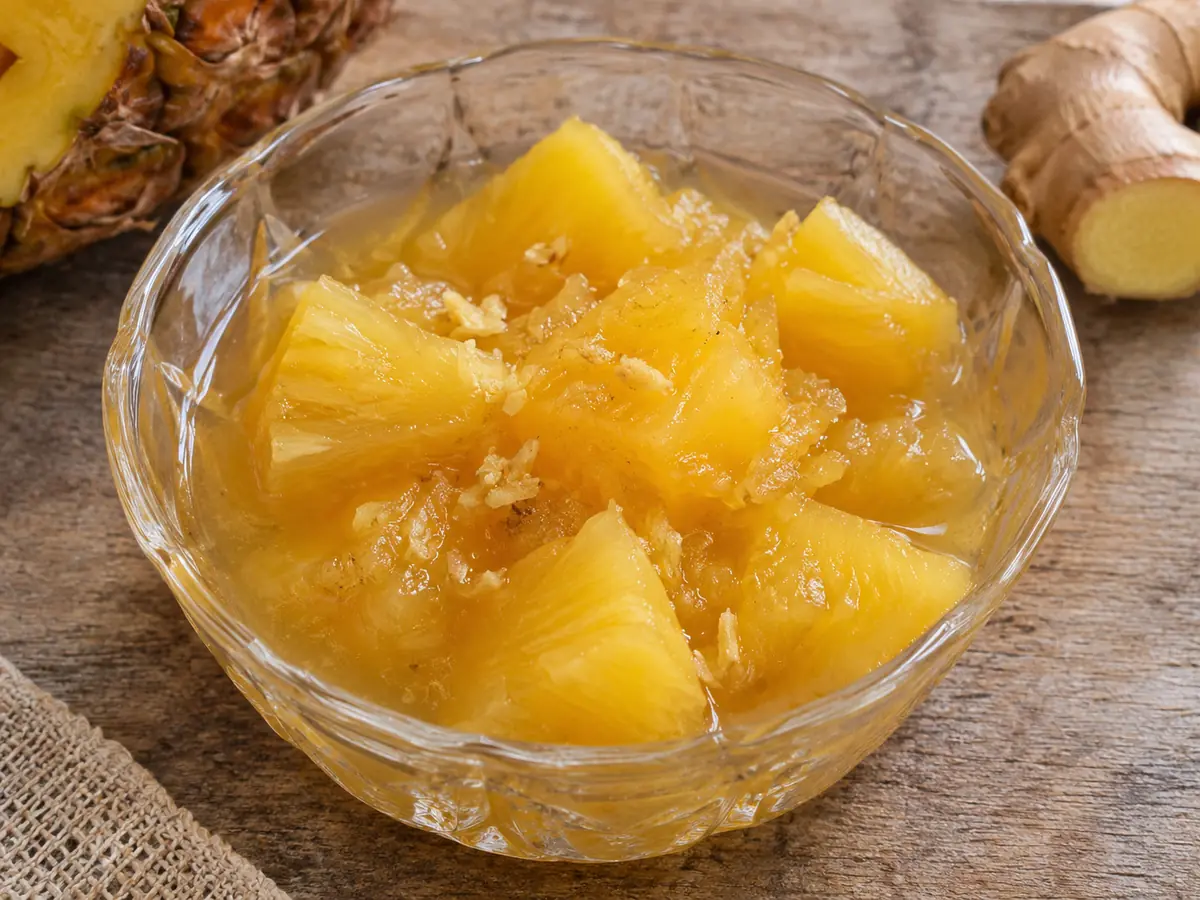
Tender pineapple pieces in their lightly reduced juice, flavoured with ginger and finished with lime, without cream or a gelling agent.
Ingredients
- 800 g fresh pineapple flesh, without skin or tough core
- 100 ml water
- 30 g white sugar
- 10 g peeled fresh ginger, finely grated
- 20 g strained fresh lime juice
- 0.5 g salt
Preparation
Prepare and weigh 800 g edible pineapple flesh. Cut into roughly 2 cm pieces and collect the juice released while cutting in a clean container.
Peel and finely grate 10 g usable ginger. Squeeze and strain the lime, then separately weigh 20 g juice.
Pour the 100 ml water into a heavy-bottomed pan. Add the 30 g sugar, ginger and 0.5 g salt; heat gently for 2 minutes, stirring.
Add the pineapple and collected juice. Partially cover and simmer for 18–22 minutes, gently turning the pieces several times.
Check that a thick piece cuts easily with a spoon. If still very firm, continue for a few minutes; if tender but very juicy, reduce briefly uncovered without drying the fruit.
Turn off the heat, add the 20 g lime juice and mix. Divide fruit and juice into four comparable portions to serve warm after slight cooling, or cold.
For cold serving and leftovers, divide promptly into small shallow containers, cool without prolonged waiting and refrigerate at 4 °C or below. Eat within 48 hours.
Introduction
This compote keeps the fruit in pieces. Pineapple releases juice that combines with a small amount of water and finely grated ginger; gentle cooking softens the flesh without aiming for a jam-like consistency. There must be enough juice to surround the pieces in every bowl. This is neither a blended cream nor a preparation concentrated enough in sugar to keep for weeks in a cupboard.
The quantities make four portions of fruit dessert. Added sugar is weighed even if the pineapple already seems sweet, and lime is added off the heat for a controlled finish. This contemporary Angola collection proposal explores a combination of ingredients without claiming a collected family recipe or a particular provincial origin. No previous kitchen trial is claimed; the cutting, liquid and tenderness cues guide the actual preparation.
Cultural context
The FAO/WFP report of 6 August 2004 on Angola describes food production and agricultural-product trade in a specific historical setting. It does not present this compote or justify its proportions or a provincial attribution. Pineapple, ginger and lime are combined here as a contemporary editorial creation, distinct from an attested traditional recipe. The source provides a reference for the country's food context, not proof of this dessert's origin. Source: https://www.fao.org/4/j2771p/j2771p00.htm
Tips
Weigh flesh after removing skin and tough core.
Cut regular pieces to make cooking checks clear.
Grate ginger finely enough to leave it in the dessert.
Keep juice rather than aiming for jam consistency.
Refrigerate the compote: cooking does not turn it into a preserve.
Planning
Choose a pineapple with sound flesh and no mouldy, weeping or fermented areas. A particular outside colour alone does not guarantee ripeness throughout. Place the fruit on a stable board and use a suitable knife. Remove the skin and remaining tough eyes while wasting as little usable flesh as possible. Cut out the fibrous centre if it clearly resists the knife. Eight hundred grams means the amount actually incorporated, not the whole fruit with crown and skin.
Cut fairly regular pieces of about two centimetres so that they cook together. Thin slices disintegrate before large cubes soften; combining them makes checking harder. Collect cutting juice in a clean small bowl and add it with the flesh. Do not use liquid that has stood on a poorly cleaned surface. If preparation is interrupted, keep the pieces chilled rather than leaving them for a long time near heat while dealing with other ingredients.
Weigh ginger after removing hard or damaged skin. Grate very finely so that its fibres do not become long strands in the bowls. All ten grams remain in the dessert; this is not a strained infusion from which the ginger solids are discarded. Keep lime juice separate. Weigh salt on a sufficiently accurate scale: half a spoonful of salt is not equivalent to the required half gram. This small quantity must not turn the dessert into a savoury dish.
Use a saucepan that holds the pieces at a reasonable depth with space to turn them. A narrow pan packs the fruit together; a huge sauté pan speeds evaporation. Start by dissolving sugar in the water with ginger and salt over low heat. There is no need to make caramel or brown dry sugar. The measured hundred millilitres of water prevent the first pieces from contacting a dry base before they release their own juice.
After adding pineapple, keep a moderate simmer and partial cover. Turn the pieces with a broad spoon without deliberately crushing them. Time depends on initial firmness and cutting size. To check, remove a thick piece, let it cool slightly and cut it with a spoon. Tender flesh can keep its shape: you need not wait for a purée. If the base threatens to dry before that tenderness is reached, add a little hot water, note the amount and reduce the heat.
Once the flesh is tender, assess the juice separately. Brief uncovered reduction may be enough if there is still a lot of liquid, but do not aim for sticky syrup that coats the base without leaving juice to serve. There is no added pectin or gelling agent; the final texture is fruit in lightly thickened juice, not jelly. Turn off the heat before adding lime. Mix and taste a small, slightly cooled amount, because burning-hot food makes it difficult to assess the balance between fruit, ginger and acidity comfortably.
Cooking and sugar do not make this compote stable at room temperature. For cold serving, divide promptly into four small containers instead of leaving the whole saucepan on the worktop for hours. A cold-water bath around the containers can speed cooling without wetting the dessert. Refrigerate at four degrees Celsius or below and protect the containers. This also lets you take out a single portion without warming or handling all the rest.
Serving
Share the pieces, then the juice, between four bowls so that the first serving is not dry and the last mostly liquid. Serve warm when no longer hot enough to burn, or cold after rapid cooling. Very short ginger fibres may remain visible; they do not mean the compote needs blending. No cream is needed. Yoghurt, biscuits or dried fruit offered separately are accompaniments to declare and count additionally; they are absent from this recipe and its nutrition.
Storage
Keep cooled portions in clean, closed containers in the refrigerator at 4 °C or below and eat within 48 hours. Do not store this low-sugar preparation in a cupboard, even if poured hot into a jar. Use a clean spoon and take out only the amount needed. Avoid long periods on a warm table and repeated reheating. Do not serve contents showing fermentation, mould or uncertain storage; attractive-looking fruit does not replace a controlled cold chain.
Variations
Firmer pineapple may need a few extra minutes and a little water, while very ripe fruit needs gentler stirring. For another batch, change sugar or ginger by a measured amount and recalculate nutrition if quantities change. Unsweetened frozen pineapple pieces may be thawed in the refrigerator, weighing edible flesh and recovered juice together to make eight hundred grams. The fresh-pineapple nutritional reference is then an approximation. Do not substitute this weight with pineapple in syrup without revising sugar and calculation references.
Nutrition notes
Values are for one quarter of the preparation without accompaniments. Edible weights of raw pineapple, peeled ginger and lime juice are used; all added sugar and salt are counted. Grated ginger is consumed, unlike a strained infusion whose solids are removed. Water supplies no macronutrients. Fruit ripeness, brands, evaporation and actual yield change composition per served weight. These figures are recipe estimates, not an analysis of the cooked compote or a promise of therapeutic benefit. Source: Anses. 2020. Ciqual French food composition table.
Conclusion
The intended result is easy to observe: tender pieces that keep their shape and enough juice in every bowl. Adapting cooking to the actual fruit matters more than systematic reduction. This contemporary proposal claims neither attested tradition nor a previous kitchen trial.
Enjoy your meal
Enjoy your meal!