Coconut rice cream with lime
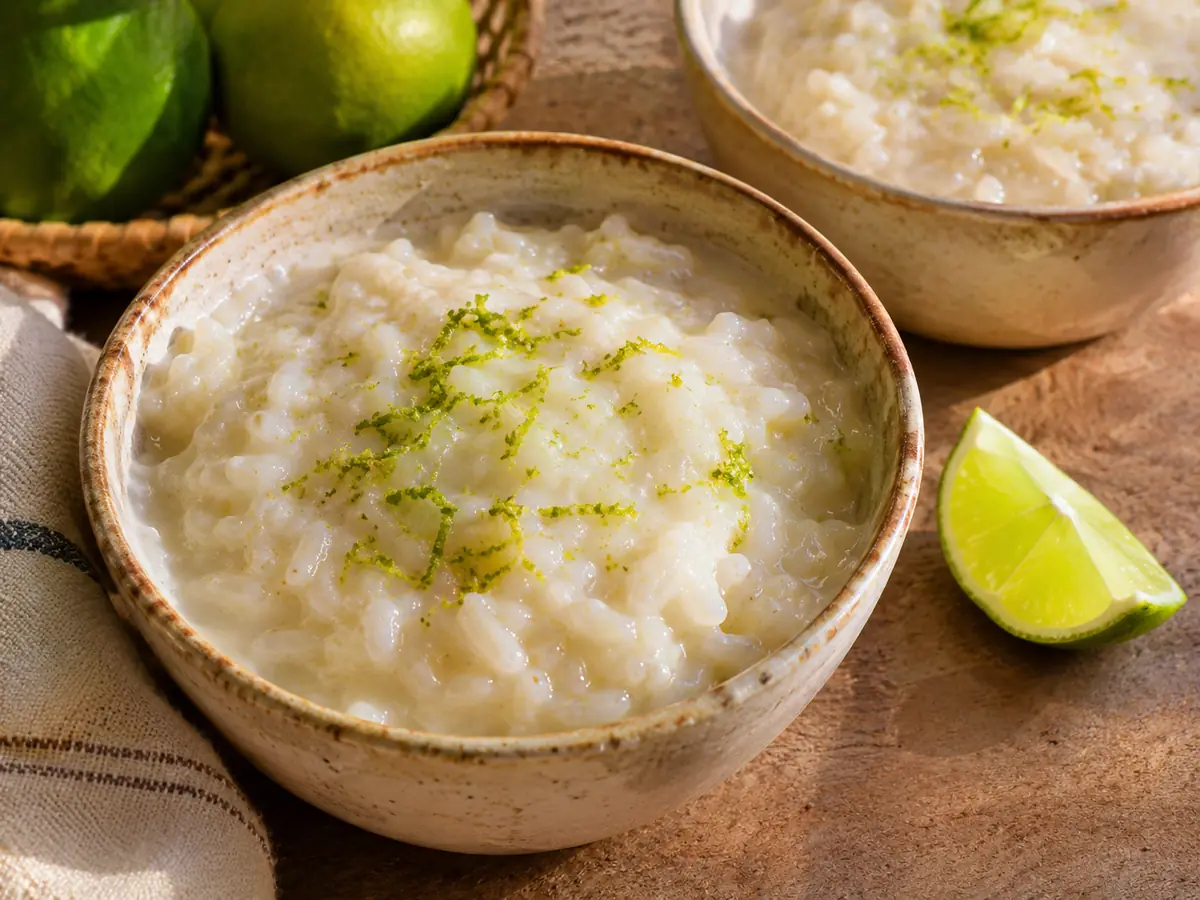
A soft pudding of round white rice and coconut milk, gently cooked and finished with lime juice, without gelatin.
Ingredients
- 140 g uncooked round white rice
- 400 g unsweetened coconut milk
- 450 ml water
- 40 g white sugar
- 15 g freshly squeezed, strained lime juice
- 1 g finely grated washed lime zest, green outer layer only
- 1 g salt
Preparation
Weigh all seven ingredients. Take the gram of zest from the washed lime before squeezing it, avoiding the white pith. Stir the coconut milk in its container to combine the thick and liquid parts. Squeeze and strain the lime juice, keeping it separate.
Put the rice, 450 ml water and salt in a heavy-bottomed saucepan. Bring to a gentle simmer, then cook on low heat for 15 minutes, partially covered and stirring regularly.
Pour in the 400 g coconut milk and add the 40 g sugar. Stir, return gently to a simmer and continue cooking for 20–25 minutes, without fully covering.
Sweep the spatula across the base and corners frequently. Taste a grain: it should be tender through the centre. The hot mixture should still flow slowly from a spoon, rather than becoming a dry paste.
Turn off the heat, stir in the 15 g lime juice and mix gently. Taste the whole mixture without automatically adding extra sugar or juice.
Serve immediately for a warm dessert. For a cold version, divide at once between four small shallow containers, cool rapidly and refrigerate at 4 °C or below.
Allow the texture to settle and soften in the refrigerator for about 2 hours; do not leave the containers waiting on the worktop. Eat the refrigerated cream within 24 hours. At serving time, divide the reserved gram of zest between the four portions.
Introduction
In this cream, rice provides both the substance of the dessert and its thickener. The grains remain distinct, surrounded by white liquid made creamy by the starch released during cooking. Coconut milk adds roundness; lime juice, stirred in off the heat, brings clear acidity without turning the mixture into a lime drink. The intended consistency is soft enough to spoon, rather than a flan that can be turned out.
The quantities make four small portions. This is a contemporary creation inspired by ingredients used in different African cuisines, presented here in the Angola collection. It does not borrow the name of an attested family speciality. Omitting gelatin is not an improvised substitution: rice, its cooking water and chilled resting determine the consistency. Keeping the grains in the dessert lets you check their cooking directly.
Cultural context
The FAO/WFP report of 6 August 2004 on Angola examines food crops and cereal supply, including rice. It supplies historical agricultural context; it does not attest this coconut-milk dessert, its quantities or its presence in a particular province. Two-stage cooking and a lime finish are contemporary editorial choices. The link distinguishes documented context from a newly proposed recipe. Source: https://www.fao.org/4/j2771p/j2771p00.htm
Tips
Weigh uncooked rice, not an already cooked portion.
Homogenise coconut milk before weighing it.
Stir the base without crushing the grains.
Keep a soft consistency before cooling.
Reserve the 2-hour rest for the refrigerator, never the table.
Planning
Choose round white rice intended for creamy dishes. Parboiled rice, brown rice and already cooked grains absorb liquid differently and are not direct replacements in these proportions. Weigh the dry rice before doing anything else. Heavy rinsing would remove some of the surface starch wanted here; use a clean product according to its packaging, without trying to make rinsing water perfectly clear. If the manufacturer gives special instructions, follow them and adjust the liquid afterwards rather than ignoring them.
Use unsweetened coconut milk sold for cooking. A very diluted plant drink, very concentrated coconut cream or a sweetened cocktail product would substantially change the result. Even a can of coconut milk may have separated into a thick layer and liquid: combine them before weighing the four hundred grams. Read the label, especially the ingredients and fat content. The recipe does not assume that every brand is equally rich or that an opened can supplies exactly the amount required.
Use a saucepan wide enough for easy stirring, but not a large sauté pan in which the water would disappear too quickly. A thick base helps distribute heat. Cooking first in water starts softening the grains without immediately exposing sugar and coconut to prolonged contact with the hot base. Maintain a gentle simmer: a hard boil causes splashes and does not guarantee more even cooking. Stir with a flexible spatula that reaches the corners, without deliberately crushing the grains.
After adding coconut milk and sugar, watch the mixture more closely. Gently loosen it from the base with each sweep. If a film browns or smells burnt, do not scrape it into the cream: transfer the unburnt part to a clean pan, then check whether its flavour still makes it suitable to serve. Extra lime cannot correct a burnt base. The stated times are guides; saucepan diameter, heat intensity and rice variety all change evaporation.
To check cooking, take out a grain and let it cool for a few seconds before tasting. There should be no hard or chalky centre. If liquid becomes scarce before the grain is tender, add hot water a little at a time and note how much you actually use. Conversely, if the grains are tender but the liquid is very thin, cook for a few more minutes over low heat, stirring. Do not reduce it to a dense mass: it thickens further as it cools, making consistency assessed only in the saucepan misleading.
Squeeze the lime with a clean utensil and strain out seeds and membrane fragments. Weigh the juice alone, excluding peel and pulp left in the juicer. Adding it off the heat reduces heating of its aroma and allows more precise mixing. First take one gram of finely grated zest from the washed and brushed lime, using only the green outer layer. Keep it clean and reserved to divide at serving. If the hot dessert seems more acidic, taste a small spoonful after it has cooled slightly before deciding to change the proportions next time.
For cold serving, do not leave the entire saucepan cooling in the kitchen for hours. Divide rapidly into small containers and arrange rapid cooling, if useful by setting the containers in cold water without wetting the dessert. Refrigerate at four degrees Celsius or below as soon as possible. Cooked rice needs particular care at this stage: the two-hour rest is for texture in the refrigerator, not permission to wait two hours at room temperature. Use a clean spoon for successive checks.
Serving
Divide the cream into four comparable portions, taking both grains and liquid each time. Serve it warm immediately after adding lime, or cold after rapid cooling. For the cold version, gently stir each portion if its surface has become firmer. Do not promise that it will turn out of a mould: this consistency is eaten from its container. Fruit, biscuits or coconut flakes added at serving are separate accompaniments, absent from the ingredients and nutritional calculation for this recipe. The gram of zest, shared between four portions, is included in the recipe and calculation; do not replace it with an unmeasured amount.
Storage
Keep cooled portions in clean, covered containers in the refrigerator at 4 °C or below and eat within 24 hours. Do not let the dessert remain lukewarm on a buffet table. Take out only the portions needed and never return a spoon that has been in someone's mouth to a shared container. This recipe favours cold consumption after refrigeration; it does not provide for repeated cooling and reheating. If the cold chain has been broken or storage conditions are unknown, do not rely on smell alone.
Variations
You may use a different amount of sugar on another occasion, weighing it and recalculating the nutrition. For a thinner consistency, mix a small amount of hot water into the portion to be eaten immediately. Do not replace round rice with rice flour without rebuilding the method: flour would make a smooth cream with different risks of lumps. Any added fruit must be declared, weighed separately and prepared with clean utensils; it does not turn this creation into a documented traditional speciality.
Nutrition notes
Values are estimates per quarter of the preparation, without accompaniments. Ciqual's uncooked white rice represents round rice here; its generic composition does not describe every variety. Coconut milk is approximated by the entry “coconut milk or coconut cream”, whose richness may differ from the product bought. All listed sugar and salt are counted; water supplies no macronutrients. Brands, evaporation and actual yield change composition per serving weight. These figures are not an analysis of the cooked dessert. Source: Anses. 2020. Ciqual French food composition table. For the gram of lime zest, the Ciqual yellow-lemon zest entry (code 13125) is used as a composition proxy; it does not measure the actual lime zest used.
Conclusion
The intended result depends on tender grains, a still-soft cream and lime measured off the heat. Checking these three signs is more useful than automatically extending cooking. This contemporary editorial proposal is not presented as a kitchen-tested formula.
Enjoy your meal
Enjoy your meal!