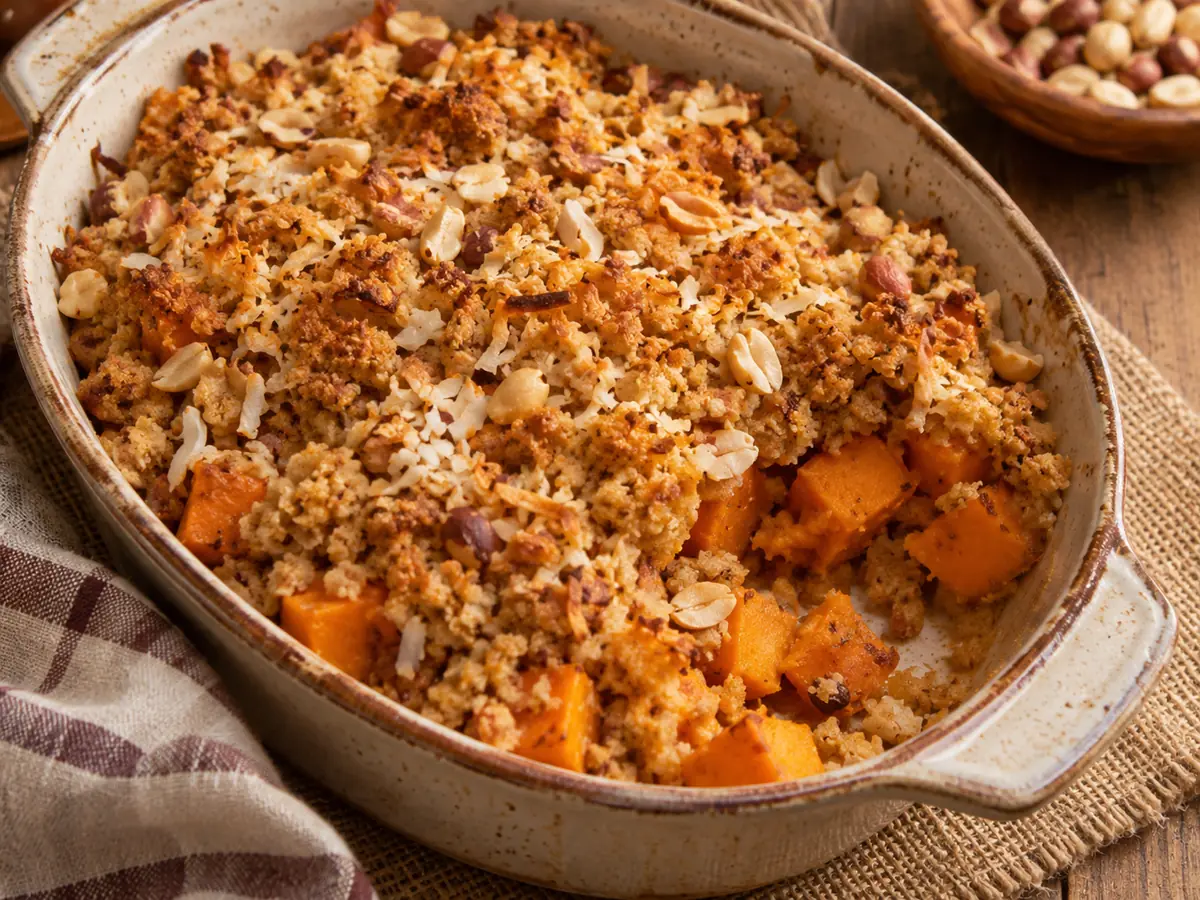
Savoury sweet potato crumble with ginguba peanuts and coconut
Already tender sweet potato cubes are covered with a crumbly peanut and coconut topping, then browned in the oven.
Ingredients
- 800 g raw sweet potato, peeled weight
- 120 g peeled onion
- 8 g peeled garlic
- 10 g fresh ginger, usable weight
- 15 g olive oil
- 150 ml water
- 70 g T55 wheat flour
- 50 g roasted peanuts without added salt
- 25 g unsweetened dried shredded coconut
- 30 g cold unsalted butter
- 4 g salt: 2 g for the vegetables and 2 g for the crumbs
Preparation
Peel and weigh 800 g sweet potato, then cut 1.5 cm cubes. Prepare 120 g onion,8 g garlic and 10 g ginger.
Sweat onion 6 minutes in 15 g oil. Add garlic and ginger 1 minute, then cubes 3 minutes, stirring.
Pour in 150 ml water and 2 g salt. Cover and gently cook 12–15 minutes until cubes are almost tender but intact.
Uncover and evaporate excess liquid 3–5 minutes. Transfer to a suitable dish and heat the oven to 180 °C.
Chop 50 g peanuts. Mix with 70 g flour,25 g coconut and the remaining 2 g salt. Rub in 30 g cold butter without forming a ball.
Scatter a thin layer of crumbs over vegetables without compressing. Bake on a middle rack 20–25 minutes until the crust is cooked, dry and lightly golden. Watch the nuts for overbrowning.
Rest 5 minutes outside the oven without sealing under a lid. Share vegetables and topping among 4 portions.
Rapidly cool leftovers in a shallow container, refrigerate at 4 °C or below and use within 48 hours. Reheat only the required portion once until thoroughly hot throughout.
Introduction
Contrast defines this dish: soft sweet potato pieces beneath an uneven layer of crisp crumbs. Ginguba, meaning peanuts, brings a toasted note; dried coconut visually lightens the crust and gives it a distinctive aroma. Onion, garlic and ginger create a savoury base so the root is not treated as dessert. No spoonful of sugar is planned.
The vegetables are precooked before the topping is added. The oven stage therefore cooks the flour and browns the crumbs rather than waiting for large raw cubes to soften. Quantities make four generous side portions or a vegetarian dish to complement according to the menu. This is a contemporary creation inspired by products present in African cuisines, including Angola's. It is presented neither as an attested traditional speciality nor as a kitchen-tested recipe.
Cultural context
The FAO/WFP report of 6 August 2004 on Angola describes food production and food needs of that period. It offers historical agricultural context, but does not document this crumble, its butter crust or the proposed sweet potato, peanut and coconut proportions. Calling it a crumble signals a contemporary culinary construction. No provincial roots, particular family transmission or ancient origin is invented for the preparation. Context source: https://www.fao.org/4/j2771p/j2771p00.htm
Tips
Weigh sweet potato after peeling.
Precook cubes before adding crumbs.
Evaporate free water without drying out the base.
Keep butter cold and peanuts in small fragments.
Do not compress the topping or burn the coconut.
Planning
Choose firm sweet potatoes without damaged areas. Wash before peeling, then weigh 800 g of usable flesh. Cut even cubes about 1.5 cm across. Uniform cutting matters more than perfect geometry: it lets you test several pieces without finding a hard one among an already tender base. Keep the cubes in a clean container while preparing the aromatics.
Slice onion, chop garlic and grate ginger after removing hard or damaged skin. Heat 15 g oil in a sufficiently wide sauté pan. Sweat onion for 6 minutes over medium heat, add garlic and ginger for 1 minute, then sweet potato cubes for 3 minutes, stirring. The cubes may colour slightly, but garlic must not blacken. Prepare the measured water before this stage so it can be added without interrupting supervision.
Add 150 ml water and 2 g salt. Cover and cook gently for 12–15 minutes, turning once. Test with a knife tip: it should enter almost without resistance while the cubes retain their shape. A very firm variety may need a few extra minutes. Do not rely on the crust to hide an undercooked base. The topping is not mixed into the vegetables to speed their cooking.
Uncover and evaporate remaining liquid for 3–5 minutes, watching the bottom. A spoonful of juice clinging to the vegetables is acceptable; a pool would soak the crumbs. Stop when the base is moist but no longer sitting in liquid. Transfer to an ovenproof dish wide enough for a moderate vegetable depth. Preheat the oven to 180 °C. A very deep dish would trap more steam beneath the topping.
Coarsely chop peanuts with a knife or mortar without reducing them to paste. In a bowl, mix flour, coconut, peanuts and the remaining 2 g salt. Add cold butter in small cubes. Briefly rub with fingertips to form crumbs ranging from coarse sand to small clumps. Stop before melting butter turns everything into a compact ball. Unsalted butter and peanuts without salt help control added salt.
Scatter crumbs over the vegetables without pressing or seeking a perfectly smooth surface. Tiny gaps allow steam to escape. Keep the layer thin and irregular: a thick compressed cover would trap moisture and leave floury patches. Do not taste the raw topping because it contains uncooked flour. Place on a middle rack so the top is not immediately exposed to the strongest heat.
Bake 20–25 minutes until the crust is dry and lightly golden. Coconut and peanuts can colour quickly: watch the surface toward the end. If it darkens before crumbs are cooked, loosely protect it and continue for a few minutes without increasing the temperature. Burnt nuts do not signal successful crispness. Rest 5 minutes outside the oven before serving, without sealing under a lid, to preserve the difference between the tender base and crust.
Serving
Use a wide spoon to take vegetables and crust together rather than giving all the crumbs to the first plates. Pieces should remain recognisable beneath the topping. Serve after the brief rest, once the crust has lost its immediate fragility without becoming cold. A protein accompaniment or salad may be served separately; its composition is excluded from these values. This crumble contains peanuts, coconut, wheat and milk through the butter. Do not present it as gluten-free, dairy-free or vegan.
Storage
Quickly divide leftovers into a shallow container and refrigerate at 4 °C or below. Use within 48 hours. The crust softens against vegetables during storage: this is normal and is not fixed with extra oil. Reheat only the required portion once until thoroughly hot at the centre, preferably in the oven to restore some surface dryness. Do not keep the dish lukewarm for hours.
Variations
A paler-fleshed sweet potato can replace the orange variety, with actual tenderness checked rather than colour alone. Coconut must remain unsweetened: sweetened products change seasoning and nutrition. Roasted salted peanuts cannot silently replace unsalted ones: their label requires revising added salt. A butter-free or wheat-free version needs a different crust balance and a check on its structure, rather than a word-for-word substitution.
Nutrition notes
Values are estimates per portion, without accompaniments, based on edible weights and Ciqual references. Sweet potato is referenced raw at peeled weight, peanuts roasted without salt, and coconut dried and unsweetened. All butter, oil, flour and added salt are counted. Water adds no nutrients. Water losses and differences between products affect yield and actual observed values; no analysis of the cooked crumble is claimed.
Conclusion
The dish relies on an almost cooked base without a pool of liquid, followed by loose crumbs watched in the oven. These stages avoid choosing between hard vegetables and burnt nuts. This contemporary creation clearly retains its editorial status and is not presented as an attested traditional speciality or a kitchen-tested formula.
Enjoy your meal
Enjoy your meal!