Baked eggs with squash and ginguba peanuts
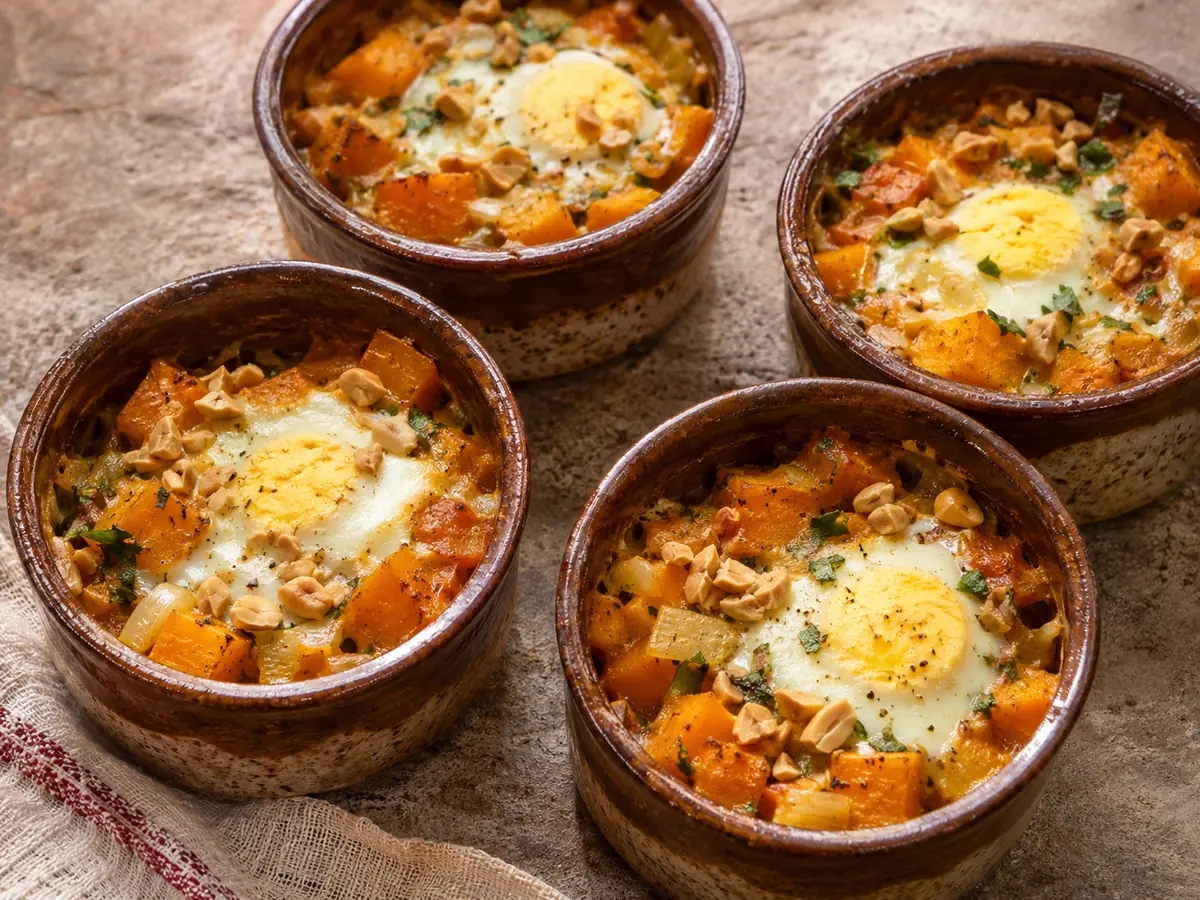
Four ramekins combine a precooked butternut base, a fully set egg and crushed unsalted roasted peanuts added at serving.
Ingredients
- 600 g raw butternut squash flesh, peeled and deseeded
- 4 hen eggs, approximately 200 g edible contents without shells
- 120 g peeled onion
- 40 g shelled unsalted roasted peanuts
- 6 g peeled garlic
- 6 g fresh ginger, usable weight
- 20 g olive oil: 16 g for the vegetables and 4 g for the ramekins
- 100 ml water to precook the squash
- 3 g salt
- Hot water for the water bath, according to the baking dish size
Preparation
Prepare 4 ramekins holding 300–350 ml and grease with 4 g oil in total. Have a deep dish ready for the water bath.
Weigh 600 g raw peeled, deseeded butternut and cut into 2 cm cubes. Prepare onion, garlic and ginger.
Soften onion in 16 g oil for 6 minutes. Add garlic and ginger for 1 minute, then squash for 2 minutes.
Pour in 100 ml water and add 3 g salt. Cover and cook gently for 15–20 minutes until the squash is very tender. Evaporate excess water uncovered.
Preheat the oven to 170 °C. Coarsely mash the squash, divide between the 4 ramekins and make a hollow in the centre, leaving roughly 1 cm below the rim.
Add 1 egg to each ramekin. Set in the dish in the oven and carefully pour hot water around them to halfway up the sides.
Bake for 25–35 minutes: whites and yolks completely set without a runny part, and at least 71 °C at the centre. Check every ramekin and continue if needed.
Remove with heat protection. Share the 40 g crushed peanuts, 10 g per ramekin, then serve hot.
Introduction
This preparation starts with a squash base that is already tender before adding the egg. It allows the vegetable’s cooking to be adjusted separately from that of the white and yolk, both of which must be completely set in this version. Crushed ginguba is added after baking, retaining its texture instead of becoming damp at the bottom of the ramekin. Onion, garlic and ginger remain supporting flavours without turning the base into a dominant spiced sauce.
The recipe is a contemporary creation inspired by ingredients used in Angolan kitchens. It is presented neither as an authenticated regional speciality nor as a recovered traditional formula. The quantities make four ramekins, one serving per person as a substantial starter or a plate to be completed. Any extra bread, rice or vegetables remain outside the stated nutritional calculation. Peanuts are an ingredient that must be explicitly pointed out to diners.
Cultural context
The FAO/WFP report of 6 August 2004 concerns food-crop production and Angola’s food needs at a particular period. It supplies historical context for discussing agricultural ingredients without authenticating this ramekin assembly. The combination, water-bath baking and final addition of ginguba are contemporary editorial decisions. No celebration story, provincial custom or family transmission is invented to give the dish antiquity. Institutional context source: https://www.fao.org/4/j2771p/j2771p00.htm
Tips
Weigh raw squash flesh after removing skin and seeds.
Fully precook the base before sliding eggs onto it.
Limit free water in the squash to avoid a soggy base.
Check each ramekin: an opaque white alone does not guarantee a set yolk.
Add crushed peanuts only when serving.
Planning
Prepare four individual ovenproof ramekins holding three hundred to three hundred and fifty millilitres and of similar size. Check that they fit into a deep baking dish without touching. Divide the four grams of oil allowed for greasing, roughly one gram per ramekin, brushing the base and relevant sides. Do not take unmeasured extra oil: the twenty grams in the list already include greasing. Keep the eggs refrigerated until needed.
Peel and deseed the butternut, then weigh six hundred grams of raw flesh. Cut into small cubes about two centimetres across. This weighing takes place before cooking, not after the vegetable’s water has reduced. Finely slice the onion, chop the garlic and grate the ginger. Cutting these aromatics finely avoids sharp-tasting pieces under the egg, whereas the squash cubes can later be mashed more coarsely with a fork.
Heat sixteen grams of oil in a wide saucepan. Soften the onion for six minutes, add garlic and ginger for one minute, then squash for two minutes while stirring. Pour in one hundred millilitres of water and add the three grams of salt. Cover and simmer for fifteen to twenty minutes. Stir occasionally to check that the base is not sticking. The squash should mash easily under a fork; cook a little longer if cubes remain firm at the centre.
Preheat a conventional oven to 170 °C. Uncover the saucepan and evaporate any excess water: the base should stay soft without leaving a puddle at the bottom of the ramekins. Coarsely mash the squash with the onion, without aiming for a perfectly smooth purée. Divide between the four dishes and make a slight hollow in the centre with the back of a spoon. Leave roughly one centimetre free below the rim to contain the egg and allow handling.
Break each egg into a small clean cup, then slide onto the squash without shell fragments. Two hundred grams of contents without shells for the four eggs is the calculation basis; actual egg size can change it. Put the ramekins in the deep dish, place it on the oven rack, then carefully pour hot water around them up to halfway up their sides. This arrangement avoids carrying a large dish already full of hot water across the kitchen.
Bake for twenty-five to thirty-five minutes, checking from the lower end of the range. Whites and yolks must be completely set, with no runny part; aim for at least 71 °C at the centre with a clean probe. Check ramekins individually, since position and material affect cooking speed. Continue in short intervals if necessary. Remove dishes with suitable heat protection, place on heatproof supports and add ten grams of crushed peanuts to each.
Serving
Present each ramekin on a stable small plate with a spoon. Warn that the dish stays hot, rather than asking diners to hold it directly. Peanuts should remain visible on top; distribute the crumbs from the bowl too, retaining the intended quantities. The squash base accompanies each spoonful of egg instead of being forgotten under the white. If adding an accompaniment, serve separately and include it in the meal’s overall contribution.
Storage
Texture is best at the first serving, but remaining portions can be cooled quickly and kept at 4 °C or below for no more than forty-eight hours. Use small clean containers or cover the ramekins once cooling is under way. Reheat the needed portion only once until the entire preparation is thoroughly hot at the centre, using 74 °C as a reference. Respect the containers’ thermal limits: do not suddenly put a cold ramekin into a very hot oven. Eggs remain fully cooked in this version.
Variations
Another squash may contain more water: check its consistency before adding eggs and review the nutritional reference if necessary. Ramekin volume changes filling depth and therefore cooking time; do not mechanically keep the same timing with small containers. For a peanut-free dish, provide suitable separate ingredients and utensils for the diners concerned. A different garnish changes flavour, possible allergens and calculated values. This recipe does not call for a runny yolk.
Nutrition notes
The estimate is for one of four ramekins with ten grams of peanuts and no accompaniment. The squash uses the raw butternut reference for the six hundred grams weighed before cooking. Four eggs are represented by two hundred grams of raw edible contents, a mass that varies with actual egg size. All vegetable-cooking and greasing oil is counted, as is added salt. The peanuts are roasted without additional salt. Cooking water and water-bath water contribute no macronutrients. Actual composition and water losses vary; no therapeutic benefit is attributed to the dish.
Conclusion
Tender squash, fully set eggs and a dry ginguba finish are the three reference points of this preparation. Adjust timing to the actual containers and the centre check. This editorial creation is not presented as kitchen-tested.
Enjoy your meal
Enjoy your meal!