Turkey skewers with squash and ginguba peanuts
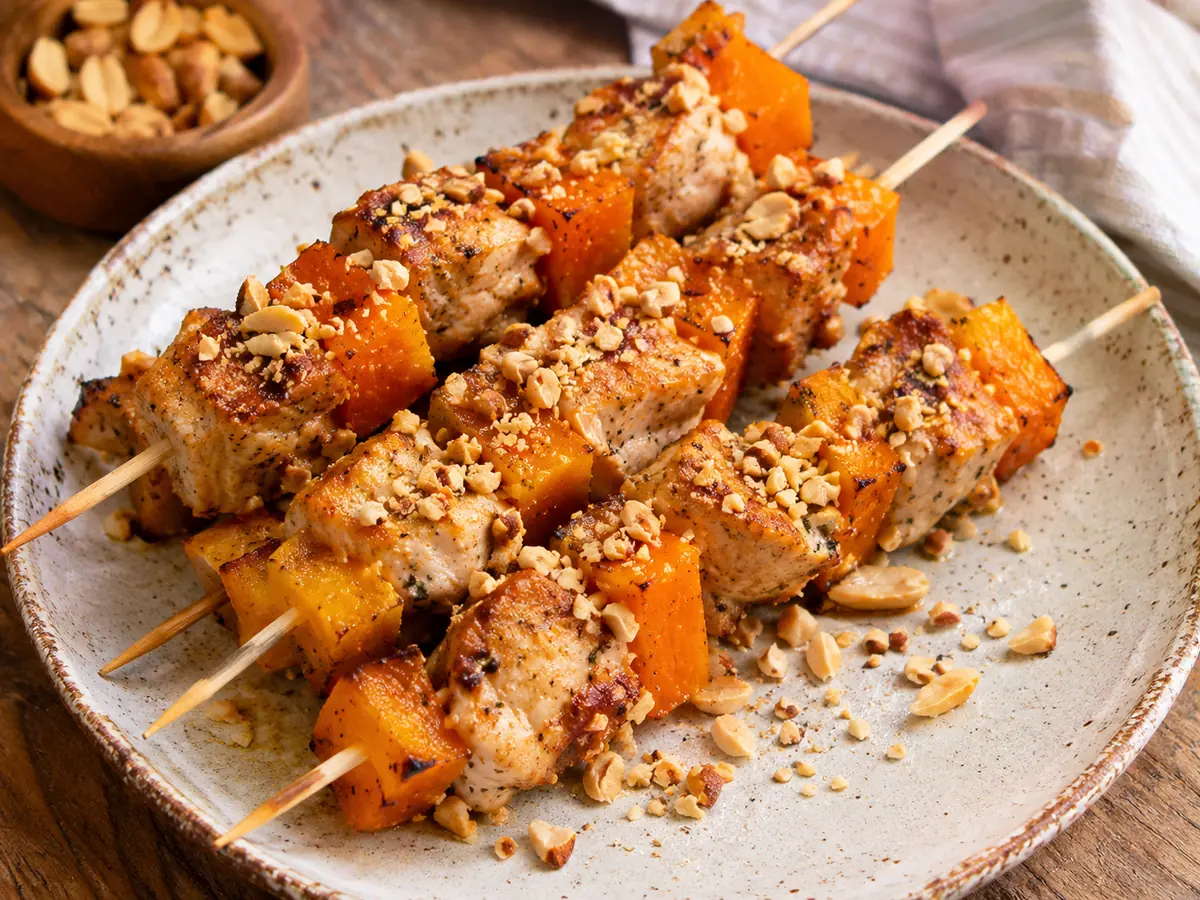
Cubes of turkey breast and butternut squash are roasted on skewers, then scattered with unsalted roasted peanuts for a crunchy finish.
Ingredients
- 600 g raw skinless turkey breast, usable weight
- 600 g raw butternut squash flesh, without skin or seeds
- 120 g peeled onion
- 40 g shelled unsalted roasted peanuts
- 8 g peeled garlic
- 10 g fresh ginger, usable weight
- 30 g pure lemon juice
- 20 g olive oil, divided into two 10 g portions
- 4 g salt, divided into two 2 g portions
Preparation
Preheat the oven to 200 °C. Peel and deseed the squash, weigh 600 g flesh and cut into 2.5 cm cubes.
Mix the squash with 10 g oil and 2 g salt. Spread on a rimmed tray and precook for 15 minutes without making it crumbly.
Cut 600 g turkey breast into 3 cm cubes. Coat with 10 g oil, 30 g lemon juice, garlic, ginger and 2 g salt. Refrigerate for 20 minutes.
Prepare the onion. Alternate turkey, precooked squash and onion pieces on 8 metal skewers without packing tightly. Clean surfaces that touched raw poultry.
Place on a clean tray and roast at 200 °C for 20–25 minutes, turning after 10 minutes.
Check several large cubes: the turkey must reach at least 74 °C at the centre. Continue if necessary and check that the squash is tender but stays in place.
Discard any raw marinade residue. Coarsely chop the 40 g peanuts using clean utensils and scatter over the cooked skewers.
Serve 2 skewers per person, sharing any peanut pieces that fell onto the tray. Warn that the skewers remain very hot.
Introduction
These skewers seek a precise contrast: meat that is cooked yet supple, tender squash that stays on the skewer and pieces of ginguba added at the last moment. The squash is briefly precooked because its cubes need longer than pieces of turkey breast. This prevents drying out the poultry while waiting for the vegetable to soften. Lemon and ginger flavour a measured marinade, without a sweet sauce that would burn on the tray.
This recipe is a contemporary creation inspired by ingredients used in Angolan kitchens. It does not claim to reproduce a documented traditional preparation. The quantities make eight skewers to divide between four people. The peanuts remain clearly visible and must be pointed out to diners; the dish is unsuitable for anyone who needs to avoid them. No additional accompaniment is included in the nutritional figures.
Cultural context
The FAO/WFP report of 6 August 2004 assesses crops and food needs in Angola at that time. Its value here is to recall the agricultural setting for considering ingredients, not to authenticate recipes proposed today. Alternating turkey and butternut, precooking in the oven and finishing with crushed ginguba are contemporary choices here. No antiquity, provincial origin or family transmission is attributed to them. Institutional context source: https://www.fao.org/4/j2771p/j2771p00.htm
Tips
Keep cubes even and leave the squash firm after precooking.
Do not compress the food: heat must circulate between skewers.
Marinate turkey in the refrigerator, never on a warm worktop.
Use a clean probe and check several pieces, not just one tip.
Add peanuts after taking the tray from the oven to preserve their crunch.
Planning
Prepare the squash on a stable board with a suitable knife and dry hands. Remove skin, seeds and fibres, then weigh six hundred grams of flesh. Cut into roughly two-and-a-half-centimetre cubes. Tiny cubes split when threaded, whereas large chunks would remain firm at the centre. Butternut is specifically chosen here: a very watery or fragile-fleshed squash may give a different result and cannot be substituted without checking.
Preheat a conventional oven to 200 °C. Mix the cubes with ten grams of oil and two grams of salt, then spread in one layer on a rimmed tray. Roast for fifteen minutes to soften them partially. They should begin to yield to the tip of a knife while retaining definite resistance. Do not wait until they collapse: cooking continues once the skewers are assembled. Let them cool just enough to handle without burning yourself.
Cut the turkey breast into roughly three-centimetre cubes after removing thick membranes. Do not wash poultry under the tap. In a container, mix the remaining ten grams of oil, lemon juice, chopped garlic, grated ginger and remaining two grams of salt. Coat the turkey, cover and refrigerate for twenty minutes, including while preparing the squash. Lemon supplies flavour but does not replace thorough cooking.
Divide the onion into pieces broad enough to stay on the skewers. Prepare eight metal skewers and check that they fit on the tray with some space between them. Thread turkey, precooked squash and onion alternately without compressing them. Divide the meat and vegetables between all eight skewers rather than loading the first few heavily. Use clean hands and utensils; clean surfaces touched by raw turkey before preparing the peanut finish.
Place the skewers on a clean rimmed tray and return to the oven at 200 °C for twenty to twenty-five minutes. Carefully turn after ten minutes using tongs and heat protection. Check several pieces of meat, including the thickest and those in the centre of the tray. The centre must reach at least 74 °C. If it has not reached this temperature, continue in short intervals; surface colour alone cannot establish doneness.
Coarsely chop the peanuts in a small clean bowl while the skewers cook. Do not reuse uncooked marinade that has touched the turkey; discard any residue in the container. Once the meat is cooked and squash tender, take out the tray and scatter the forty grams of peanuts over the skewers. Adding them after cooking prevents burning and preserves their crunch. Serve immediately, warning that the metal skewers remain very hot.
Serving
Allow two skewers per person and collect any onion or squash pieces that have come off. Peanut fragments that fall onto the clean tray belong to the preparation and are shared between the plates. Present the skewers on a heatproof platter without sticking them into an unstable decorative support. Plain rice or salad can accompany the meal, but must be added separately to the shopping list and nutrient calculation. Offer a fork so food can be removed without gripping hot metal.
Storage
Remove leftovers from the skewers using clean utensils and quickly place in shallow containers. Refrigerate at 4 °C or below and eat within forty-eight hours. Reheat the necessary portion only once until the turkey is thoroughly hot at the centre, using 74 °C as a reference. The squash becomes more fragile and the peanuts lose crunch after reheating. Do not leave skewers lukewarm for hours on the serving platter, and do not mix leftovers from a partially eaten plate with the stored food.
Variations
For another squash, check how well it holds together after precooking before assembling: floury flesh may break on the skewer. If replacing turkey with another cut or species, review temperatures, timings and the nutritional calculation. Removing peanuts does not make a preparation suitable for an allergy if surfaces and ingredients have been in contact with them; design a separate dish instead. Any extra garnish is weighed and added to the calculation rather than treated as negligible.
Nutrition notes
The estimate is for one quarter of the recipe: two skewers with their share of peanuts, without accompaniments. Turkey breast uses the raw turkey escalope reference; the squash is butternut weighed raw, peeled and deseeded. The peanuts are roasted without added salt. All planned oil, lemon juice and salt are counted, even if small residues remain in the container. Actual composition and cooking losses vary. The table’s pure juice supplies a reference and does not describe every freshly squeezed juice or brand. These figures are neither an analysis of the finished dish nor a health promise.
Conclusion
Precooking the squash and checking the turkey’s centre separates the needs of the two ingredients. Ginguba finishes the dish after the oven. This editorial creation is not claimed to be a kitchen-tested formula.
Enjoy your meal
Enjoy your meal!