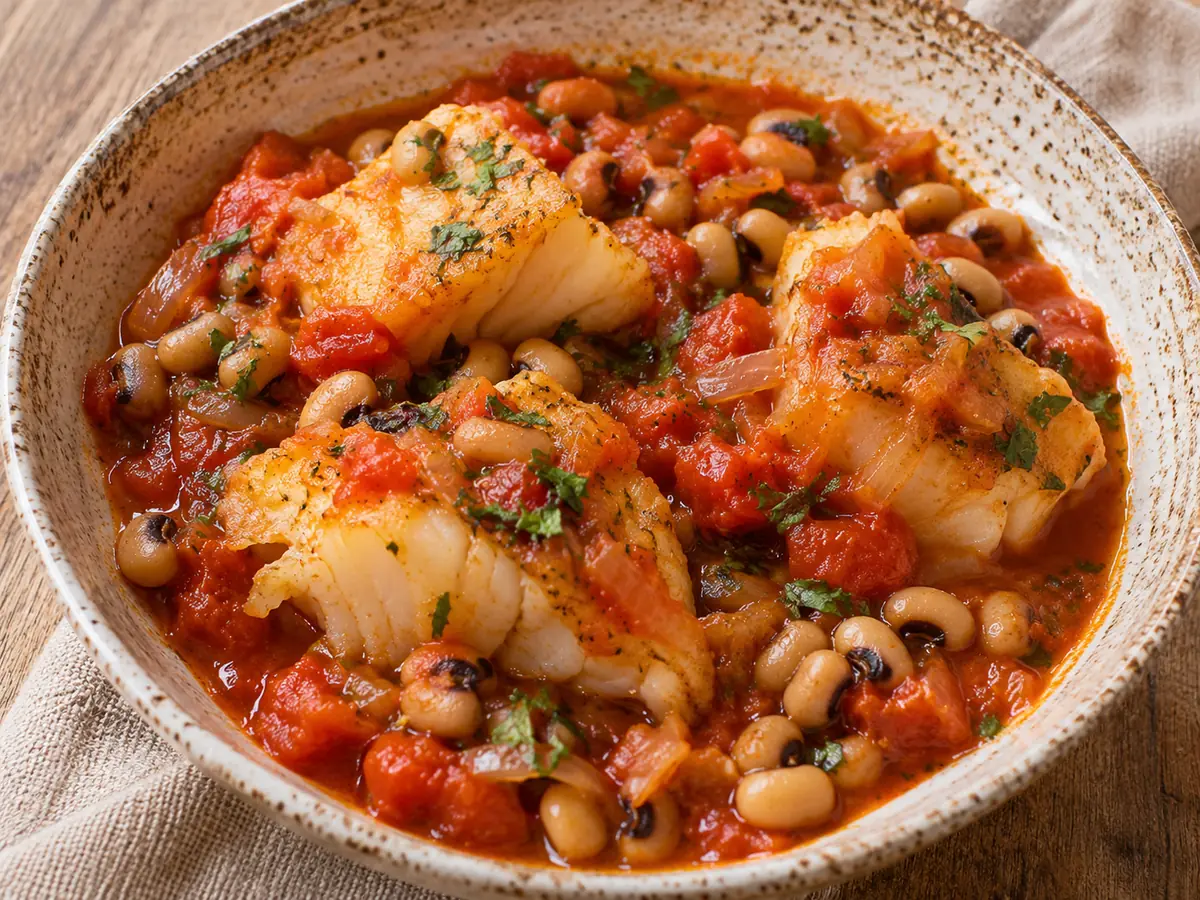
Cod simmered with black-eyed peas and tomatoes
Thick pieces of cod cook gently in a tomato sauce with already cooked black-eyed peas, lifted with ginger and lime.
Ingredients
- 600 g raw cod, skinless and boneless, net weight
- 500 g black-eyed peas already boiled, drained, with no added salt
- 600 g ripe tomatoes
- 150 g peeled onion
- 10 g peeled garlic
- 10 g prepared fresh ginger
- 20 g olive oil
- 20 g lime juice
- 3 g salt
- 250 ml water
Preparation
Prepare and pat dry 600 g cod; remove bones and refrigerate. Drain and weigh 500 g already cooked black-eyed peas.
Dice the onion and tomatoes; chop garlic and ginger. Measure oil, salt, lime juice and 250 ml water.
Soften the onion in the oil for 8 minutes. Add garlic and ginger for 1 minute, then the tomatoes and their juice.
Reduce the tomatoes uncovered for about 15 minutes, adding a little of the measured water if the base dries out.
Add peas and remaining water. Simmer for 10 minutes; reduce now if the sauce is too liquid.
Arrange fish in one layer, cover and cook gently for 8–12 minutes. Check for 63 °C at the centre of the thickest piece with a clean probe.
Off the heat, add salt and lime juice. Divide fish, peas and sauce among four plates and serve hot.
Introduction
This dish brings together tender legumes and fish whose flakes should remain recognisable. Tomato connects the two without turning the dish into a soup: a spoonful of sauce should coat the peas, then fall slowly back into the pan. Lime is added at the end to retain a fresh edge. It is not used to marinate the raw fish or replace cooking. The quantities make four portions; any accompaniment is prepared and counted separately.
This is a contemporary creation inspired by products that can be encountered in Angolan cooking, rather than a documented calulu or a recipe collected from a particular province. The black-eyed peas must already be completely cooked. Their time in the sauce warms and flavours them; it cannot cook dried beans. This distinction makes the sequence easier to follow and avoids prolonging the fish’s cooking while waiting for the beans.
Cultural context
The FAO/WFP report of 6 August 2004 presents Angola’s food crops and agricultural constraints in a specific historical situation. It provides context for legumes and staple products, but does not describe this cod dish or its proportions. The combination proposed, the choice of a reduced tomato sauce and the final single-layer cooking are contemporary editorial decisions. Context source: https://www.fao.org/4/j2771p/j2771p00.htm
Tips
Weigh the peas after cooking and draining.
Reduce the sauce before adding the cod.
Choose pieces of similar thickness.
Shake the pan rather than breaking up the fish by stirring.
Add lime off the heat and check salt after tasting a pea.
Planning
Choose fairly thick pieces of cod, preferably similar in size. The specified weight is usable flesh after removing skin and bones. Run a finger gently over each portion to find remaining pin bones, then remove them with clean tweezers. Pat the surface dry without rinsing the fish under a stream of water that would splash the sink. Keep the portions refrigerated while preparing the vegetables. Frozen fish must be thawed in the refrigerator, in a container that catches its liquid.
Drain the cooked black-eyed peas thoroughly before weighing them. If canned, check the ingredients, rinse and drain; the nutritional reference used here describes boiled black-eyed peas. A salted canned product can change the final salt content even after rinsing. Each pea should squash easily between two clean fingers while retaining its skin. Set aside any still-hard peas instead of relying on a few minutes in an acidic sauce to finish cooking them.
Finely dice the onion and chop the garlic. Grate the ginger finely to avoid thick fibres in the sauce. Dice the tomatoes and keep their juice. Their water content varies: very juicy tomatoes need more reduction before the fish is added. Squeeze and measure the lime juice separately. Use a clean board for the vegetables that are ready to cook and wash equipment that touched raw fish before using it for anything else.
Use a sauté pan wide enough to hold the four fish portions in one layer. Soften the onion in the measured oil for 8 minutes over medium heat, stirring. Add garlic and ginger for 1 minute, then the tomatoes. Cook uncovered for about 15 minutes, until the pieces break down and the sauce thickens slightly. If the base catches before the tomatoes release their juice, add a spoonful of the measured water, without pouring in extra oil.
Add the peas and remaining water, then simmer for 10 minutes. Check the consistency before adding the fish: it should be loose but not watery. Reduce an overly liquid sauce now, uncovered, because the cod cannot withstand a long reduction. Arrange the pieces in the hot sauce, submerge them halfway and cover. Maintain a very gentle simmer for 8–12 minutes, according to thickness. Do not stir through the portions with a spoon; gently shake the pan by its handles.
Check the centre of the thickest piece with a clean probe, aiming for 63 °C. The flesh should separate into opaque flakes, without a translucent centre. Remove any portion that is already cooked if another needs a few more minutes. Turn off the heat, distribute the 3 g salt and lime juice through the sauce, then taste a pea with a little liquid. The sauce can be loosened with a small quantity of hot water, but any addition should be stated if the final yield is being tracked precisely.
Serving
Lift out a portion of cod first with a broad spatula, then distribute the peas around it. Spoon over sauce without drowning the fish. Serve in warm deep plates that are safe to handle. This combination already provides a fish and legume dish; plain rice or another vegetable remains a separate choice, whose ingredients are not included in the calculation. Keep a little sauce in the pan for a second serving rather than overloading the first plate.
Storage
Refrigerate leftovers promptly in shallow containers at 4 °C or below and eat within 24 hours. Do not leave the lukewarm pan on the table. Reheat only the portion needed, once, until thoroughly hot in the centre, without a strong boil that would break up the fish. Add a little water if the peas have absorbed the sauce. Do not mix a reheated portion with the remaining cold food.
Variations
Another white fish may replace cod, but its name, net weight and nutritional reference must be adjusted. Thin pieces need earlier checking. Plain canned tomatoes can be used if their juice is also weighed and their salt checked; the reduction time will change. Lime can be offered at the table for individual adjustment. Replacing the black-eyed peas with already cooked red kidney beans produces a different dish to identify and recalculate, rather than an invisible substitution in this recipe.
Nutrition notes
Values are estimates per portion from edible weights, excluding accompaniments. All oil and the 3 g added salt are counted. The black-eyed pea reference concerns soaked and boiled seeds; their intrinsic sodium is not quantified and is excluded from the salt estimate. A commercial product may therefore supply more salt. Brands, draining, moisture and cooking change the results; no laboratory analysis or health promise is claimed. Black-eyed pea composition source: World Agroforestry, P0008, https://apps.worldagroforestry.org/products/nutrition/index.php/food/food_item_details/P0008
Conclusion
Aim for hot black-eyed peas in a cohesive sauce and cod flakes that remain whole. Reducing the sauce before the fish is added protects this balance. This editorial proposal is not presented as an attested traditional recipe or a formula tested in a kitchen.
Enjoy your meal
Enjoy your meal!