Red bean salad with pineapple and red pepper
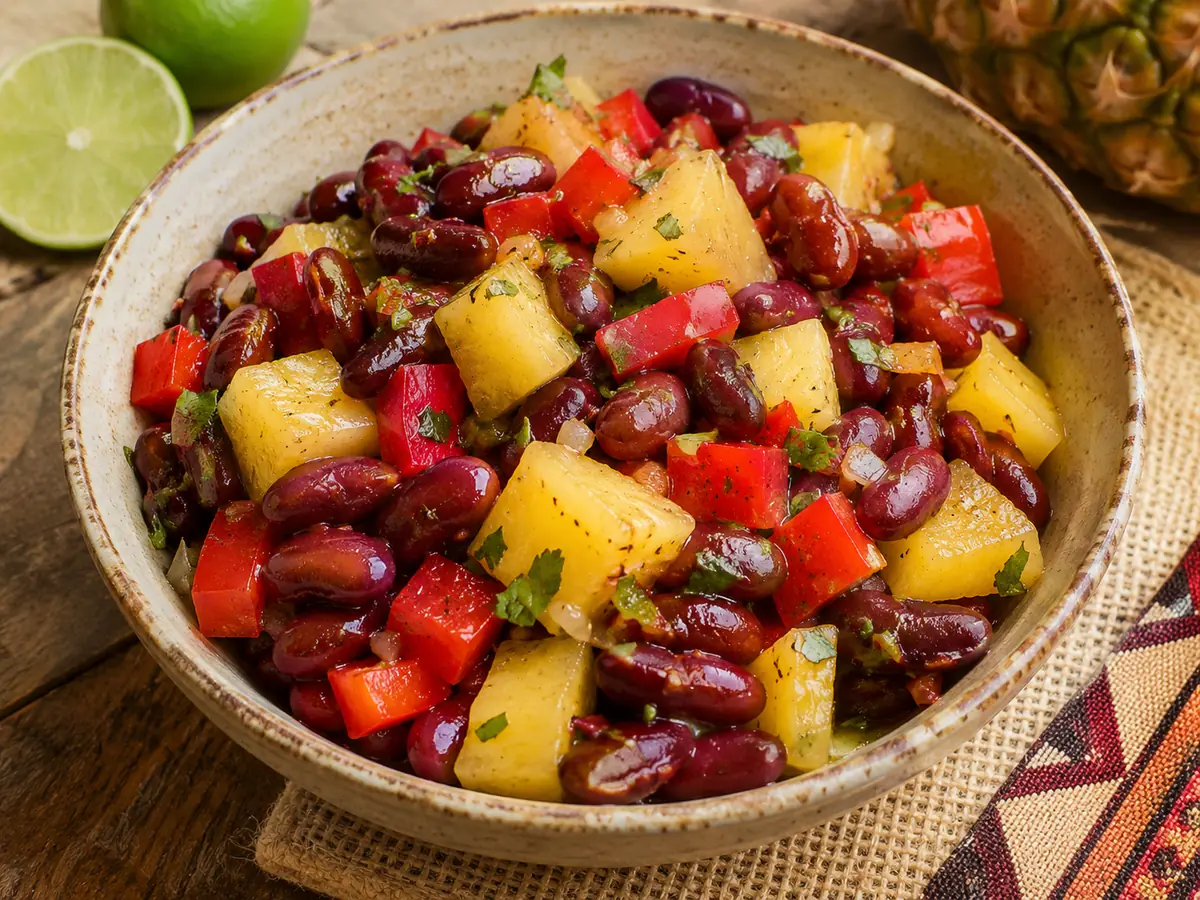
Ready-cooked red beans, fresh pineapple and crunchy red pepper, assembled cold with lime, olive oil and weighed fresh coriander.
Ingredients
- 400 g canned red beans, already cooked and drained
- 300 g fresh pineapple flesh, without skin or hard core
- 200 g raw red pepper, edible part without seeds
- 60 g raw onion, peeled weight
- 10 g fresh coriander, washed and drained
- 20 g olive oil
- 25 g lime juice
- 2 g salt
Preparation
Check that the canned beans are already cooked and ready to eat. Drain for 5 minutes, then weigh 400 g drained beans.
Prepare fresh pineapple and weigh 300 g flesh without skin or hard core. Cut into 1 cm pieces, retaining juice from the weighed flesh.
Wash and prepare 200 g seedless red pepper; cut into 1 cm dice. Finely slice 60 g peeled onion.
Wash, dry and weigh 10 g coriander. Reserve 2 g small leaves and chop the remaining 8 g.
Dissolve 2 g salt in 25 g lime juice, then whisk in 20 g olive oil.
Combine beans, pineapple, pepper and onion. Add dressing and the 8 g chopped coriander; lift gently to keep the beans whole.
Divide equally among 4 plates, distribute the reserved 2 g leaves and serve chilled.
Introduction
Red beans bring a tender texture and deep colour, while fresh pineapple adds juicy pieces and red pepper provides a firmer bite. The salad should resemble neither a sweet compote nor a mixture drowned in canning liquid. Lime brings the elements together, onion adds character and fresh coriander punctuates the whole. The quantities make 4 starter or side-dish portions, with a comparable share of beans and fruit on each plate.
This contemporary creation uses canned beans that are already cooked and ready to eat. It is not a method for cooking dried beans and does not allow raw or merely soaked beans to be used. The pineapple is fresh and weighed after preparation; fruit packed in syrup would considerably alter the sugar and the result. The coriander visible on the dish is included in the ingredients and calculation even though its quantity is small.
Cultural context
The joint FAO/WFP report dated 6 August 2004 concerns agricultural production and food requirements in Angola at that time. It describes food crops and differences between production zones, among other matters. Here it provides historical context, not evidence that a family, province or community prepared this recipe. The combination of ingredients, proportions and preparation organisation belong to a contemporary editorial creation. A new recipe can engage with products used in Angola without being artificially given a traditional name. Context source: https://www.fao.org/4/j2771p/j2771p00.htm
Tips
Use only beans already cooked and ready to eat.
Weigh pineapple after removing skin and hard core.
Cut fruit and pepper into comparable pieces for even portions.
Lift the mixture rather than crushing the beans.
Include the 10 g coriander, including finishing leaves, in the portions.
Planning
Read the bean label to confirm that they are cooked and ready to eat. Open the can, drain through a sieve and let the liquid run off for 5 minutes. Then weigh 400 g drained beans, excluding the discarded liquid. Do not replace this amount with 400 g dried beans: their weight after cooking and their preparation are not equivalent. Keep the beans chilled in a clean container while continuing the work.
Wash the outside of the pineapple before cutting, then use a stable board and suitable knife. Remove the skin, eyes and genuinely hard central part. Weigh 300 g usable flesh after these removals. Cut into approximately 1 cm pieces so that a piece of fruit fits into a spoon with several beans. Large decorative wedges would unbalance portions and require everyone to cut up their salad again.
Keep with the flesh the small amount of juice released during cutting; it belongs to the weighed quantity of fruit. Do not add a glass of pineapple juice from outside the recipe. If the fruit is particularly juicy, pour its juice gradually over the beans while mixing: it is all used, but progressive addition distributes the coating better. The aim remains a coated salad, not a pool of liquid around floating beans.
Wash the red pepper, remove its stalk, seeds and very thick white parts. Weigh 200 g edible flesh and cut into 1 cm dice. Red is the vegetable colour chosen for flavour and the nutritional reference; green pepper gives a grassier note and is a variation. Peel and very finely slice 60 g onion. Mixing without cooking will not make large pungent strips disappear.
Wash and dry the coriander well, remove large fibrous stalks and weigh 10 g usable material. Reserve 2 g small leaves for the top and chop the remaining 8 g with their tender stalks. This puts herbs into every portion without piling a large tuft onto just one plate. Keep prepared ingredients separate until making the dressing, using clean utensils to avoid carrying pineapple-skin debris back onto cut food.
Dissolve the 2 g salt in the 25 g lime juice, then whisk in the 20 g oil. Place beans, pineapple, pepper and onion in a sufficiently wide bowl. Pour in the dressing and lift with two large spoons. Do not treat it as a purée: beans should remain whole even if a few naturally split. Add the 8 g chopped coriander and taste a mouthful containing bean, fruit and vegetable together.
Divide promptly among 4 plates or 4 small bowls, reaching for beans at the bottom of the mixing bowl. Share the reserved 2 g leaves over the portions. If waiting is necessary, cover and refrigerate, then mix gently before serving. Do not try to thicken the juice with raw flour or added sugar: that would change the recipe without solving the excess liquid at its source.
Serving
Include beans and coloured pieces in every serving to avoid a portion composed almost entirely of pineapple. A small amount of juice from the bottom can be shared over the plates; no new dressing is needed. This salad can accompany a hot preparation or be served as a starter. If bread, rice, fish or another addition is provided, present it as a separate element with its own nutritional contribution. For an outdoor meal, keep the salad in a closed container under refrigeration until serving.
Storage
Refrigerate the covered preparation at 4 °C or below as soon as it is assembled and consume within 24 hours. Follow any shorter time required by an ingredient's packaging. Put out small amounts for serving rather than leaving the whole bowl at room temperature for a long time. Pineapple and pepper gradually release juice: this texture change is not permission to keep the salad longer. A normal smell alone does not guarantee that a salad exposed to a prolonged break in refrigeration remains safe to eat.
Variations
Canned beans of another colour require a different name and calculation reference even if assembly remains similar. Drained canned pineapple would be another variation: distinguish fruit in juice from fruit in syrup rather than using the same figures. To soften the onion's presence, reduce the amount or slice it more finely, then record the adjustment. Do not add extra coriander or oil without weighing it when following the stated values. Do not replace cooked beans with raw beans that have merely been soaked.
Nutrition notes
Values are estimates per portion, calculated for 4 equal portions from edible weights and the stated reference foods. All added oil and salt are counted; accompaniments are excluded. Brands, draining, water content and cooking losses alter the results. If a reference lacks energy, the calculation uses 4 kcal/g for protein and carbohydrate, 9 kcal/g for fat and 2 kcal/g for fibre. These figures do not represent an analysis of the actual dish served and support no health promise.
Conclusion
Observing the texture of the ingredients and tasting the whole dish before changing the seasoning keeps the preparation clear. Time guides help organise the work; the actual condition of the food determines the final decision. This contemporary creation is not presented as an attested traditional recipe or as a formula tested in a kitchen.
Enjoy your meal
Enjoy your meal!