Sweetcorn salad with cucumber and ginguba peanuts
Ready-cooked sweetcorn, crunchy cucumber, tomato and roasted peanuts, with a lime dressing and a measured fresh coriander garnish.
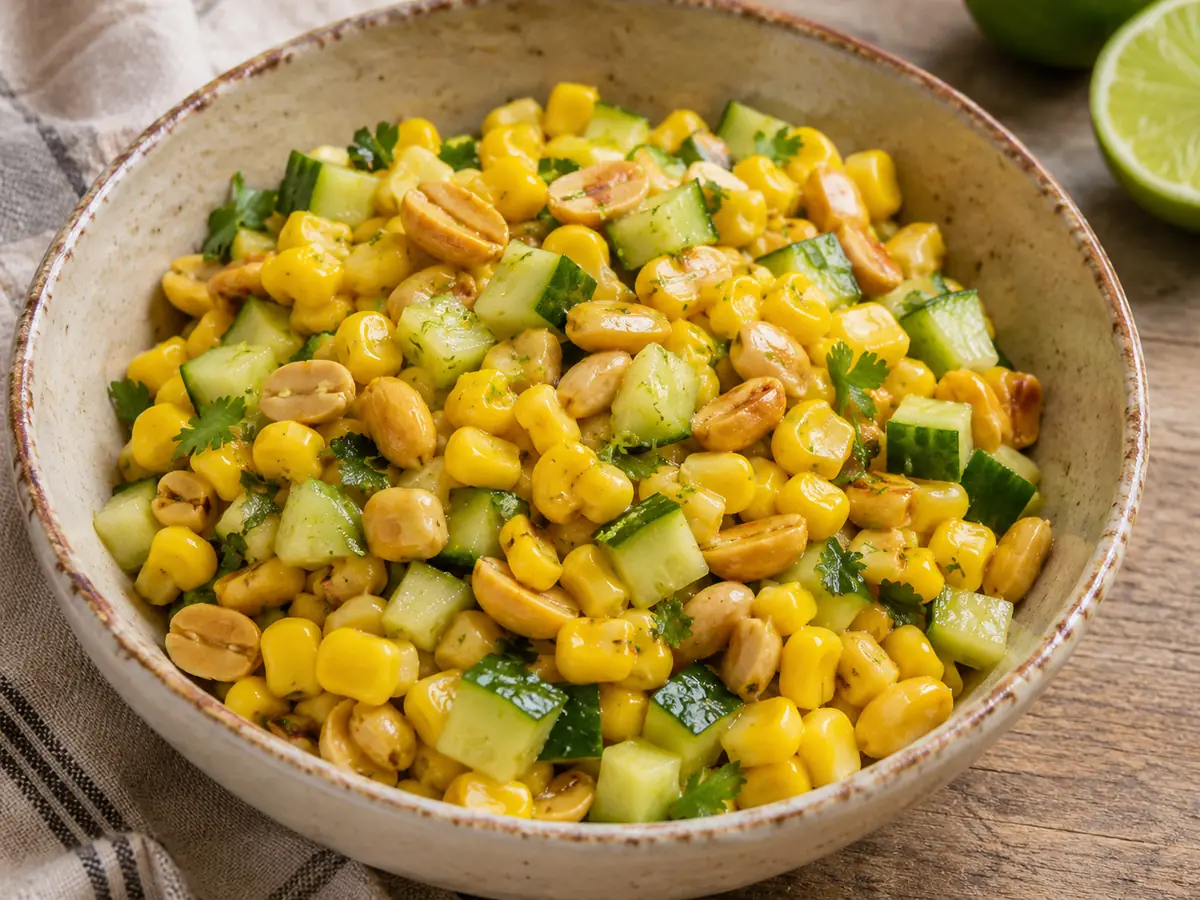
Ingredients
- 400 g canned sweetcorn, already cooked and drained
- 300 g raw cucumber with skin, edible part
- 150 g raw tomato, edible part
- 80 g raw onion, peeled weight
- 60 g roasted peanuts without added salt
- 10 g fresh coriander, washed and drained
- 20 g olive oil
- 25 g lime juice
- 2 g salt
Preparation
Drain the ready-to-eat corn and weigh 400 g kernels. Keep chilled in a clean covered container.
Wash and prepare 300 g cucumber with skin and 150 g tomato; cut into 1 cm dice. Finely slice 80 g peeled onion.
Wash, drain and weigh 10 g coriander. Reserve 2 g small leaves and chop the remaining 8 g.
Coarsely chop 60 g already roasted unsalted peanuts; keep them separate until serving.
Dissolve 2 g salt in 25 g lime juice, then whisk in 20 g olive oil.
Combine corn, cucumber, tomato with its juice and onion. Add dressing and the 8 g chopped coriander; lift gently to mix.
Divide among 4 plates. Add 15 g peanuts to each and distribute the reserved 2 g coriander leaves. Serve chilled.
Introduction
This salad combines the sweetness of ready-cooked corn with the freshness of cucumber and the crunch of roasted peanuts, called ginguba here. Tomato adds juice and colour; lime supports the whole without becoming a sharply acidic marinade. The appeal comes from contrasting textures, not a thick dressing that hides every ingredient. The quantities make 4 generous starter or side-dish portions. For a complete meal, plan the desired addition separately and include it in its own calculation.
No cooking is needed because the corn is ready to eat and the peanuts are already roasted, without added salt. This choice does not allow dry corn kernels or raw peanuts to be used directly: they would need different preparation. Fresh coriander is a weighed ingredient, not a decoration missing from the list. A small portion remains as leaves on top, while the rest joins the vegetables at the last moment.
Cultural context
The joint FAO/WFP report dated 6 August 2004 concerns agricultural production and food requirements in Angola at that time. It describes food crops and differences between production zones, among other matters. Here it provides historical context, not evidence that a family, province or community prepared this recipe. The combination of ingredients, proportions and preparation organisation belong to a contemporary editorial creation. A new recipe can engage with products used in Angola without being artificially given a traditional name. Context source: https://www.fao.org/4/j2771p/j2771p00.htm
Tips
Weigh corn after draining, not with its liquid.
Keep cucumber skin and cut evenly sized dice.
Weigh the 10 g coriander after washing and drying.
Add peanuts at the last moment to preserve crunch.
Taste a complete mouthful before adjusting the dressing.
Planning
Check that the corn is a ready-to-eat canned product. Open, tip into a sieve and drain carefully before weighing 400 g kernels. The packing liquid is not part of the salad. If rinsing is desired, rinse briefly with drinking water and drain again; a still-dripping sieve would dilute the dressing. Put the kernels in a clean covered container in the refrigerator while cutting the vegetables.
Choose a firm cucumber with intact skin and a ripe tomato that still holds together when cut. Wash before cutting, remove the cucumber ends and the hard tomato stalk attachment. Keep the cucumber skin, which is included in the reference food used. Weigh the edible portions after these removals. If the cucumber is very mature and spongy in the centre, choose another one rather than trying to compensate for excess water with more salt.
Cut cucumber and tomato into approximately 1 cm dice. Pieces of similar size distribute textures better in each mouthful. Keep the tomato juice released on the board and add it with the pieces; it forms part of the weighed 150 g. Slice the onion very finely to avoid large, overpowering pieces. The stated amount is 80 g net; do not use a whole onion of variable size without weighing it.
Wash the coriander and dry it gently before weighing 10 g usable material. Reserve 2 g small leaves for finishing and chop the remaining 8 g, including leaves and tender stalks. Discard large fibrous stalks before weighing. This division provides a visible garnish while distributing the aroma through the salad. Adding a large extra handful would alter the taste and actual weight served.
Check the peanuts: they should be already roasted, dry and free of any rancid smell. Chop them coarsely with a knife on a stable board without grinding them into powder. Uneven fragments a few millimetres across bring crunch; powder would absorb dressing and produce a pastier texture. Keep the 60 g separate until serving. Do not replace them with peanut butter, which would behave very differently in this salad.
In a bowl, dissolve the 2 g salt in the 25 g lime juice, then whisk in the 20 g oil. Pour over corn, cucumber, tomato and onion, then lift with two spoons without crushing the kernels. Fold in the 8 g chopped coriander. Taste some corn, a cucumber cube and dressing together: tasting only the juice at the bottom would give a misleading impression of acidity.
Immediately before presenting, divide the salad among 4 plates and distribute the peanuts evenly, 15 g per portion. Share the reserved 2 g leaves across the plates without adding an uncounted garnish. If serving is delayed, keep dressed vegetables, peanuts and finishing leaves separately, chilled or dry as appropriate to the product. This does not extend the vegetables' keeping time; it mainly preserves the contrasting textures.
Serving
Serve the salad chilled, using a spoon wide enough to collect kernels, vegetables and dressing together. It can accompany a hot dish or open the meal. Keep the peanuts visible so everyone can clearly identify the ingredient; do not conceal them in a dressing under another name. Divide the juice collecting at the bottom between portions without requiring anyone to drink it. Any bread, rice or other accompaniment is not included in this recipe. For transport, put the closed container in equipment that maintains refrigeration and add peanuts on arrival.
Storage
Keep prepared vegetables and salad covered at 4 °C or below. Consume within 24 hours, preferably assembling shortly before the meal to keep cucumber firm. Do not leave the bowl on a hot table for a long wait; take out only the amount to be served and return the rest promptly to refrigeration. Keeping peanuts separately dry preserves their crunch, but does not make badly stored salad acceptable. Discard a preparation exposed to a prolonged break in the cold chain rather than trying to rescue it with lime.
Variations
For less assertive onion texture, slice it even more finely or reduce its quantity, recording the change; lime does not replace cooking. Frozen corn would first need cooking and cooling as directed on its packaging, followed by weighing after draining. A different herb does not reproduce coriander's aroma and must be declared. If peanuts need to be excluded, prepare a separate salad with clean utensils; do not claim that removing the pieces after mixing is enough. Any nutritionally significant replacement requires an adjusted calculation.
Nutrition notes
Values are estimates per portion, calculated for 4 equal portions from edible weights and the stated reference foods. All added oil and salt are counted; accompaniments are excluded. Brands, draining, water content and cooking losses alter the results. If a reference lacks energy, the calculation uses 4 kcal/g for protein and carbohydrate, 9 kcal/g for fat and 2 kcal/g for fibre. These figures do not represent an analysis of the actual dish served and support no health promise.
Conclusion
Observing the texture of the ingredients and tasting the whole dish before changing the seasoning keeps the preparation clear. Time guides help organise the work; the actual condition of the food determines the final decision. This contemporary creation is not presented as an attested traditional recipe or as a formula tested in a kitchen.
Enjoy your meal
Enjoy your meal!