Maize and lime shortbread biscuits
These biscuits combine maize flavour and lime aroma in short, crumbly pastry.
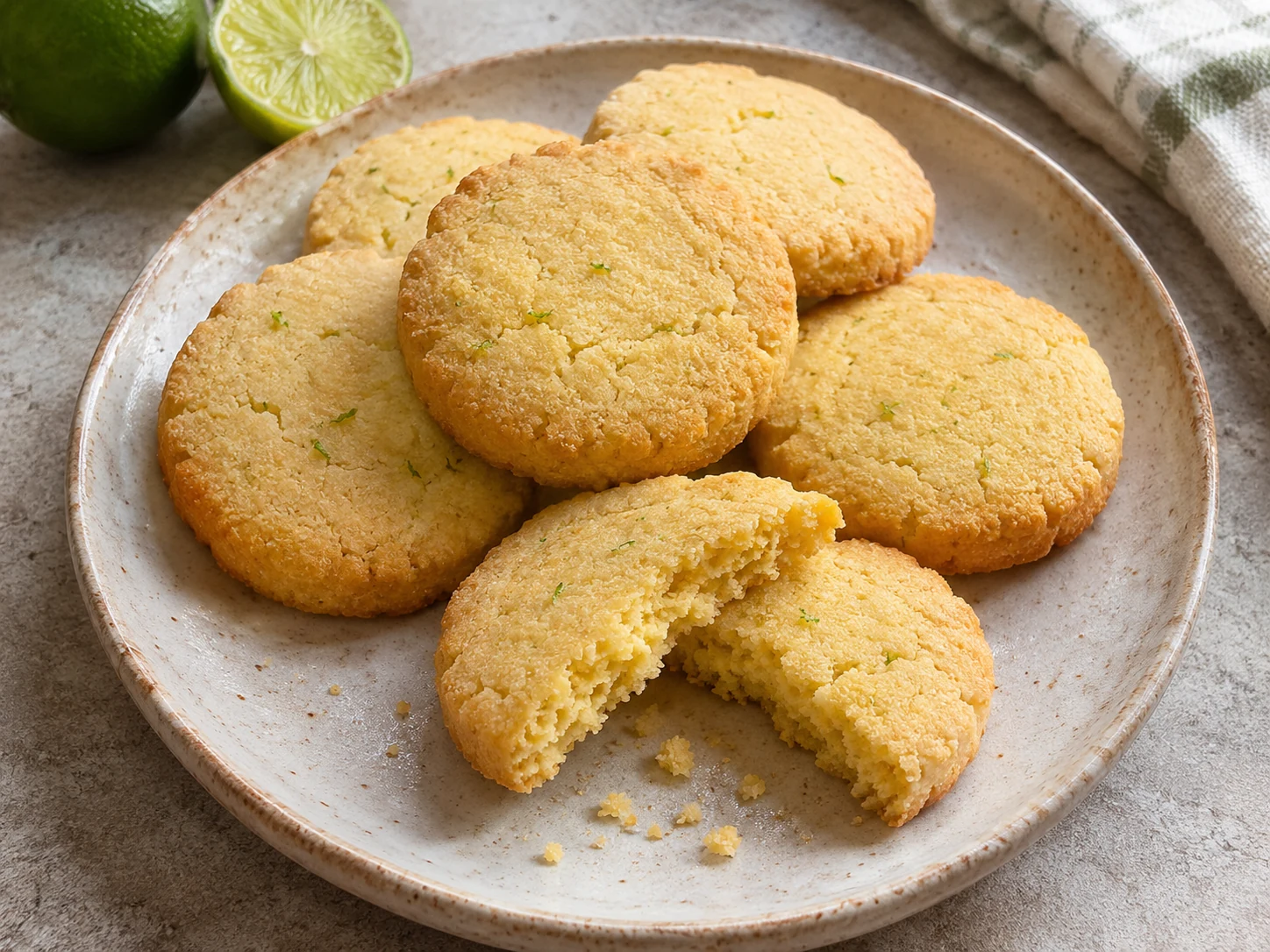
Ingredients
- 140 g fine food-grade maize flour
- 60 g T55 wheat flour
- 80 g cold unsalted butter
- 50 g beaten egg without shell
- 60 g sugar
- 15 g lime juice
- 2 g lime zest
- 1 g salt
- 1 optional pinch vanilla powder, excluded from calculation
Preparation
Mix both flours and 1 g salt. Wash and dry lime; take 2 g zest and measure 15 g juice.
Rub in 80 g diced cold butter. Distribute 60 g sugar and zest.
Incorporate 50 g beaten egg and juice. Press together without prolonged kneading.
Make a covered disc and refrigerate 30 minutes.
Roll to 5 mm between papers and form sixteen similar biscuits, about 5 cm wide. Put on a lined tray.
Preheat to 170°C and bake 14–18 minutes on the middle shelf until edges set and lightly golden.
Wait 5 minutes on the tray, transfer to a rack and cool about 20 minutes. Serve eight portions of two biscuits.
Introduction
These biscuits combine maize flavour and lime aroma in short, crumbly pastry. A little wheat flour and egg help them hold without removing their delicate texture. Butter remains prominent and lime juice is measured so pastry does not become liquid batter. The recipe gives sixteen biscuits, or eight servings of two. Keep this count explicit when reading nutrition values.
Maize flour is fine food-grade flour, not starch or coarse meal. The product contains wheat, egg and milk through butter; it is not gluten-free. This contemporary creation inspired by Angola is not presented as an attested traditional speciality or kitchen-tested recipe. Aim for set, lightly golden edges and a structure that firms when cool, not a biscuit hard straight from the oven.
Cultural context
Maize appears in Angola's agricultural context described by the FAO/WFP report. This informs flour choice but does not prove a history of lime shortbread. The embassy's official cultural page gives general background without validating our formula. The title describes ingredients and texture rather than tradition attributed to a community. Context sources: https://www.fao.org/4/j2771p/j2771p00.htm ; https://www.embassyangolatr.org/tr/angola/cultura
Tips
Grate only green peel to avoid excessive bitterness.
Weigh juice rather than pouring in a whole fruit.
Chilling often replaces unnecessary extra flour.
Move biscuits with a spatula after five minutes, not bare-handed straight from the oven.
The stated serving is two of sixteen biscuits.
Planning
Read the maize-flour package. Coarse milling can stay sandy under the teeth and require different hydration; precooked flour does not automatically give the same result. Weigh one hundred and forty grams maize flour and sixty grams plain wheat flour without raising agents. Combine in a dry bowl with one gram salt. No baking powder is used: the desired texture is short, not risen like a small cake.
Wash and dry lime. Choose fruit with skin suitable for culinary use. Remove only the thin coloured layer with a clean grater, avoiding bitter white pith. Weigh two grams of zest, then squeeze and measure fifteen grams juice, removing seeds. Fruit requirements vary. More juice is not simply more aroma: it introduces water and changes cohesion.
Dice eighty grams cold butter. Add to flours and rub with fingertips into even crumbs without melting it in palms. Add sugar and zest and distribute strands. Beat an egg separately and weigh fifty grams without shell. A very large whole egg would give more moisture than planned. Keep any remaining egg hygienically for another use instead of adding it for convenience.
Incorporate weighed egg and lime juice, then press gently to bring dough together. Kneading into an elastic ball is unnecessary and overworks wheat flour. Dough that holds under pressure may still have cracks at its edges. If very sticky because butter warms, cover and chill rather than dusting with much extra flour. Flatten into a disc, wrap and refrigerate thirty minutes.
Roll between two baking-paper sheets to about five millimetres thick. Remove top sheet and cut sixteen discs about five centimetres wide, bringing scraps together with light pressure. If the count differs, divide total weight into sixteen portions before flattening: quantity per portion matters more than strict diameter. Put on a lined tray with a little space. Do not taste raw scraps: flour and egg must cook.
Preheat oven to one hundred and seventy degrees. Bake on the middle shelf fourteen to eighteen minutes according to oven and thickness. Watch from fourteen minutes. Edges should set and lightly colour, while undersides release after the first rest. Very dark zest brings bitterness. If the tray heats unevenly, turn carefully near the end without moving fragile biscuits individually.
Leave five minutes on the tray out of the oven, then transfer with a broad spatula to a rack. Wait about twenty further minutes before judging crispness. A hot biscuit breaks readily and may appear insufficiently firm despite being cooked. Baking until completely hard often makes it too dry. If biscuits spread greatly, record butter temperature and chilling time for next batch. If centres remain doughy after cooling, reconsider thickness and cooking without hiding the problem under icing.
Serving
Serve two cooled biscuits per person with a customary drink. Use a dry plate to preserve bases. Zest aroma should be perceptible without icing sugar, which adds an uncounted amount. Fresh fruit may accompany them outside the calculation. For transport, wait until completely cold and separate with clean paper if needed. Do not fill a still-warm box: steam rapidly softens surfaces.
Storage
Store only after complete cooling in a clean dry box away from heat and humidity. Do not close with fresh fruit in the same box. Discard biscuits with mould or unusual smell. No fixed time applies in every home climate. For longer keeping, freeze cold protected biscuits, then thaw without enclosing them while still damp. Crispness may diminish.
Variations
An optional pinch of vanilla powder can complement lime; tiny, it is excluded from estimates. Replacing all wheat with maize requires reformulating the binder and does not guarantee the same hold. Another citrus changes aroma and must be declared. Darker maize flour may change colour without meaning burning. Smaller biscuits need earlier checking and a revised number per serving, not a new book recipe.
Nutrition notes
Values represent two biscuits, one eighth of dough. All butter, sugar and egg are counted. Lemon zest approximates lime zest where no specific reference is available; aroma cannot be deduced from that calculation equivalence. Accompaniments and optional vanilla are not included. No therapeutic effect is attributed to these biscuits.
Conclusion
Lightly worked dough and full cooling reveal the intended crumbliness. Recording thickness and timing is more useful than always pursuing darker colour. This contemporary creation remains an editorial proposal not tested in a kitchen. Enjoy your meal!
Enjoy your meal
Enjoy your meal!