Banana and ginguba parcels
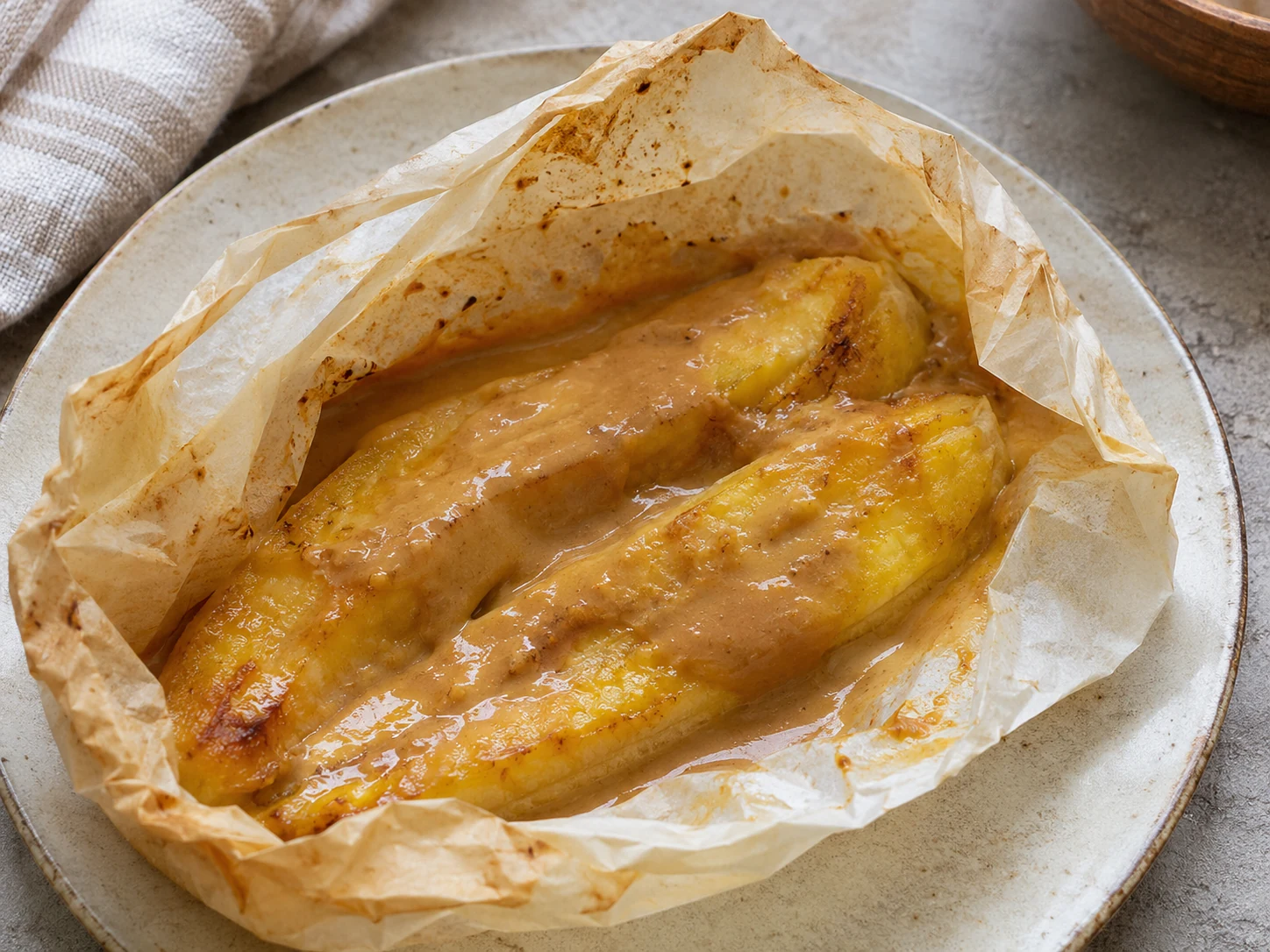
Ripe banana cooks in a baking-paper parcel with a little butter, lime and a small amount of sugar.
Ingredients
- 480 g ripe dessert banana flesh
- 40 g roasted unsalted ginguba
- 20 g unsalted butter
- 20 g sugar
- 15 g lime juice
- 20 ml water
- 1 optional pinch cinnamon, excluded from calculation
Preparation
Preheat oven to 180°C. Prepare four baking-paper sheets and a rimmed tray.
Peel and weigh 480 g banana; divide into four portions near 120 g. Open flesh slightly without cutting through.
Mix 15 g lime juice, 20 g sugar and 20 ml water.
Place portions on sheets. Divide the 20 g butter and lime liquid.
Close parcels with seams and ends upwards, leaving a little space inside.
Bake 18–22 minutes on the middle shelf until a point enters fruit easily. Chop ginguba meanwhile.
Wait 5 minutes, open carefully and distribute the 40 g ginguba. Serve four portions at a comfortable temperature.
Introduction
Ripe banana cooks in a baking-paper parcel with a little butter, lime and a small amount of sugar. Trapped steam softens fruit, while ginguba pieces are added after opening to preserve contrast. Serve this dessert hot but not scalding, in four portions. It does not seek a caramelised crust: a closed wrapper mainly produces moist cooking and fragrant juice.
Ginguba means peanut, here roasted and unsalted. Choose dessert banana, not green plantain, which would require different timing. This is a contemporary creation inspired by ingredients associated with Angola, without claiming an attested tradition. The editorial formula is not presented as kitchen-tested. The main point of attention is opening hot wrappers, which release steam.
Cultural context
The FAO/WFP report on Angola discusses food crops including banana and peanut. This documents ingredient choices, not the existence of this parcel dessert. The embassy's official cultural presentation provides further general context. Ginguba is retained and explained to identify the ingredient without attributing dessert to a particular region or ceremony. Context sources: https://www.fao.org/4/j2771p/j2771p00.htm ; https://www.embassyangolatr.org/tr/angola/cultura
Tips
Weigh peeled flesh rather than merely counting fruit.
Use paper actually intended for ovens and respect its maximum temperature.
Close ends upwards to retain the small amount of juice.
Add ginguba after cooking to retain distinct pieces.
Open with steam directed away from face and fingers.
Planning
Choose ripe bananas still firm enough to move without falling apart. Spotted skin is acceptable if flesh is sound, without fermented smell or mould. Peel and weigh four hundred and eighty grams total. Fruit sizes vary; four large bananas do not automatically equal the specified weight. If a banana is very long, halve it to fit paper without forcefully bending it.
Prepare four sheets of baking paper suitable for oven temperature, about thirty centimetres square. Do not use ordinary plastic wrap, printed wrapping paper or unfamiliar plant leaves. Material must be intended for food contact and cooking. Fragile paper can be doubled. Parcels sit on a rimmed tray, not directly on a heating element or flame. This recipe is for the oven, not improvised barbecue cooking.
Preheat oven to one hundred and eighty degrees with a middle shelf. Make a small opening in the flesh of each banana portion without cutting completely through, to hold butter. Divide twenty grams of butter into four small pieces. Measure lime juice and mix with twenty grams of sugar and twenty millilitres of water. Water distributes sugar without adding enough liquid to drown fruit.
Place a roughly one-hundred-and-twenty-gram portion centrally on each sheet. Add five grams of butter and one quarter of the lime mixture. Bring long edges above banana and fold several times, then close ends upwards. Leave some space inside for steam without compressing paper against all the flesh. A reasonably tight closure retains juice; it needs neither glue nor a metal staple hidden in dessert.
Arrange four parcels seam-side up on the tray. Bake eighteen to twenty-two minutes. Timing depends on fruit thickness and ripeness. Do not crush wrappers to inspect: hot liquid would escape. To check one, pull tray onto a stable support, use dry oven gloves and open a corner away from the face. A knife point should enter flesh easily while it retains an identifiable shape.
During cooking, chop forty grams of ginguba into small pieces. Avoid prolonged grinding that makes oily paste. Keep pieces in a dry bowl; distribute ten grams per portion after opening. Peanut is an allergen, as is milk in butter. Declare both at table and use clean utensils. Removing peanuts from an allergic person's plate does not make a contaminated preparation safe.
Rest parcels five minutes out of the oven, then open carefully with steam directed away from hands. Sugary juice stays hot even when paper seems handleable. Transfer fruit and juice to deep plates, or leave paper fully open on plates that support it. Divide ginguba and serve after checking a comfortable temperature. If juice burns following a leak, do not scrape it into sauce; extra sugar does not correct burning.
Serving
Serve one portion per person with a spoon for juice. Forty grams of ginguba are shared among four portions, with no implied extra. Ice cream may accompany it but adds its own ingredients, allergens and values and is not calculated. For children, transfer from paper and let cool sufficiently. Do not put a closed scalding parcel before someone unaware it contains steam.
Storage
Open remaining parcels to aid cooling, then transfer to a clean shallow container. Refrigerate at 4°C or below and consume within forty-eight hours. Keep peanut pieces separate if possible to preserve texture. Reheat needed portions only once until centres are thoroughly hot, then let cool to warm. Do not reuse soaked or torn paper for another cooking session. Cooked fruit may become softer after storage.
Variations
An optional pinch of cinnamon can join the lime mixture; tiny, it is excluded from the estimate. Cashews give a differently named variation without guaranteeing suitability for all allergies. Neutral oil instead of butter changes flavour and composition; declare this adaptation rather than making it silently. Very ripe banana needs earlier checking and gives a softer texture, not a portion that can be moved in the same way.
Nutrition notes
Values are estimated for one quarter of ingredients and include all butter, sugar and ginguba, including served juice. Banana brings natural sweetness without making added sugar invisible in calculations. Accompaniments and optional cinnamon are not counted. No medical effect or therapeutic benefit is associated with this dessert.
Conclusion
Tender flesh, unburnt juice and pieces added at the last moment are the intended criteria. Recording fruit ripeness and time helps adjust another preparation. This contemporary creation is not presented as kitchen-tested. Enjoy your meal!
Enjoy your meal
Enjoy your meal!