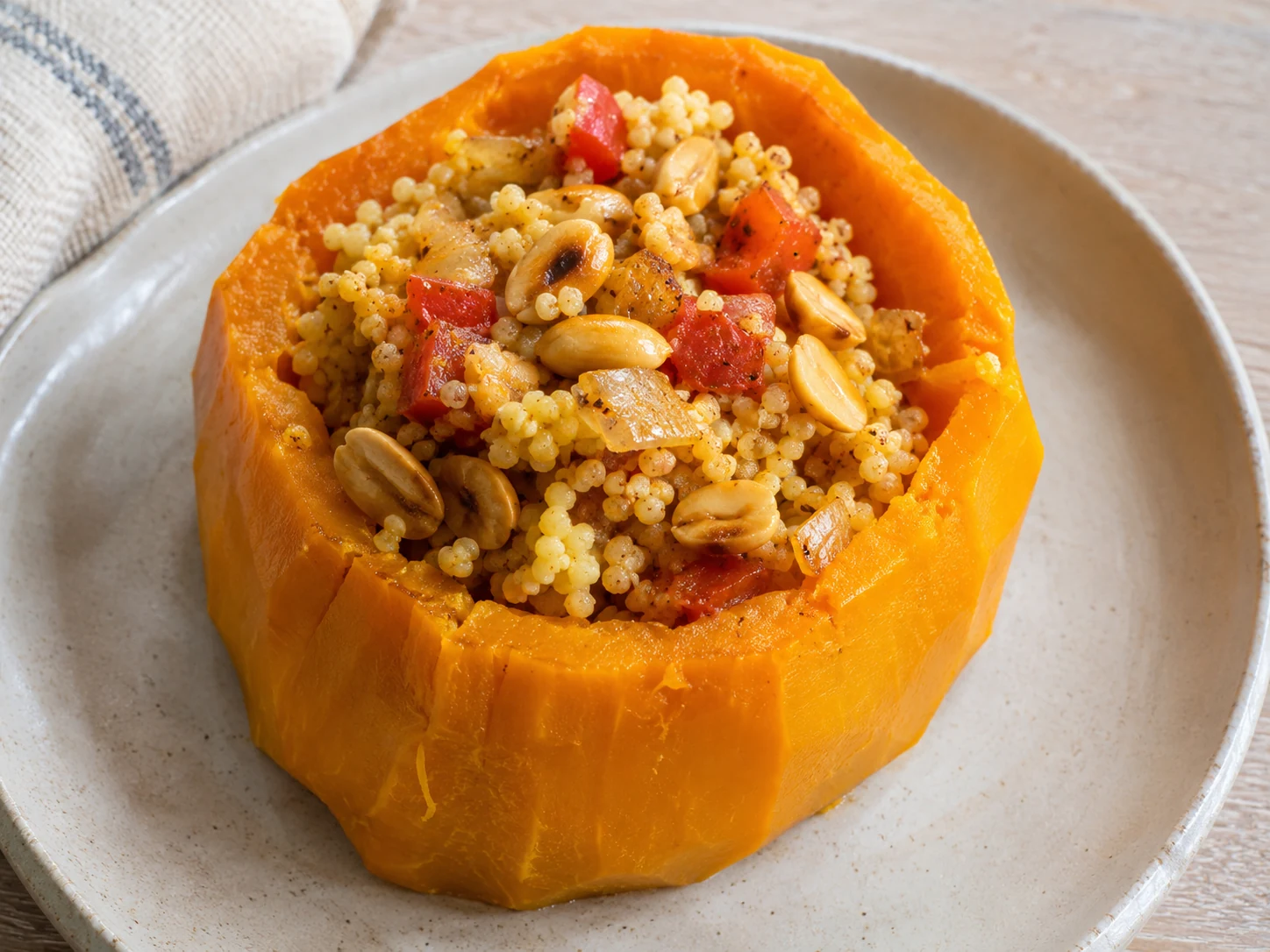
Pumpkin stuffed with millet and peanuts
Pumpkin is an edible support for a filling of already-cooked millet, tomato and peanuts.
Ingredients
- 900 g firm pumpkin flesh without rind or seeds, in four hollow pieces
- 180 g dry hulled millet grains
- 60 g roasted peanuts with no added salt
- 250 g plain crushed tomatoes
- 100 g onion
- 6 g peeled garlic
- 25 g peanut oil
- 400 ml water, adjusted to millet
- 3 g salt
- Optional pepper in a tiny quantity
Preparation
Prepare four stable hollow pumpkin pieces, then weigh 900 g flesh without skin or seeds. Preheat oven to 190 °C.
Coat with 10 g oil and roast about 30 minutes until tender but still holding.
Cook millet in water following its packet, often about 20 minutes, drain possible excess and let steam evaporate.
Soften chopped onion in remaining 15 g oil for 8 minutes. Add garlic for 1 minute, then tomatoes and reduce 10 minutes.
Scoop some roasted flesh without piercing supports. Mix it with cooked millet, tomato, salt and half the chopped peanuts.
Fill without packing and return to oven 15 minutes until fully hot in the centre. Pepper if desired.
Transfer with a wide slice, scatter remaining peanuts and serve hot.
Introduction
Pumpkin is an edible support for a filling of already-cooked millet, tomato and peanuts. Use four hollow pieces without rind or seeds, weighing their flesh before cooking. Millet does not swell raw inside the cavity: cook it separately, then mix with some roasted flesh. Filling stays grainy and soft, while peanuts give a crunchy finish. The proportions give four servings.
This is a contemporary creation inspired by grains, vegetables and peanuts used in Angolan diets. It claims neither attested tradition nor kitchen testing. Choosing similarly sized pieces helps more than seeking a perfect shape. Open wedges are suitable if their natural cavity receives filling and their base remains stable in the baking dish.
Cultural context
The FAO/WFP report on Angola places grains and peanuts in agricultural context. The embassy’s cultural page gives a general framework. These references document neither this stuffed pumpkin nor its proportions. Choosing a vegetable support and millet filling belongs to this contemporary creation, without provincial attribution or claim to attested tradition.
https://www.fao.org/4/j2771p/j2771p00.htm https://www.embassyangolatr.org/tr/angola/cultura
Tips
Weigh only flesh without rind or seeds.
Choose stable, sufficiently thick pieces.
Cook millet separately before stuffing.
Reduce excess tomato water.
Reserve half the peanuts for serving.
Planning
Allow nine hundred grams of firm pumpkin flesh in four hollow pieces, weighed without rind, seeds or fibres to discard. An unprepared whole pumpkin’s weight cannot directly support calculation. The cavity can follow the natural seed compartment; no deep bowl needs carving. Keep enough flesh on the base and sides for each piece to retain structure after cooking.
Prepare on a stable board, first cutting a supporting face if pumpkin rolls. Use a suitable knife and do not force towards the hand holding the vegetable. Remove skin, seeds and fibres, then weigh the edible part actually used. If the available pumpkin is much larger, reserve excess for another use rather than overloading four portions without changing filling quantities.
Use food-grade hulled millet grains, weighed at one hundred and eighty grams dry. Check packet instructions, since varieties and hulling alter water needs. The proposed four hundred millilitres are a starting point, not a universal rule. Millet flour possibly used as a nutritional proxy is not the culinary ingredient: it must not replace grains in this filling. Rinse only as instructed for the product.
Preheat oven to one hundred and ninety degrees. Set pumpkin pieces in a dish where they cannot tip and coat with ten grams of oil. Cook about thirty minutes until flesh yields to a knife tip but still holds. Remove thinner pieces earlier. The second baking mainly heats filling; flesh left hard may not soften during that brief stage.
While pumpkin cooks, bring water to a simmer in a saucepan and add millet. Partially cover and cook gently following the packet, often about twenty minutes. Grains must be tender without a hard core. Drain any free water, then let steam escape a few minutes in a dish. Very wet millet would make filling runny; correct excess before mixing rather than adding a thickener absent from the recipe.
Chop onion and garlic finely. Soften onion in remaining fifteen grams of oil for eight minutes, then garlic for one minute. Add crushed tomatoes and reduce ten minutes, stirring the base. Very watery tomatoes may take longer. The mixture should bind grains without a pool of juice beneath pumpkin pieces. Use plain tomatoes rather than an already-seasoned industrial sauce.
Spoon a little flesh from each roasted piece without piercing its base. Keep sufficient thickness for support. Chop this flesh and combine with cooked millet and tomato base. None is discarded: all flesh initially weighed remains in the dish. Add salt and half the coarsely chopped peanuts. Mix without crushing every grain and taste before filling.
Fill cavities without packing firmly; a slight dome is acceptable if it does not fall down the sides. Reheat fifteen minutes in the oven until thoroughly hot at the centre. Add remaining peanuts just before serving to keep them distinct. If surface dries too early, cover loosely for part of reheating. A wide slice supports hot pumpkin during transfer, since tender flesh can split under narrow tongs.
Serving
Serve one stuffed piece per person and divide any fallen grains among plates. Leaf salad or separately cooked greens complete the meal without inclusion in stated values. Do not pour much sauce over filling, which would lose its hold. At a multi-dish table, pieces can be divided after cooking with some filling retained in every portion. A spoon and fork allow eating both grains and all edible flesh of the support.
Storage
Cool remaining portions rapidly in shallow containers and refrigerate at 4 °C or below. Eat within forty-eight hours. Keep topping peanuts separate if not yet added. Reheat only once until thoroughly hot in the centre, protecting the top if needed. Millet may firm when cold; a small spoonful of water on filling limits drying without submerging pumpkin.
Variations
Another firm squash can suit, adjusting time to thickness. Cooked rice would make another recipe: absorption and structure differ from millet. Roasted pumpkin seeds can form a variation to rename and recalculate; they are not exact peanut equivalents. A tiny pinch of pepper is optional. Do not add dried beans inside expecting simultaneous cooking. For finer filling, chop peanuts more without turning them into a paste that would weigh grains down.
Nutrition notes
Pumpkin provides vegetables, millet the grain base, and peanuts protein and fat among other nutrients. Peanut is a major allergen to disclose. Estimates concern four servings without accompaniments. The flour proxy approximating millet-grain composition is a documented uncertainty; it changes neither the ingredient to purchase nor the need to cook grains before stuffing.
Conclusion
The intended result combines tender pumpkin, cooked-grain filling and crunchy fragments. Adjust times to actual pieces. This editorial formula is not presented as kitchen-tested. Enjoy your meal!
Enjoy your meal
Enjoy your meal!