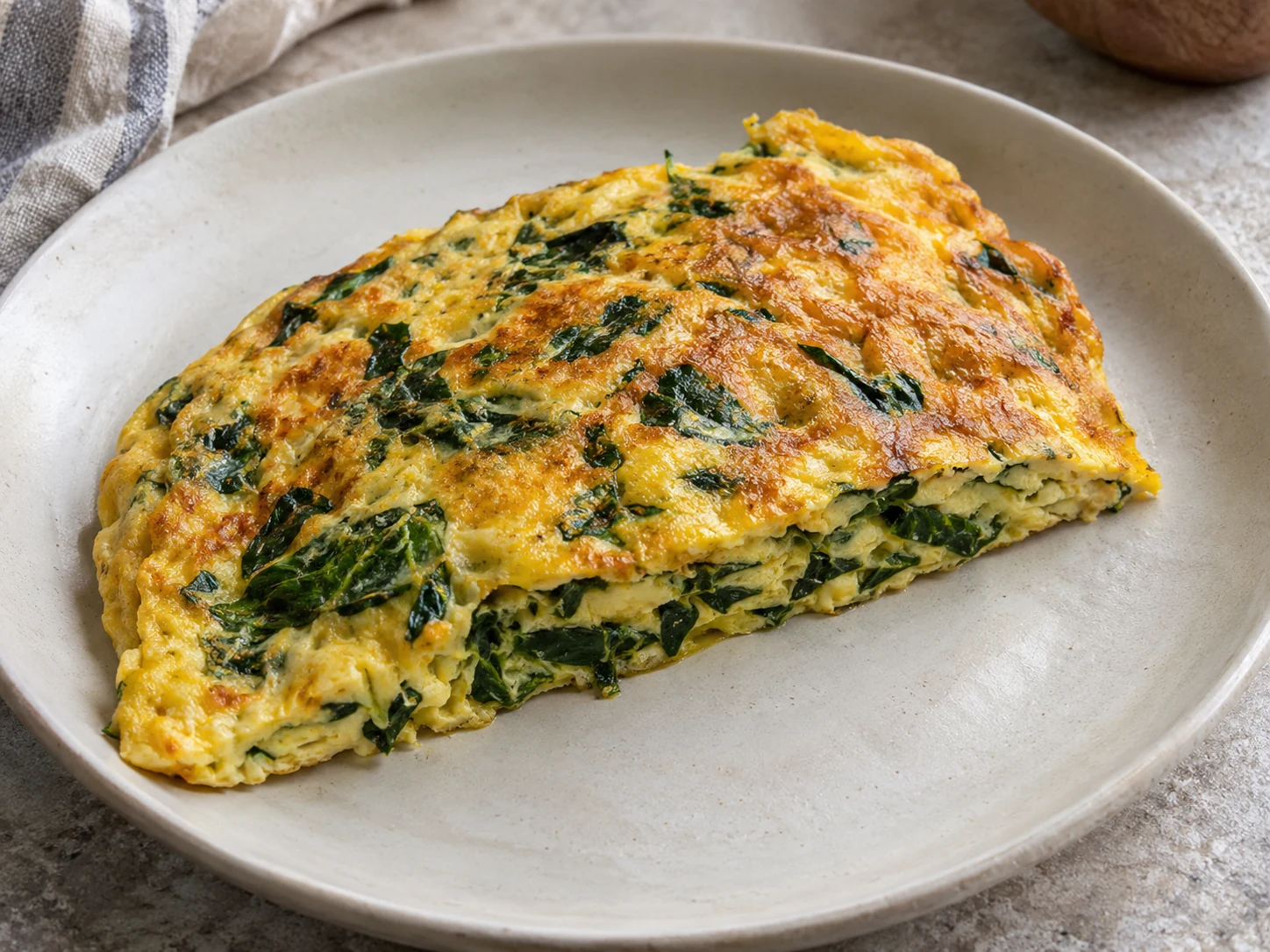
Spinach and coconut milk omelette
This thick omelette finishes in the oven for an even set without turning a large fragile mass.
Ingredients
- 8 medium eggs, about 400 g without shells
- 600 g trimmed fresh spinach
- 180 g unsweetened coconut milk
- 150 g onion
- 8 g peeled garlic
- 15 g sunflower oil, including 5 g for dish
- 2.5 g salt
- 1 optional pinch pepper
Preparation
Wash spinach thoroughly, drain, then cook covered in a large saucepan with residual water for 5 to 7 minutes until thoroughly hot and wilted.
Drain, press moderately, then chop spinach. Slice onion and chop garlic.
Preheat oven to 170 °C. Oil a 24 cm round dish with 5 g oil.
Soften onion in remaining 10 g oil for 8 minutes. Add garlic then spinach and heat another 2 minutes, stirring.
Beat eggs with coconut milk, salt and optional pepper. Incorporate vegetables without pouring them boiling hot onto eggs.
Pour into dish and bake at 170 °C for 20 to 25 minutes until completely set at centre. Check 71 °C with a clean thermometer if available.
Rest 5 minutes, cut into four and serve. For storage, cool quickly in portions, then refrigerate at 4 °C or below and eat within 48 hours.
Introduction
This thick omelette finishes in the oven for an even set without turning a large fragile mass. Spinach is cooked, drained and reheated with onion before meeting eggs; it is not merely hidden raw in a mixture that would remain wet. Coconut milk gives gentle roundness and replaces some liquid that milk might supply. It does not turn the omelette into a custard or a sweet preparation.
Eight eggs yield four main portions of two eggs each. Vegetable volume reduces greatly during cooking, but water must be controlled for the centre to set correctly. The aim is a supple, fully cooked slice that lifts easily without a pocket of liquid white. The twenty-four-centimetre round dish is part of the organisation: a narrower mould gives greater thickness and needs more time. A vegetable accompaniment or small bread portion remains a separate choice, outside calculation.
Cultural context
This contemporary creation is inspired by products and combinations of the Angolan table; it is not an attested traditional recipe. The proportions and method are an original editorial proposal, not presented as kitchen-tested. The institutional references below illuminate agricultural or cultural context without documenting this exact formula or assigning it a provincial origin.
https://www.fao.org/4/j2771p/j2771p00.htm https://www.embassyangolatr.org/tr/angola/cultura
Tips
Heat all spinach thoroughly before mixing.
Remove free water without drying it out.
Use a dish that keeps thickness reasonable.
Check centre is completely set.
Cool stored portions quickly at 4 °C or below, for no more than 48 hours.
Planning
Choose fresh eggs with intact shells, stored according to product instructions. Crack individually into a clean cup before combining in a bowl to spot shell fragments without searching the whole mixture. Eight medium eggs represent roughly four hundred grams without shells for estimation; actual weight may vary. Do not automatically compensate for a small difference with a whole extra egg, which would change proportions and number of portions. Wash hands after handling shells.
Sort spinach, remove large tough stems and weigh six hundred grams of usable leaves. Wash in several changes of water if necessary, lifting leaves to leave sand on the bottom rather than pouring all water back over them. Drain without trying to dry every leaf: residual moisture suffices for first cooking. Use a pan large enough for initial volume. Cover and heat for five to seven minutes, turning leaves; they must be thoroughly hot everywhere, not merely wilted on top.
Drain cooked spinach in a colander, let become manageable, then press moderately with a spoon or clean hands. The aim is to remove free water, not form a completely dry compact ball. Chop roughly to distribute leaves in each portion and avoid long strands when cutting. If green liquid accumulates in the bowl, drain before continuing. Excess water cannot simply be corrected by greatly extending egg cooking, which would eventually make eggs rubbery.
Use unsweetened coconut milk intended for cooking, not a flavoured drink or cocktail preparation. Stir can contents before weighing one hundred and eighty grams because fat may separate. Very light products or highly concentrated creams produce another texture; substitution must be declared. Coconut milk and eggs remain distinct ingredients: do not add extra cream to make the mixture thicker. Eggs are an allergen to declare.
Preheat oven to one hundred and seventy degrees. Choose a roughly twenty-four-centimetre round dish, shallow but with clearance above the mixture, and coat with five grams of oil. Soften sliced onion for eight minutes in remaining ten grams oil over medium heat without burning. Add garlic then chopped spinach and heat for two minutes, stirring to distribute aromatics. Remove from heat and let lose its burning heat for a few minutes while eggs are beaten.
Beat eggs just enough to combine whites and yolks without seeking a bulky foam. Incorporate homogenised coconut milk, two and a half grams salt and optional pepper. Then add warm or hot but not scorching vegetables, mixing quickly to prevent coagulation into small lumps before oven cooking. Distribute leaves evenly in the oiled dish. If they bunch in the centre, gently move with a fork rather than compacting everything. Surface level should remain reasonably even.
Bake for twenty to twenty-five minutes, then check centre. Edges often set before the middle; a coloured surface does not guarantee no liquid below. The middle must be set without raw egg flowing when slightly opened with a point. A clean food thermometer can confirm 71 °C at the centre without touching the dish bottom. If top colours too early, lightly shield and continue until completely cooked. The formula does not call for a runny centre; do not shorten cooking for that presentation.
Remove using dry oven gloves and rest five minutes on a heat-resistant surface. Resting eases cutting but does not replace centre cooking. Loosen edges with a flexible spatula, cut into four and lift each portion from below. Avoid turning the entire dish onto a plate while preparation is very hot and fragile. If a little moisture appears after resting, spoon it away rather than returning every portion to the oven for a long time.
Serving
Serve one portion per person with tomato or cucumber salad dressed separately. Bread or cooked cassava can supplement according to appetite, excluded from this recipe. Serve omelette hot or after controlled refrigerator cooling, not after a long room-temperature wait. For storage, separate portions in shallow containers and cool quickly; keep at 4 °C or below and eat within 48 hours. Reheat only once until thoroughly hot at the centre, or serve cold directly from correct storage.
Storage
Quickly divide leftovers among shallow containers, then refrigerate at 4 °C or below. Eat within 48 hours. Reheat the required quantity only once, until the entire portion is thoroughly hot at the centre. Do not keep the dish lukewarm in the saucepan for a long time.
Variations
Frozen spinach can be used after complete cooking according to packaging, then draining and adjusting weight; do not randomly replace six hundred fresh grams with the same weight of already-cooked product. Thicker leaves need longer preliminary cooking. For a thinner omelette, divide between two small dishes and check earlier without automatically retaining twenty-five minutes. Sweetened coconut drink is not a neutral alternative to culinary coconut milk. Adding cheese or meat changes the proposal, possible allergens and nutritional calculation.
Nutrition notes
Values are estimates per serving for four people, without the suggested accompaniments. Calculation uses the stated edible weights and Ciqual reference foods. All oil and salt are counted; water and very small optional amounts of pepper or gindungo are excluded. Brands, meat fat content, cooking losses and actual yield change the result. If energy is missing from the table, it is estimated using 4 kcal/g protein, 4 kcal/g carbohydrate, 9 kcal/g fat and 2 kcal/g fibre. Coconut milk is represented by a generic reference combining coconut milk and cream; actual product fat proportion may significantly change estimates.
Conclusion
Aim for a supple slice, evenly distributed leaves and a completely set centre. Serve after brief resting, then cool portions for storage quickly. Enjoy your meal!
Enjoy your meal
Enjoy your meal!