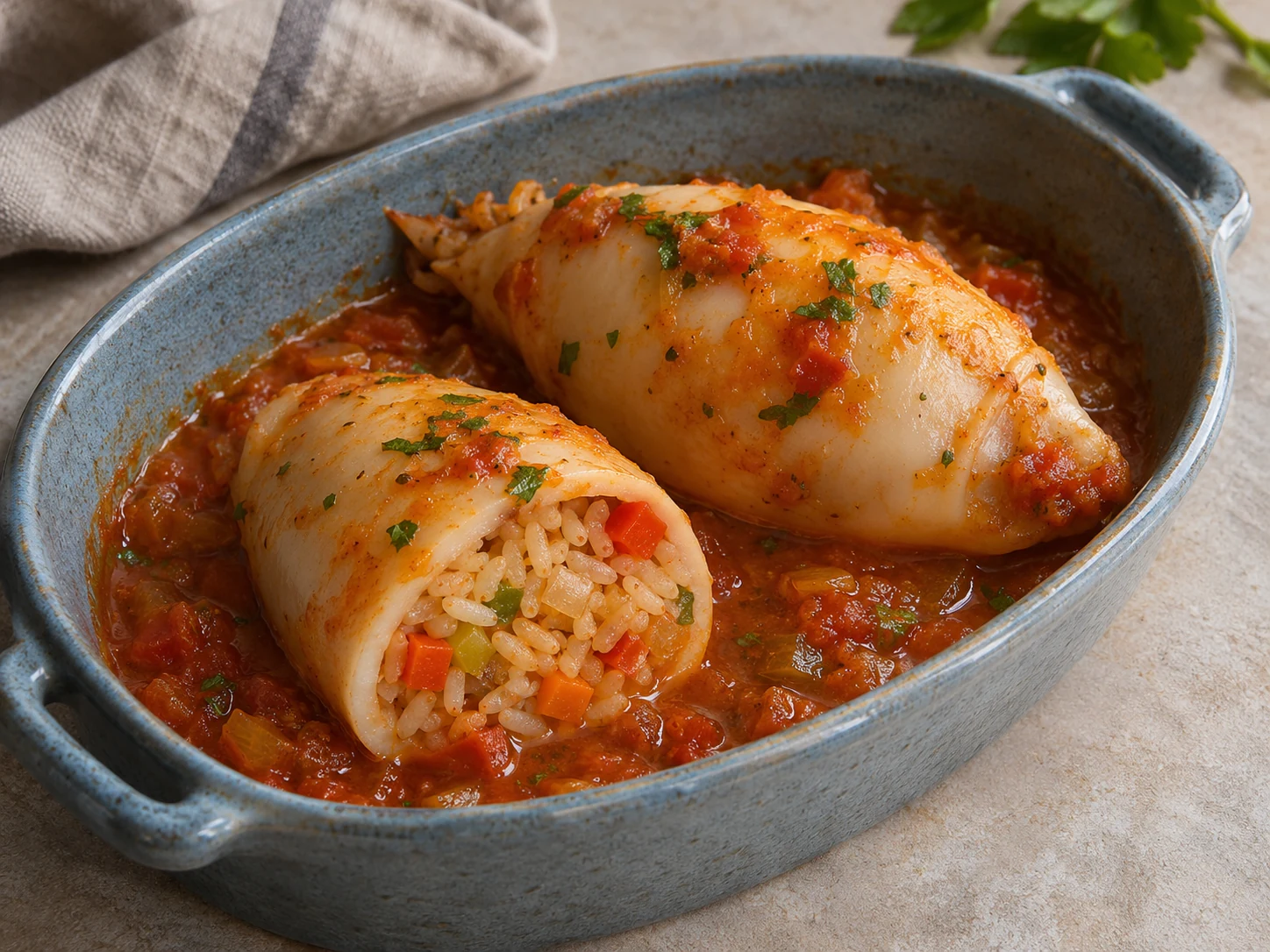
Squid stuffed with rice and vegetables
Squid bodies become little pockets for already cooked rice and softened vegetables.
Ingredients
- 4 cleaned raw squid bodies, 600 g edible total
- 160 g cooked unsalted white rice
- 100 g peeled carrot
- 100 g deseeded red pepper
- 120 g peeled onion, two 60 g portions
- 6 g peeled garlic, two 3 g portions
- 500 g tomatoes
- 20 g sunflower oil, two 10 g portions
- 200 ml water divided between filling and sauce
- 20 g lemon juice
- 10 g fresh parsley
- 2 g salt, two 1 g portions
- 1 minute pinch gindungo, optional
Preparation
Keep cleaned bodies chilled. Prepare precooked rice and finely dice carrot and pepper. Divide onion, garlic, oil and salt as stated.
Soften 60 g onion, carrot and pepper in 10 g oil with two spoonfuls of measured water around 10 minutes. Add 3 g garlic for 1 minute; mix with rice, half parsley and 1 g salt.
Soften remaining 60 g onion in 10 g oil 8 minutes. Add remaining 3 g garlic for 1 minute, tomatoes for 6, then remaining water and 1 g salt. Add gindungo if desired.
Fill four bodies no more than two-thirds without packing. Hold each with a pick leaving a slit; refrigerate excess filling.
Place in lightly simmering sauce and cook partly covered around 45–60 minutes or longer until tender, turning gently halfway and monitoring liquid.
Check at least 63 °C in the filling centre with a clean thermometer and fully cooked flesh. Reheat remaining filling in sauce if needed.
Remove four picks, add lemon and remaining parsley off heat, divide among four plates and serve.
Introduction
Squid bodies become little pockets for already cooked rice and softened vegetables. Long, gentle cooking in tomato sauce makes them tender. This differs from quick searing: grilled rings are not the aim, and cooking does not stop at the intermediate stage where flesh may remain firm. Filling is light and loosely packed to allow natural squid contraction.
This contemporary creation uses products of the Angolan table without claiming an attested family or regional recipe. Four portions each include one stuffed body, its vegetables and sauce. Rice is part of the formula and calculation. It is weighed cooked, not dry; confusing those states would create far too much filling.
Cultural context
This recipe is a contemporary creation inspired by ingredients from the Angolan table, not an attested traditional recipe. The references document the products and their context; they are not the source of the proposed formula. The proportions and method are an original editorial proposal. The institutional texts cited provide agricultural or cultural context and do not establish a traditional origin for this formula.
https://www.fao.org/4/j2771p/j2771p00.htm https://www.embassyangolatr.org/tr/angola/cultura
Tips
Use cleaned bodies weighed without inedible parts.
Rice must be precooked and handled without lengthy lukewarm waiting.
Fill no more than two-thirds without packing.
Close partly, never airtight.
Check tenderness, 63 °C centre and removal of all four picks.
Planning
Ask for four cleaned squid bodies of similar size, totalling six hundred edible grams. They must be whole, without major tears, with an opening wide enough for a teaspoon. Weight excludes innards, beak, eyes, pen and unused parts; tentacles are not added to this formula. The recipe starts with this prepared product. Have the seller check cleaning rather than using whole-animal weight that overstates the amount actually served.
Refrigerate bodies. After chilled thawing, drain, check inside with clean fingers and pat dry without forceful stretching. Prepare four small food-safe picks to hold the openings later. They are not intended to seal the pockets airtight. A small or damaged body can cook open with its filling in the sauce: abandoning the stuffed shape is better than forcing a closure that tears flesh.
Provide one hundred and sixty grams of already cooked unsalted white rice. Freshly made rice can be used after brief cooling for handling without burns. Advance-prepared rice must have been rapidly cooled and refrigerated, never left lukewarm for hours. Separate grains with a fork; they should be tender, not mush. Do not fill with raw rice expecting it to swell inside an almost closed pocket: volume and moisture would not be controlled.
Peel carrot and cut five-millimetre dice. Remove pepper seeds and white parts and cut equally finely. Slice onion and divide one hundred and twenty grams into two sixty-gram portions, one for filling and one for sauce. Chop garlic and divide equally. In ten grams of oil, soften onion, carrot and pepper over medium heat around ten minutes with two spoonfuls of measured water. Add half the garlic for one minute. Vegetables must soften before assembly, since a large raw carrot piece would stay hard in the centre.
Mix vegetables with rice, half the washed, dried, chopped parsley and one gram of salt. Let become just warm while preparing sauce, without lengthy room-temperature waiting. Filling should distribute in supple grains, not a compact ball. If wet, spread briefly in its container to release excess steam; do not add flour or bread that would alter texture and volume. Prepare separate utensils for cooked filling and raw squid.
In a sauté pan wide enough for four bodies, soften the other onion portion in remaining ten grams of oil for eight minutes. Add remaining garlic one minute, then diced tomatoes six minutes. Pour in the rest of the two hundred millilitres of water, allowing for spoonfuls already used for filling. Add remaining gram of salt and bring to a light simmer. Sauce should reach roughly halfway up bodies once installed; depth depends on the vessel, not just poured volume.
Fill each body no more than two-thirds full with a teaspoon, without pushing hard towards the bottom. Divide filling among four according to their actual capacity. If some vegetable rice remains, refrigerate then reheat in sauce near the end; it is already counted and should not be discarded for a more uniform photograph. Hold opening with a transverse pick, leaving a small slit. The pocket is neither stitched airtight nor tightened to compress contents.
Place bodies in sauce and partly cover. Maintain a very gentle simmer, not a violent boil that knocks them around. Cook around forty-five to sixty minutes, sometimes longer according to size, turning with two wide spoons halfway. Add small amounts of hot water if the base dries, without making soup. Check tenderness by gently piercing an area of flesh: it should yield without rubbery resistance. If still firm, continue gently rather than sharply raising heat.
Also check temperature in the filling centre with a clean thermometer inserted through the opening: it must reach at least sixty-three degrees, with fully cooked flesh. Edge tenderness alone or boiling sauce does not guarantee centre temperature. If that threshold is reached but flesh still resists, continue gentle cooking until tender while monitoring liquid. Do not press bodies to judge them, as filling would emerge and presentation be needlessly damaged.
Serving
Lift bodies with two spoons or a wide spatula and remove all picks before serving. Count them: four inserted, four removed. Add lemon juice and remaining parsley to sauce off heat. Divide one body and sauce per plate, with any extra reheated filling. Each pocket can be cut in half to show grains without crushing.
Since vegetables and rice are included, offer only a fresh salad if desired, outside calculations. Do not automatically add another rice portion. To work ahead, prepare sauce and filling separately, cool rapidly and refrigerate. Stuff near cooking time and adjust timing for a cold start, checking the centre. Do not leave raw filled pockets waiting long on the worktop.
Storage
Cool leftovers rapidly in a shallow container, refrigerate at 4 °C or below and eat within 24 hours. Reheat only once until thoroughly hot at the centre. Do not keep a portion that has stood at room temperature for a long time.
Variations
Different vegetables must be finely cut and precooked before entering bodies. Very watery courgette needs more water removed to avoid soaking rice. Corn kernels can replace some pepper but change nutrients and require recalculation.
Already cooked brown rice gives firmer filling; weight remains cooked-product weight with an adapted nutritional reference. Do not add raw egg to bind: this creation does not seek a moulded filling and it would change allergens, density and cooking checks. A minute pinch of gindungo may join sauce, optional and uncounted. Adjust lemon at the end without masking vegetable sweetness.
Nutrition notes
Estimated values per serving, excluding accompaniments. Calculated from edible weights and reference foods; brands, cooking and actual yield may change the results. All fats are counted in full. Where energy is not provided in the table, it is estimated from protein and carbohydrate (4 kcal/g), fat (9 kcal/g) and fibre (2 kcal/g). Optional spices in very small quantities are not counted. All added oil and salt are counted; water and optional spices in minute quantities are excluded. Moisture content can also change the nutritional intake. The filling’s 160 g cooked unsalted white rice is included; this is not 160 g dry rice.
Conclusion
Serve as soon as the described textures are obtained and adjust the final seasoning on the plate. This contemporary editorial creation is presented neither as an attested traditional recipe nor as a kitchen-tested formula. Enjoy your meal!
Enjoy your meal
Enjoy your meal!