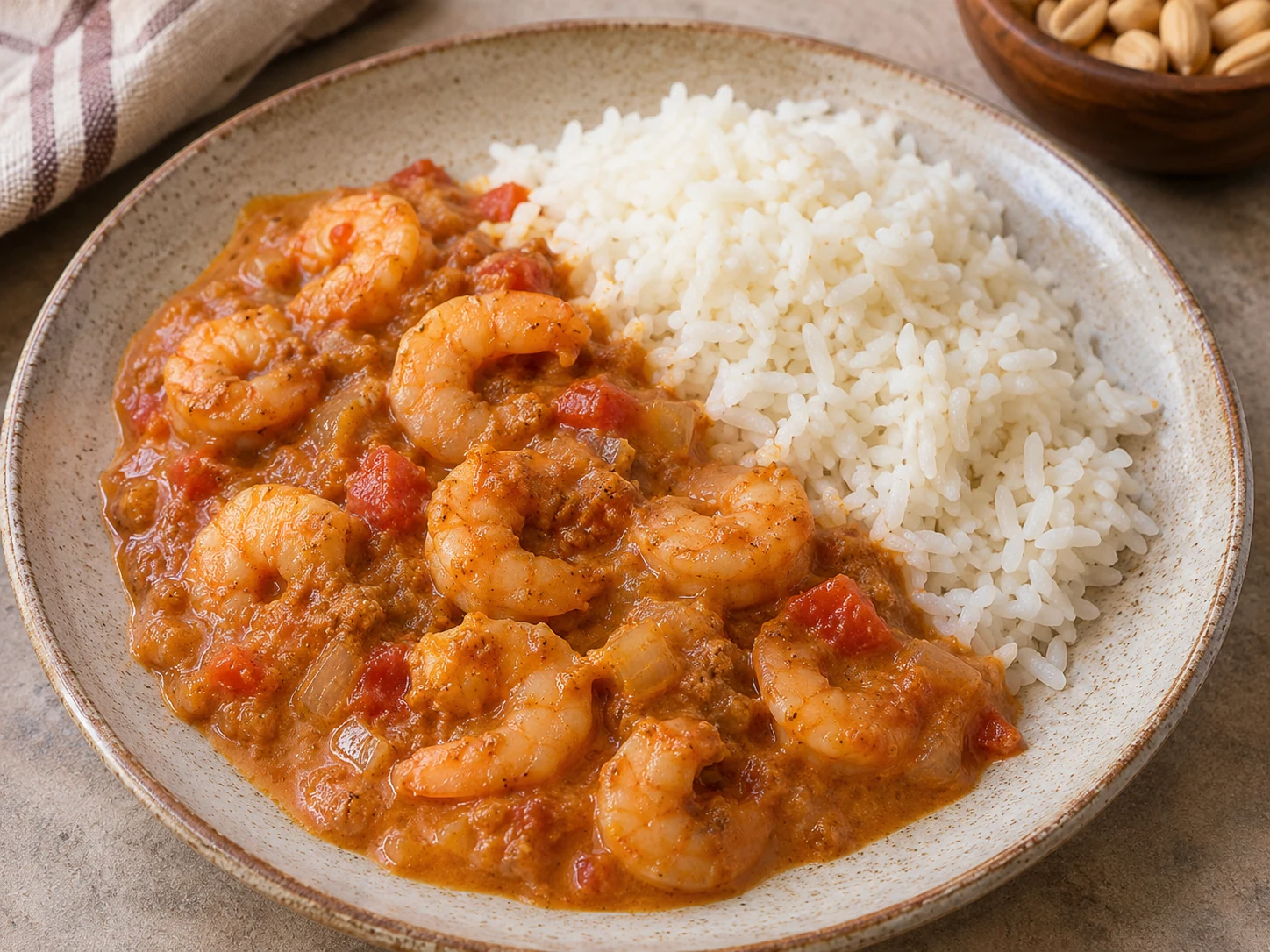
Prawns in ginguba sauce with rice
Here ginguba means peanuts, used as pure unsweetened paste to thicken tomato sauce.
Ingredients
- 600 g raw shelled, drained prawns
- 200 g raw white rice
- 80 g pure unsweetened unsalted peanut paste
- 250 g tomatoes
- 120 g peeled onion
- 6 g peeled garlic
- 10 g prepared fresh ginger
- 10 g sunflower oil
- 400 ml water for sauce
- 400 ml water for rice, adjusted to packet instructions
- 20 g lime juice
- 10 g fresh coriander
- 2 g salt
- A minute pinch gindungo, optional, separately
Preparation
Prepare aromatics and tomatoes. Keep prawns chilled. Soften onion in oil 8 minutes, add garlic and ginger for 1 minute, then tomatoes for 6 minutes.
Meanwhile cook the 200 g rice with its water around 15–18 minutes according to packet. Rest covered 5 minutes and fluff grains.
Loosen peanut paste with 100 ml warm water taken from sauce water. Stir into tomato, then add remaining 300 ml.
Simmer 8–10 minutes, stirring. Adjust texture with a little hot water or reduction before prawns.
Add prawns and cook gently 3–5 minutes according to size until the opaque centre is fully cooked; check 63 °C with a clean thermometer if possible.
Remove from heat, add salt, lime and coriander. Divide all rice, prawns and sauce among four plates and serve immediately.
Introduction
Here ginguba means peanuts, used as pure unsweetened paste to thicken tomato sauce. Prawns are added only once sauce has its texture; rice cooks separately meanwhile. Each plate therefore combines the three elements named in the title. Rice appears in ingredients and nutritional calculations, unlike an accompaniment merely suggested as an idea.
This contemporary creation inspired by the Angolan table claims no traditional moamba formula. Sauce should remain fluid enough to surround prawns and moisten rice without becoming compact paste. Lime brightens the finish and is measured after cooking. Four portions contain moderate rice and generous shellfish; no commercial stock is necessary.
Cultural context
This recipe is a contemporary creation inspired by ingredients from the Angolan table, not an attested traditional recipe. The references document the products and their context; they are not the source of the proposed formula. The proportions and method are an original editorial proposal. The institutional texts cited provide agricultural or cultural context and do not establish a traditional origin for this formula.
https://www.fao.org/4/j2771p/j2771p00.htm https://www.embassyangolatr.org/tr/angola/cultura
Tips
The 200 g dry rice is included in the calculation.
Choose pure ginguba paste and stir the jar.
Prepare sauce before adding prawns.
The dish contains peanuts and crustaceans.
Cool advance-prepared rice quickly and reheat only once.
Planning
Weigh two hundred grams of dry white rice before rinsing. Choose long-grain rice with absorption cooking instructions and adjust only water and timing to that product. The nutritional reference uses raw weight even though rice swells. Do not substitute two hundred grams of cooked rice while keeping the calculation. Rinse in a fine sieve if desired and drain; rinsing water is not included in the four hundred millilitres intended for cooking.
Provide six hundred grams of raw headless, shelled prawns, weighed drained. Refrigerate prepared products. After chilled thawing, check the visible intestinal thread and remove if needed with a small knife. Pat dry without crushing. Cooked prawns do not suit the same time and need only reheating at the end. Clean hands and utensils after raw handling before touching ready rice or finishing herbs.
Read peanut paste ingredients: choose pure product without added sugar or salt. If oil has separated, stir the jar before weighing eighty grams. Do not take only the dry sediment, which would make sauce hard to loosen. Sweetened spreading peanut butter changes flavour and nutrients. Peanuts are an allergen throughout the sauce; removing visible pieces would not make the dish suitable for someone who must avoid them.
Chop onion and garlic, grate prepared ginger and dice tomatoes. Use a sauté pan wide enough later to distribute prawns without a thick layer. Soften onion in ten grams of oil over medium heat eight minutes without dark colouring. Add garlic and ginger for one minute, then tomatoes for six. Stir the base; a spoonful of measured water can loosen initial juices if tomato lacks moisture.
During this stage, put drained rice and cooking water in a saucepan with a well-fitting lid. Bring to a simmer, reduce heat and cook around fifteen to eighteen minutes according to rice instructions, without constant stirring. Remove when water is absorbed and rest covered five minutes. Fluff with a fork. Do not leave lukewarm rice waiting all afternoon; organise sauce to finish at roughly the same time.
Take one hundred millilitres from the four hundred intended for sauce and warm it. In a bowl, loosen peanut paste by adding water gradually; it may thicken first before becoming smooth. Stir into tomato, then add remaining water. Maintain a gentle simmer eight to ten minutes, stirring the base regularly because peanut particles stick more readily than clear broth. Strong boiling is unnecessary and may splash thick sauce onto hands.
Check consistency before prawns. Sauce should run from the spoon in a broad ribbon and spread on its own across the pan base. If it forms a mass, add a spoonful of hot water, stir and reassess; do not pour a large glass at once. If too thin, reduce a few minutes now without shellfish. Thickening continues slightly on standing. Taste a cooled spoonful before prawns to judge balance without burning.
Distribute cold prawns in simmering sauce and turn gently to coat. Cook around three to five minutes according to size without vigorous boiling. The centre must become opaque and firm without toughening; a clean thermometer can confirm sixty-three degrees in a large piece. Do not prolong cooking to finish delayed rice. If needed, finish rice before adding prawns and keep briefly covered and hot. The two cooking processes should meet at serving, not wait together for long.
Remove sauce from heat once prawns are cooked. Add two grams of salt, lime juice and washed, dried, chopped coriander. Fold gently to preserve pieces. Some oil may appear on peanut sauce; that does not require boiling again. Taste before adding more lime because tomatoes already provide variable acidity. The finish must neither mask ginguba aroma nor make rice aggressively sour.
Serving
Divide all rice among four plates, then arrange prawns and sauce beside or partly over it. Preserve an area of separate grains rather than mixing everything into one uniform mass. Plain cooked green vegetables can complete the meal but are excluded from quantities and calculations. Do not automatically add bread since rice is planned already.
To prepare ahead, make sauce without prawns, cool rapidly and refrigerate. Reheat while stirring before cooking shellfish at the last moment. Rice is best made near mealtime; if prepared ahead, cool rapidly in a shallow layer, refrigerate, then reheat only once until thoroughly hot. Do not leave rice or prawns waiting in lukewarm sauce on the table.
Storage
Cool leftovers rapidly in a shallow container, refrigerate at 4 °C or below and eat within 24 hours. Reheat only once until thoroughly hot at the centre. Do not keep a portion that has stood at room temperature for a long time.
Variations
Chunky peanut paste gives a more rustic sauce; composition must stay pure and weight unchanged. Seed butter does not automatically eliminate allergy risk and changes nutrients, taste and title. This variation needs a separate calculation.
A minute pinch of gindungo may be offered separately, optional and uncounted. Brown rice needs its own water and longer cooking; start before sauce and change the nutritional reference. Replacing prawns with fish keeps neither time nor main allergen. Coriander may be omitted without adding lots of spices to compensate.
Nutrition notes
Estimated values per serving, excluding accompaniments. Calculated from edible weights and reference foods; brands, cooking and actual yield may change the results. All fats are counted in full. Where energy is not provided in the table, it is estimated from protein and carbohydrate (4 kcal/g), fat (9 kcal/g) and fibre (2 kcal/g). Optional spices in very small quantities are not counted. All added oil and salt are counted; water and optional spices in minute quantities are excluded. Moisture content can also change the nutritional intake. The 200 g raw white rice is included in these values, not excluded as an optional accompaniment.
Conclusion
Serve as soon as the described textures are obtained and adjust the final seasoning on the plate. This contemporary editorial creation is presented neither as an attested traditional recipe nor as a kitchen-tested formula. Enjoy your meal!
Enjoy your meal
Enjoy your meal!