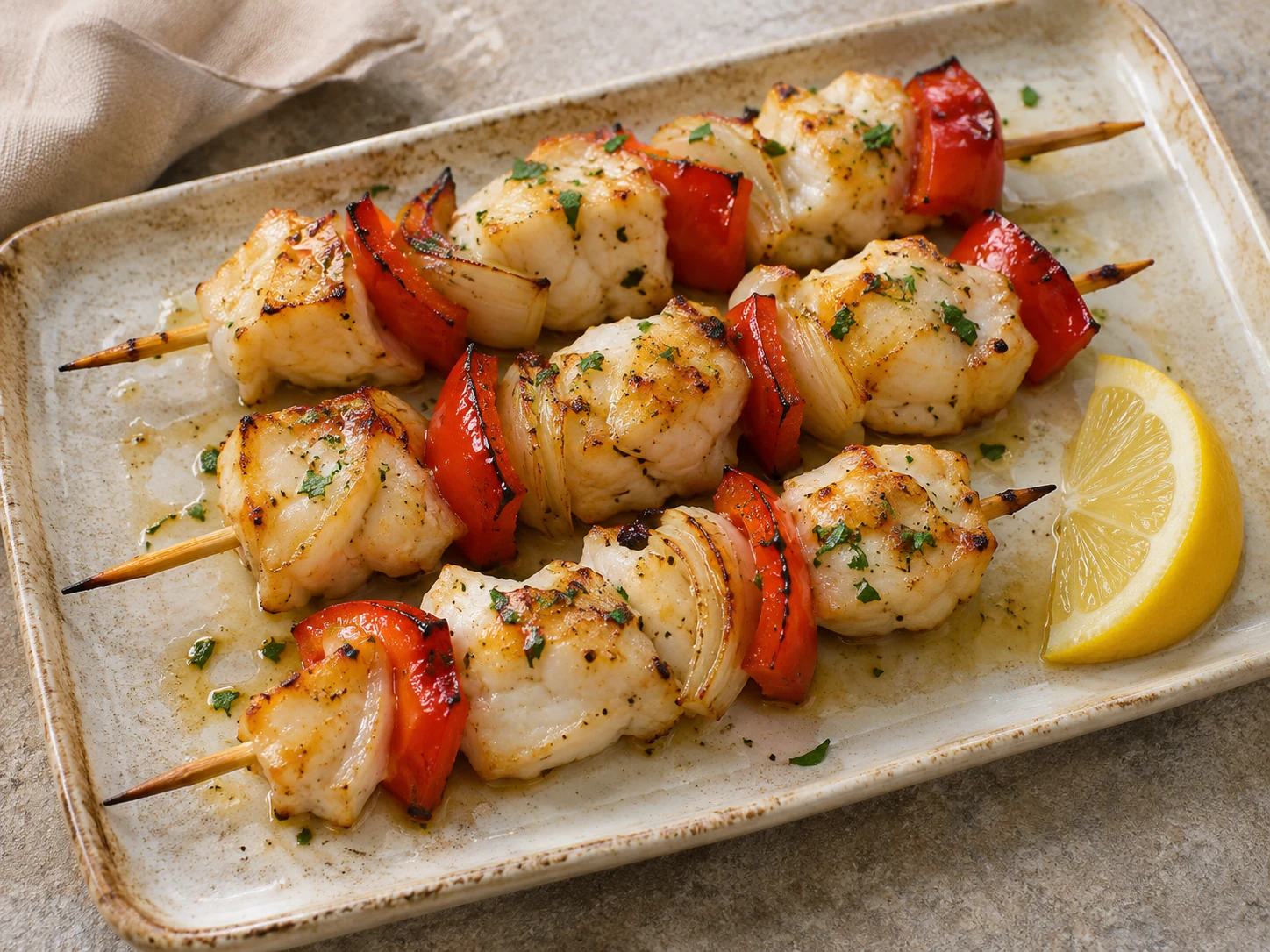
Fish skewers with lemon and ginger
These skewers combine firm fish cubes, onion and red pepper.
Ingredients
- 600 g prepared raw monkfish flesh
- 200 g deseeded red pepper
- 150 g peeled onion
- 20 g sunflower oil
- 20 g lemon juice
- 15 g prepared fresh ginger
- 6 g peeled garlic
- 10 g fresh parsley
- 2 g salt
- 1 minute pinch gindungo, optional
Preparation
Pat monkfish dry and cut into 3 cm cubes. Grate garlic and ginger. Reserve 5 g oil.
Mix fish, lemon, aromatics and 15 g oil; cover and marinate 15 minutes in the refrigerator.
Cut pepper into 2 cm squares and onion into thin pieces. Assemble eight skewers without packing tightly. Discard remaining marinade.
Season with the planned 2 g salt. Heat a griddle pan with reserved 5 g oil and cook around 8–12 minutes, turning every 2–3 minutes, in two batches if needed.
Check 63 °C at the centre of the thickest cube and opaque flesh. Place on a clean platter and serve immediately with parsley, taking care with hot skewers.
Introduction
These skewers combine firm fish cubes, onion and red pepper. A short lemon and ginger marinade flavours the surface without trying to transform the raw flesh. Monkfish is chosen for holding its shape; its weight means flesh stripped of skin and membranes. The aim is a juicy centre with lightly marked vegetables tender enough to eat with the fish.
This is a contemporary proposal inspired by products of the Angolan table, not a traditional grill attributed to a region. Lemon does not replace thorough cooking. Eight small skewers make four portions, two per person. Vegetables are cut to cook quickly; they must not require drying the fish while they remain thick and raw.
Cultural context
This recipe is a contemporary creation inspired by ingredients from the Angolan table, not an attested traditional recipe. The references document the products and their context; they are not the source of the proposed formula. The proportions and method are an original editorial proposal. The institutional texts cited provide agricultural or cultural context and do not establish a traditional origin for this formula.
https://www.fao.org/4/j2771p/j2771p00.htm https://www.embassyangolatr.org/tr/angola/cultura
Tips
Use firm flesh and remove membranes.
Marinate chilled for fifteen minutes, not several hours.
Do not pack pieces tightly on skewers.
Discard raw fish marinade.
Check 63 °C in the thickest cube without touching the skewer.
Planning
Ask for six hundred grams of prepared monkfish flesh without central bone, skin or elastic membrane. Remaining membrane contracts in heat and may bend cubes. Check the surface with clean fingers before cutting. If using another firm fish, ask about its ability to hold as cubes and adapt the title and nutritional reference. A very thin, fragile fillet is not a direct substitute: it would slip off the skewer before cooking finishes.
For frozen fish, allow complete refrigerator thawing before starting. Drain and pat thoroughly dry. Cut roughly three-centimetre cubes with a sharp blade to avoid tearing edges. Pieces should have similar thickness but need not be perfectly shaped. Set small irregular scraps aside for another use rather than compressing them onto a skewer. Keep cubes covered and chilled until marinating.
Peel ginger and grate very finely. Weigh fifteen grams of prepared flesh excluding discarded dry pieces. Grate garlic and squeeze lemon. Mix aromatics with fifteen grams of oil, reserving five for the pan. An even marinade adheres better than one in which large ginger threads concentrate on a single portion. Salt will be distributed just before cooking to control each skewer and avoid forgetting vegetables.
Gently mix fish with marinade in a clean container, cover and refrigerate fifteen minutes. This brief time adds aroma without lengthy acidic soaking. Several hours may whiten and firm the surface without making the centre safe. Do not marinate at room temperature. Meanwhile, prepare vegetables and skewers on another clean area so ready-to-serve ingredients do not enter raw fish juices.
Remove pepper seeds and white parts, then weigh two hundred grams of flesh. Cut roughly two-centimetre squares. Peel onion and separate pieces of two or three layers, thinner than fish cubes. A large onion half would remain hard. If vegetables are particularly firm, soften two minutes in a small pan of simmering water, then drain well and cool before assembly. This water is excluded from nutritional ingredients.
Prepare eight skewers suitable for the pan. Metal skewers require protective handling; their ends become as hot as the food-carrying part. For wooden skewers, follow their instructions and avoid direct flame contact. Their length must fit in the pan without preventing food touching its base. An overly long skewer resting on the edges leaves fish suspended above the heat.
Thread fish, pepper and onion alternately, leaving very slight gaps. Do not pack tightly: compressed faces receive less heat and are harder to check. Divide cubes among eight skewers rather than making some very large and others nearly empty. Drain excess marinade and discard liquid that touched raw fish; do not retain it as a cold sauce. Salt skewers with the planned two grams just before cooking.
Heat a large griddle or heavy frying pan over medium-high heat and distribute the reserved five grams of oil. Cook in two batches if necessary to retain clear contact. Gently turn every two or three minutes using tongs and a spatula if fish resists. Allow around eight to twelve minutes total according to thickness. Lower heat slightly if vegetables blacken before the fish centre cooks; excessive heat does not properly shorten internal cooking.
Check the thickest cube with a clean thermometer inserted from the side without touching the skewer: it must reach sixty-three degrees. Flesh becomes opaque and separates easily without a glassy centre. Colour on one face is insufficient. If some skewers finish earlier, remove to a clean platter, never the marinade container. Handle carefully to avoid burns from skewers. Do not extend cooking just for darker marks.
Serving
Place two skewers on each plate and add washed, dried, chopped parsley. Warn that skewers may be hot; for young diners, remove food from the skewer before presenting. Tomato salad or plain rice can accompany according to appetite but are excluded from quantities and nutritional estimates. Avoid a further very acidic sauce that would mask the marinade’s measured balance.
To organise the meal, cut vegetables ahead and keep separately chilled. Marinate and assemble only near cooking time. Keep raw skewers covered in the refrigerator until the last moment. Prepare the clean serving platter before heating the pan. Cooked leftovers come off skewers more easily once slightly cooled; removing them before storage helps even reheating and avoids handling a long hot skewer.
Storage
Cool leftovers rapidly in a shallow container, refrigerate at 4 °C or below and eat within 24 hours. Reheat only once until thoroughly hot at the centre. Do not keep a portion that has stood at room temperature for a long time.
Variations
A different firm fish gives another flavour and requires checking time and edible weight again. Prawns do not automatically replace monkfish cubes: they change the allergen, time and assembly shape. Pepper may be another colour if pieces remain thin.
For a slightly spicy version, add a minute pinch of gindungo to the marinade without replacing ginger with chilli. This optional amount is not counted. Parsley may be omitted. Do not add honey or sugar to the hot pan for artificially quick colour: it would burn without indicating fish doneness and change the formula.
Nutrition notes
Estimated values per serving, excluding accompaniments. Calculated from edible weights and reference foods; brands, cooking and actual yield may change the results. All fats are counted in full. Where energy is not provided in the table, it is estimated from protein and carbohydrate (4 kcal/g), fat (9 kcal/g) and fibre (2 kcal/g). Optional spices in very small quantities are not counted. All added oil and salt are counted; water and optional spices in minute quantities are excluded. Moisture content can also change the nutritional intake.
Conclusion
Serve as soon as the described textures are obtained and adjust the final seasoning on the plate. This contemporary editorial creation is presented neither as an attested traditional recipe nor as a kitchen-tested formula. Enjoy your meal!
Enjoy your meal
Enjoy your meal!