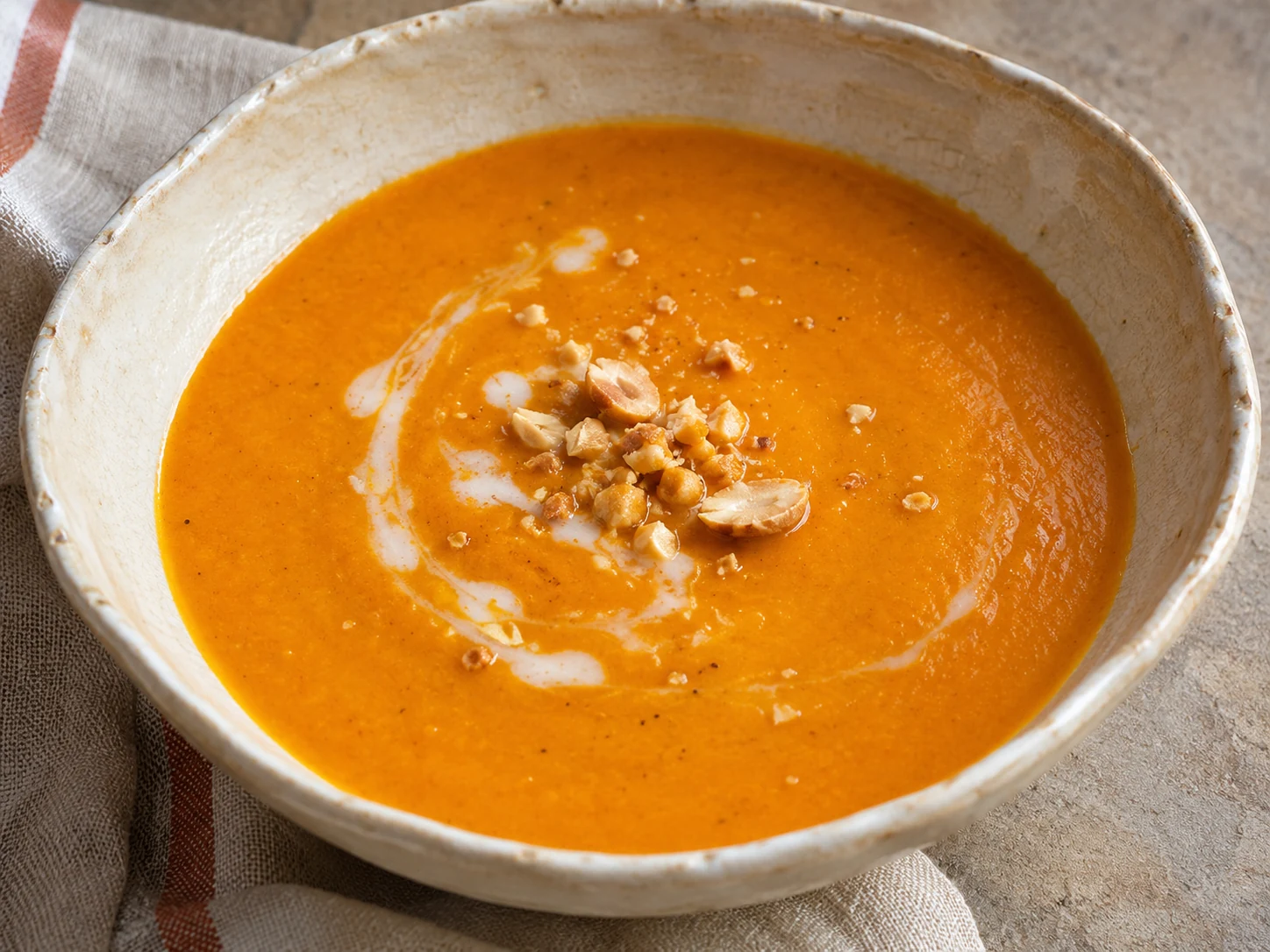
Carrot soup with coconut milk and ginguba
Very tender carrots, pure ginguba paste and coconut milk make a smooth soup softened without added sugar.
Ingredients
- 700 g prepared carrots
- 150 g onion
- 10 g garlic
- 10 g fresh ginger
- 60 g pure unsweetened peanut paste
- 200 g unsweetened coconut milk
- 15 g olive oil
- 900 ml water
- 20 g lime juice
- 3 g salt
- 1 optional pinch of pepper
Preparation
Wash and prepare carrots, weigh 700 g and cut 1 cm rounds. Slice onion, chop garlic and grate ginger. Stir coconut and peanut container contents before weighing.
Sweat onion in oil 8 minutes. Add garlic and ginger 1 minute, then carrots 2 minutes. Pour in 800 ml water, reserving 100 ml.
Simmer partly covered for 20–25 minutes until a blade passes through the largest round without resistance.
Dilute ginguba paste with the reserved 100 ml warmed water. Stir into carrots and cook gently 5 minutes, stirring the bottom.
Switch off and carefully blend until smooth. Add coconut milk, salt and optional pepper. Heat gently 3 minutes without a vigorous boil.
Adjust fluidity with water if needed. Add lime off heat, taste and divide between four bowls.
Introduction
Carrot provides this soup’s colour and sweetness; coconut milk rounds it out and ginguba adds a noticeable peanut flavour. The three should not compete. Paste quantity remains moderate to preserve soup rather than thick sauce. Ginger adds discreet fragrance while lime is adjusted after cooking. The result should lightly coat a spoon and pour easily into four bowls.
This is a contemporary creation inspired by products used in Angola, not a transcription of a documented traditional soup. Ginguba here means peanut in pure unsweetened paste form. This allergen’s presence must be announced even when final texture no longer shows seeds. Soup may open a meal or make a light lunch with a separate accompaniment. Garnishes and bread are included neither in quantities nor nutritional estimates.
Cultural context
Angola’s embassy in Türkiye mentions ginguba among Angolan table products. The 2004 FAO/WFP report provides food-crop context. These references situate ingredients; neither proves this carrot, coconut and peanut soup’s historical existence. Proportions, blending and citrus finish are contemporary editorial choices. Context sources: https://www.embassyangolatr.org/tr/angola/cultura and https://www.fao.org/4/j2771p/j2771p00.htm
Tips
Check ginguba paste’s ingredients.
Make all rounds tender before blending.
Dilute paste separately to avoid clumps.
Keep blender submerged to limit splashes.
Clearly declare the peanut allergen.
Planning
Choose firm carrots without soft or slimy areas. Wash, remove ends and peel if necessary, then weigh seven hundred grams of usable part. Fine skin may remain if thoroughly cleaned. Cut even rounds about one centimetre thick. Very thick carrots are first halved lengthwise. Regularity matters for blending: a large, still-firm round will not become smooth simply because the rest is tender.
Choose paste containing only peanuts, with no added sugar, salt or oil. If the jar has separated, stir all paste before weighing sixty grams; taking only the upper layer gives too much fat and little substance. Smooth paste facilitates results, but paste with very small pieces works with an effective blender. Discard anything smelling rancid. Coconut milk must likewise be unsweetened and intended for cooking, not a flavoured drink.
Stir coconut milk in its container to reunite thick part and liquid before weighing. The formula uses two hundred grams. Very concentrated coconut cream produces different fluidity; read the label and choose milk to follow proportions. The nutritional estimate nevertheless uses Ciqual’s combined milk-and-cream reference: this is a proxy whose actual concentration may differ. This limitation is not corrected by arbitrarily adding water in calculations.
Prepare onion, garlic and ginger before heating the pan. Slice onion, chop garlic and grate ginger finely. Sweat onion in oil without strong colouring until soft. Garlic and ginger then heat one minute, not longer alone on a dry base. Add carrots, turn and pour in water. The pan needs enough headroom for coconut milk later and stirring without overflow.
Reserve one hundred of the nine hundred millilitres for diluting ginguba. Simmer carrots in the other eight hundred, partly covered, for twenty to twenty-five minutes. A blade should pass through the thickest round without resistance. If the bottom becomes exposed first, add a little hot water and note the changed final quantity. Do not trust colour alone: carrots stay beautifully orange even when too firm for smooth soup.
Dilute peanut paste with reserved warmed water in a bowl. Paste may first tighten, then loosen as liquid is incorporated. Mix until homogeneous and pour into tender carrots. Cook gently five minutes, stirring the bottom, then switch off and blend with the head submerged. With an enclosed blender, follow its hot-liquid directions and work in small batches. Stir in coconut milk, return to gentle heat three minutes and adjust fluidity. Lime goes in off heat after an initial taste.
Serving
Pour into four preheated bowls, stirring the pan before each serving for even texture. Serve without further reduction: peanut paste keeps thickening slightly during rest. Fresh salad or separately cooked vegetables complement the meal. Avoid loading extra cream or peanuts on top without counting them. Inform guests of peanuts before serving and do not present perfectly smooth soup as suitable for this allergy.
Storage
Cool promptly in shallow containers, keep at 4 °C or below and consume within 48 hours. Reheat the needed portion only once, stirring until thoroughly hot in the centre. Loosen with a little water if thickened, then adjust salt only after tasting. Do not let soup stand all evening in a lukewarm pan.
Variations
Replace some carrot with firm squash and adapt tenderness checks. For less pronounced aroma, reduce ginger in another preparation rather than trying to remove it after blending. Sunflower-seed purée makes a different soup and is not safe for every allergy; check the guest’s situation separately. Sweet peanut spread is not equivalent: it changes taste and nutritional calculations.
Nutrition notes
Carrots, coconut and peanuts contribute respectively carbohydrate, fat and some protein without constituting a medical promise. Per-serving estimates use edible weights, exclude accompaniments and count all oil. Brands, cooking and yield may alter results. Optional tiny spices are excluded. If energy is absent, protein and carbohydrate count 4 kcal/g, fat 9 kcal/g and fibre 2 kcal/g. The “coconut milk or cream” reference is a proxy for the chosen unsweetened milk; concentration may differ.
Conclusion
Aim for a homogeneous, pourable texture with carrot foremost and ginguba clearly recognizable in flavour. Tenderness before blending and diluting paste are more useful than prolonged blender time. This editorial formula is not presented as kitchen-tested.
Enjoy your meal
Enjoy your meal!