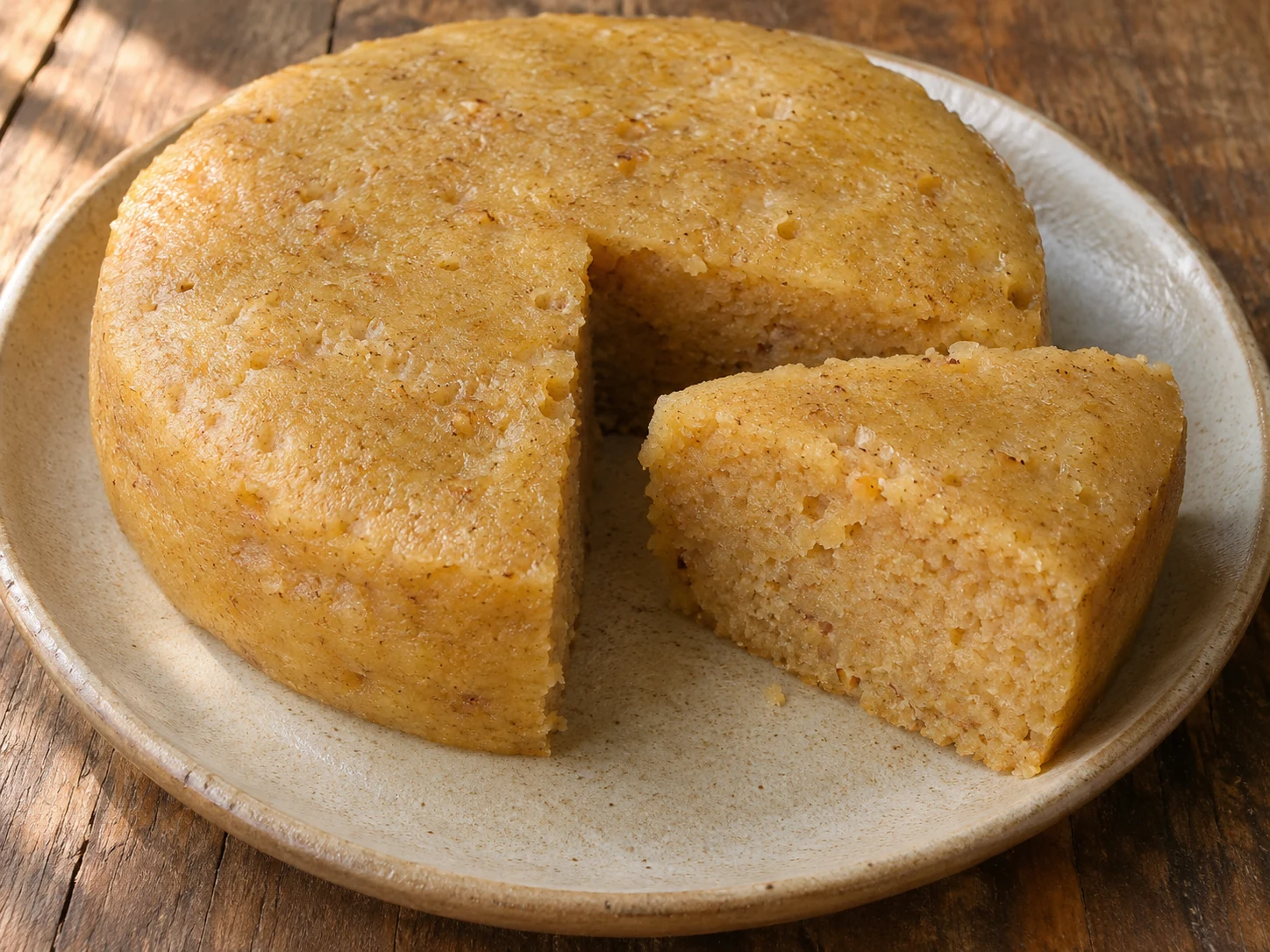
Steamed banana and ginguba cake
This soft cake combines ripe banana, ginguba pieces and a batter raised with baking powder.
Ingredients
- 250 g ripe banana flesh
- 160 g T55 wheat flour
- 60 g roasted unsalted ginguba, chopped
- 100 g eggs without shells, about 2 medium eggs
- 50 g sugar
- 40 g sunflower oil, including 5 g for the tin
- 6 g baking powder
- 1 g salt
- Water for the pot, without contact with the cake
- 1 optional pinch cinnamon, excluded from the calculation
Preparation
Fit a stable rack inside a pot; add water below the rack and bring to a simmer. Check that the 16 cm tin stays above the water.
Grease the tin with 5 g oil and line the base. Mash the 250 g banana.
Mix eggs and sugar, then banana and the remaining 35 g oil.
Fold in flour, baking powder and salt, then ginguba, without prolonged mixing.
Pour into the tin, cover with a small foil dome and place on the rack. Close the pot.
Steam steadily for 40–45 minutes. Check the centre with a skewer and, if available, a clean probe: at least 75°C. Continue if needed.
Remove carefully, wait 10 minutes, turn out and leave another 10 minutes before cutting eight slices.
Introduction
This soft cake combines ripe banana, ginguba pieces and a batter raised with baking powder. It is steamed in a small covered tin without direct contact with the water. This produces a pale, supple crust unlike an oven-browned loaf cake. Colour therefore cannot indicate doneness: the centre must be set, without liquid batter or a cold area. The quantities give eight dessert slices, not eight individual cakes.
Choose a metal tin about sixteen centimetres wide that fits inside a pot with space for steam to circulate around it. It rests on a stable rack above the water. The mixture must not fill more than two thirds of its height. A large pot with a well-fitting lid is suitable; a pressure cooker requires a different procedure and is not covered here. This contemporary creation inspired by Angola is neither an attested traditional speciality nor a formula presented as kitchen-tested.
Cultural context
The FAO/WFP report on Angola describes food crops including banana and peanut; this context motivates the ingredients but does not document this cake or its steaming technique. The embassy's cultural presentation offers a general framework without validating our proportions. The word ginguba is explained to identify the ingredient. Context sources: https://www.fao.org/4/j2771p/j2771p00.htm ; https://www.embassyangolatr.org/tr/angola/cultura
Tips
Prepare the steaming setup before wetting the flour so the baking powder does not wait.
Reserve five grams of oil for the tin: this amount is part of the stated total.
Check water from the side and replenish with hot water without wetting the batter.
The skewer must reach the centre, not only the already firm area by the edge.
No visible steam above the lid does not prove the pot is dry; check cautiously.
Planning
Weigh two hundred and fifty grams of banana after peeling. A spotted skin can enclose sound, sweet flesh, but discard mouldy or fermented fruit. Mash with a fork into a coarse purée without large hard pieces. A still-green banana gives a less sweet, more floury batter; adding sugar does not reproduce the texture of ripe banana. Keep the mash covered while preparing the equipment, without leaving it warm for a long time.
Ginguba here means roasted, unsalted peanut. Chop the sixty grams into small pieces rather than an oily powder. Wheat, egg and peanut are present: declare them clearly. Crack the eggs separately, then weigh one hundred grams without shells. Very large eggs cannot automatically replace medium ones unit for unit. Mix the six grams of baking powder into the flour; baker's yeast is not a direct alternative for this unkneaded batter.
Before mixing the batter, fit the rack into the pot and check while cold that the tin remains level. Add enough water for prolonged simmering, but below the rack and without touching the tin. Practise removal with dry oven gloves: a secure grip must remain accessible. An unstable plate or stacked cutlery is not a reliable support. Then heat to a steady simmer. Keep a small reserve of hot water nearby for topping up if needed, without pouring onto the cake.
Grease the tin with five grams of oil and place a disc of baking paper in the base. Whisk eggs with sugar just until combined, then incorporate banana and the remaining thirty-five grams of oil. Add flour mixed with baking powder and salt, then ginguba pieces. Fold with a spatula until dry streaks disappear; prolonged mixing develops gluten unnecessarily. The batter should fall in a thick ribbon. Do not automatically add liquid before finishing incorporating the flour.
Pour into the tin and level. Cover its opening with foil secured around the rim, leaving a small dome for rising and no contact with the batter. This protection limits condensation droplets that would pit the surface. It must not seal the pot into a pressure chamber. Carefully place the tin on the rack, close the lid and maintain steady steam for forty to forty-five minutes. Avoid violent boiling and do not open every five minutes, which would lower the temperature.
From forty minutes, open with the lid directed away from your face and carefully lift the tin covering. A skewer in the centre should emerge without raw batter; a few moist crumbs are acceptable. The top should spring back slightly under gentle pressure. If the centre is liquid, replace the covering and continue in five-minute intervals, checking the water level. A core temperature of at least 75°C measured with a clean probe provides an additional guide for egg cooking. Remove without burning yourself, wait ten minutes and turn out onto a rack. Allow another ten minutes before cutting.
Serving
Cut eight wedges with a clean knife after resting. Serve warm or at room temperature on small plates that catch peanut crumbs. Banana already brings noticeable sweetness; a layer of syrup is unnecessary. Fresh fruit may accompany it but is outside the nutrition calculation. Do not cover the whole cake with a sauce if part will be stored. A pale surface is normal: do not prolong steaming in pursuit of a brown crust that this technique cannot produce.
Storage
Cool remaining slices promptly without enclosing them piping hot. Refrigerate in a clean container at 4°C or below and consume within forty-eight hours. Reheat only the slices needed, once, until the centre is thoroughly hot. A box full of condensation further softens the cake; let steam escape during cooling. Banana and egg rule out prolonged storage on the table. Freeze cooled slices if prompt consumption is not planned.
Variations
Cashews can replace ginguba in a clearly named alternative, without guaranteeing suitability for someone with an allergy. Removing egg requires reformulating the binder and checking cooking; the same times do not cover it. Individual moulds change the volume-to-surface ratio and require earlier checks. For another aroma, an optional pinch of cinnamon may be mixed into the flour; this tiny quantity is excluded from the calculation.
Nutrition notes
The values represent one eighth of the cake and include all oil, including the amount greasing the tin. Banana supplies some carbohydrates, while ginguba contributes fat and protein; the dessert portion still matters. Variations and fruit added at serving are not counted. No medical effect or therapeutic benefit is attributed to this preparation.
Conclusion
A cooked centre, evenly distributed peanut pieces and a soft crumb are the intended criteria. Record tin dimensions and the actual time required to adapt the next cooking session. This editorial proposal remains a contemporary creation not tested in a kitchen. Enjoy your meal!
Enjoy your meal
Enjoy your meal!