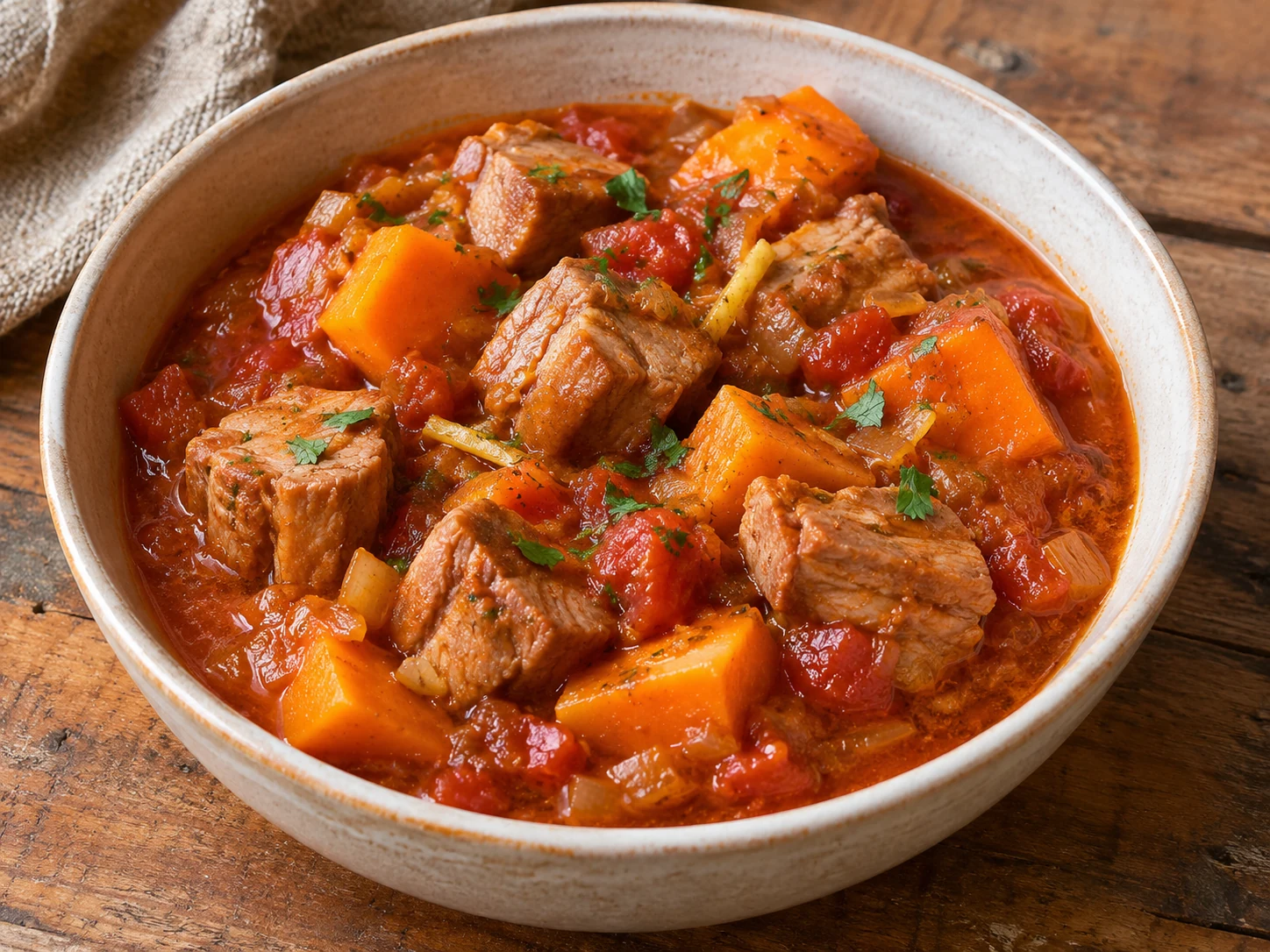
Pork stew with sweet potato and ginger
Fresh ginger gives this stew a clear direction without requiring a fiery sauce.
Ingredients
- 700 g trimmed boneless raw pork shoulder
- 600 g peeled sweet potato
- 400 g ripe tomatoes
- 180 g onion
- 20 g peeled fresh ginger
- 10 g peeled garlic
- 20 g sunflower oil
- 650 ml hot water
- 3 g salt
- 1 optional pinch pepper
Preparation
Cut pork into 4 cm cubes. Slice onion, chop garlic and grate ginger.
Heat oil and brown pork in two batches for 10 minutes in total. Set aside.
Soften onion for 8 minutes, add garlic and ginger for 1 minute, then tomatoes for 8 minutes.
Pour in water, return pork and add 2 g salt. Cover and simmer gently for 60 minutes.
Cut sweet potato into 3 cm cubes. Add when meat begins to soften.
Continue for 20 to 25 minutes until pork is fully cooked and both ingredients are tender. Continue cooking meat separately if necessary.
Adjust consistency and remaining salt, rest off heat for 5 minutes and serve without crushing cubes.
Introduction
Fresh ginger gives this stew a clear direction without requiring a fiery sauce. Its aromatic warmth accompanies sweet potato's sweetness and pork shoulder's flavour. Tomato prevents everything from seeming purely sweet and fatty; it also supplies initial moisture before water is added. The dish should reach the table with recognisable cubes and a sauce coating them, rather than purée mixed with meat.
The four portions combine meat and a starchy food in the same casserole. A crunchy salad or green leaves cooked separately often suffice to complete the meal; automatically adding rice would make it more substantial. Cooking order is crucial: pork starts alone in the sauce, then sweet potato joins meat already beginning to soften. If added together at the start, the vegetable may dissolve before the shoulder is pleasant to eat.
Cultural context
This contemporary creation is inspired by products and combinations of the Angolan table; it is not an attested traditional recipe. The proportions and method are an original editorial proposal, not presented as kitchen-tested. The institutional references below illuminate agricultural or cultural context without documenting this exact formula or assigning it a provincial origin.
https://www.fao.org/4/j2771p/j2771p00.htm https://www.embassyangolatr.org/tr/angola/cultura
Tips
Add sweet potato after pork initially softens.
Do not replace peeled weight with whole weight.
Grate ginger finely.
Maintain a gentle, monitored simmer.
Remove ready vegetables if meat needs longer.
Planning
Ask for boneless pork shoulder suitable for stewing. The seven hundred grams refers to meat after removing large fat pieces and thick outer membranes. A little internal fat contributes to tenderness; removing every trace is unnecessary. Do not directly replace it with tenderloin or chops, which behave differently. Cut roughly four-centimetre cubes and refrigerate while preparing vegetables. Separate utensils that touched raw pork from serving utensils.
Choose firm sweet potato without mould or large damaged areas. Peel, remove fibrous parts and weigh six hundred grams of flesh. Colour may be orange or pale; actual firmness varies with variety and storage. Make three-centimetre cubes rather than thin slices. Reserve them for the second cooking stage and avoid prolonged soaking, which is not useful here. Unpeeled tuber weight does not replace the stated edible weight.
Ginger should be fresh and firm. Remove thin skin, then weigh twenty grams and grate very finely. If fibres are long, chop them with a knife after grating so they do not remain as threads in the sauce. Ground ginger is not interchangeable gram for gram with this root. Chop garlic separately and cut tomatoes. Preparing all these items before searing avoids leaving the casserole to burn during late chopping.
Heat oil over medium-high heat, then brown meat in two batches. An overcrowded casserole would mostly release water. Wait for light browning on several sides without seeking a black crust. Set pork aside, then soften onion in the same vessel. Add a spoonful of measured water if cooking juices start sticking too strongly. Then add garlic and ginger for one minute, followed by tomatoes; this brief stage releases aromas without burning the small fragments.
Let tomatoes cook for eight minutes, stirring the bottom. Pour in six hundred and fifty millilitres of hot water and return meat with its juices. Add two grams of salt, cover and maintain a very steady simmer for one hour. The lid limits evaporation, but checks every twenty to thirty minutes remain necessary. Turn pieces and top up hot water if sauce threatens to dry. Vigorous boiling does not usefully shorten softening and may dry surfaces.
Before adding sweet potato, remove a pork piece and test resistance with a fork. It should begin yielding even if not perfectly tender yet. If still hard, continue alone for fifteen to twenty minutes, then check again. Add sweet potato cubes, distributing them in liquid. Cook for twenty to twenty-five minutes, partly covered. Stir sparingly and lift with a wide spatula: vegetable corners deteriorate faster than the centre cooks.
At the end, pork must be thoroughly cooked at the centre and tender enough to cut easily, with no raw area. Sweet potato should yield to a knife tip while holding shape. If vegetables are ready but meat still firm, remove them with a slotted spoon and continue cooking pork; do not sacrifice all cubes to a longer meat cooking time. Then reunite ingredients. Adjust water by spoonfuls if juices are thick, or briefly reduce sauce alone if too watery. Taste after this correction before using remaining salt.
Serving
Rest off the heat for five minutes, then serve in deep plates with an even distribution of pork, sweet potato and sauce. Finely sliced cabbage salad, dressed separately, provides contrast without transforming the stew. Avoid a sweet garnish that would obscure ginger's nuance. To prepare for the following day, stop while cubes still hold well, cool quickly and reheat gently with a little water; do not use lukewarm holding as storage. Suggested accompaniments remain outside the calculation.
Storage
Quickly divide leftovers among shallow containers, then refrigerate at 4 °C or below. Eat within 48 hours. Reheat the required quantity only once, until the entire portion is thoroughly hot at the centre. Do not keep the dish lukewarm in the saucepan for a long time.
Variations
A pale-fleshed sweet potato may be chosen for often less pronounced sweetness, checking cooking earlier. Some can be replaced with smaller-cut carrots, but times and calculation change. For milder ginger flavour start with fifteen grams rather than twenty and state the change. Gindungo remains optional and is added to the sauce in a very small pinch. A beef version would need a different time and distinct title; it is not a simple swap at constant cooking time.
Nutrition notes
Values are estimates per serving for four people, without the suggested accompaniments. Calculation uses the stated edible weights and Ciqual reference foods. All oil and salt are counted; water and very small optional amounts of pepper or gindungo are excluded. Brands, meat fat content, cooking losses and actual yield change the result. If energy is missing from the table, it is estimated using 4 kcal/g protein, 4 kcal/g carbohydrate, 9 kcal/g fat and 2 kcal/g fibre.
Conclusion
Aim for tender meat, a bound but flowing sauce and still-identifiable pieces. Adjust seasoning after cooking before dividing into four portions. Enjoy your meal!
Enjoy your meal
Enjoy your meal!