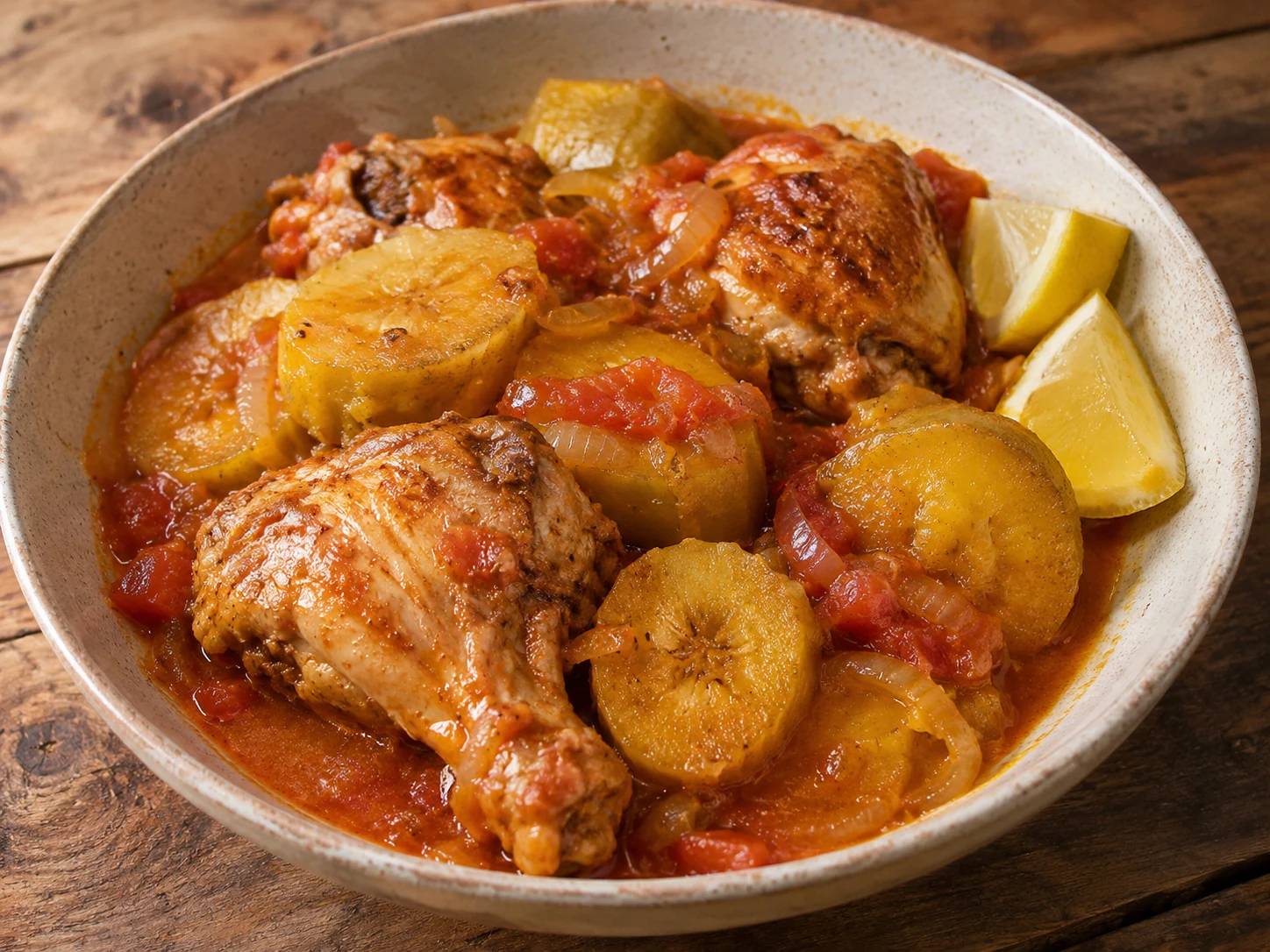
Chicken stewed with green plantain and lemon
Green plantain makes this a substantial stew whose sauce gently binds during cooking.
Ingredients
- 700 g skinless boneless chicken thigh meat
- 600 g peeled green plantain
- 400 g ripe tomatoes
- 180 g onion
- 10 g peeled garlic
- 30 g lemon juice
- 20 g sunflower oil
- 600 ml water
- 3 g salt
- 1 optional pinch pepper
Preparation
Cut chicken into 4 cm pieces and keep chilled. Slice onion, chop garlic and cut tomatoes.
Peel plantain and cut into 3 cm sections. Set aside without a prolonged wait.
Heat oil in a casserole and brown chicken in two batches for 6 to 8 minutes in total. Set aside.
Soften onion for 8 minutes, add garlic for 1 minute, then tomatoes for 8 minutes.
Pour in water, return chicken and simmer partly covered for 15 minutes.
Add plantain and 2 g salt. Simmer for 20 to 25 minutes until plantain is tender and chicken reaches 74 °C at the centre.
Remove from heat, add lemon juice and adjust with the remaining gram of salt. Rest 5 minutes and serve.
Introduction
Green plantain makes this a substantial stew whose sauce gently binds during cooking. It behaves more like a starchy food than a sweet banana: its flesh stays firm, absorbs some liquid and needs genuine cooking time. Chicken supplies tender pieces while lemon finishes the preparation without aggressive acidity. Tomato forms a short sauce, present enough to surround the ingredients without turning the dish into soup.
The quantities make four main-course portions. As plantain is already included, rice is not essential; some green vegetables make a lighter addition. The recipe uses boneless thigh meat, more tolerant of simmering than breast. A whole jointed chicken would require different weights and checks adapted to bone-in pieces. The sequence separates the chicken's initial cooking from adding plantain so the latter does not break down throughout the entire cooking time.
Cultural context
This contemporary creation is inspired by products and combinations of the Angolan table; it is not an attested traditional recipe. The proportions and method are an original editorial proposal, not presented as kitchen-tested. The institutional references below illuminate agricultural or cultural context without documenting this exact formula or assigning it a provincial origin.
https://www.fao.org/4/j2771p/j2771p00.htm https://www.embassyangolatr.org/tr/angola/cultura
Tips
Weigh plantain after peeling.
Keep sections thick enough.
Browning chicken does not prove its centre is cooked.
Add lemon off the heat.
Top up liquid gradually, never with a large unchecked volume.
Planning
Weigh chicken after removing bones, skin and large fat deposits. Keep the meat in a closed container in the refrigerator until the last moment. Do not wash it under the tap: splashes may contaminate the sink and nearby surfaces. Use a board reserved for raw meat, then wash hands and utensils before preparing ready-to-serve items. Pieces close to four centimetres cook more evenly than very different sizes.
Choose distinctly green plantains, heavy and firm without soft patches. Remove their thick skin by cutting off the ends and making shallow lengthwise slits. Lift the strips with a finger or knife tip directed away from your hand. The six hundred grams refers to flesh, not whole fruits. Cut thick sections: thin rounds would lose their shape more easily in the sauce. Slight discolouration in air does not prevent their use.
Use a casserole wide enough to sear chicken without crowding. Heat the twenty grams of oil, then brown in two batches without seeking a very dark crust. This develops cooking juices but does not completely cook the centres. Put reserved pieces on a plate intended for this purpose and do not reuse that plate for serving without washing. If a deposit turns black and bitter, remove it rather than dissolving it in the sauce.
Soften onion in the same vessel, stirring the browned areas. A spoonful of the measured water can help if the bottom becomes dry. Add garlic only after onion softens, then chopped tomatoes. Eight minutes allows their flesh to start breaking down and their raw taste to lessen. Plain canned chopped tomatoes suit the same weight; check their salt before adding the recipe's salt. No stock cube is needed.
Pour in the six hundred millilitres of water and return chicken with juices on the plate. Maintain a simmer, not a vigorous boil. After fifteen minutes add plantain and an initial portion of salt. Liquid should reach about two-thirds up the ingredients; depth depends on casserole diameter. If necessary add small amounts of hot water. Move pieces gently with a spatula rather than stirring vigorously, as plantain gradually releases starch.
Check after another twenty minutes with a knife tip: plantain must be tender to the centre without a hard core. A very firm variety may need a few more minutes. Also check several thick chicken pieces with a clean thermometer; they must reach 74 °C at the centre. If plantain is ready before the meat, remove it temporarily. If sauce remains too thin, remove cooked ingredients and reduce the juices for a few minutes without crushing them.
Squeeze lemon separately and remove seeds before weighing the juice. Add off the heat, then mix without breaking the sections. Taste before using the remaining salt: acidity changes perceived saltiness without changing its actual amount. Rest five minutes with the lid ajar; sauce stabilises and plantain continues absorbing a little liquid. If the mixture has tightened too much, one or two spoonfuls of hot water often restore a supple sauce.
Serving
Divide chicken and plantain among four deep plates, then spoon sauce over without hiding all the pieces. Serve green leaves cooked separately or an unsweetened cucumber salad. Avoid pouring more lemon over the whole casserole before everyone has tasted. A wedge can be offered separately, but its extra juice is not included in the calculation. For a delayed meal, keep the preparation chilled rather than prolonging simmering indefinitely, which would eventually break down the plantain.
Storage
Quickly divide leftovers among shallow containers, then refrigerate at 4 °C or below. Eat within 48 hours. Reheat the required quantity only once, until the entire portion is thoroughly hot at the centre. Do not keep the dish lukewarm in the saucepan for a long time.
Variations
Yellow plantain would give a sweeter, more fragile result: the dish name and addition time would need adjusting. Chicken breasts require different cooking and may dry out in this sequence. A pinch of gindungo may replace pepper without changing liquid quantities. For a less acidic sauce, start with two-thirds of the juice and offer the rest separately; this slightly reduces the ingredient actually consumed. Do not replace lemon with a large amount of vinegar without reassessing the balance.
Nutrition notes
Values are estimates per serving for four people, without the suggested accompaniments. Calculation uses the stated edible weights and Ciqual reference foods. All oil and salt are counted; water and very small optional amounts of pepper or gindungo are excluded. Brands, meat fat content, cooking losses and actual yield change the result. If energy is missing from the table, it is estimated using 4 kcal/g protein, 4 kcal/g carbohydrate, 9 kcal/g fat and 2 kcal/g fibre. Lemon juice is represented by raw lemon flesh, a declared approximation that may slightly alter estimates.
Conclusion
Aim for tender meat, a bound but flowing sauce and still-identifiable pieces. Adjust seasoning after cooking before dividing into four portions. Enjoy your meal!
Enjoy your meal
Enjoy your meal!