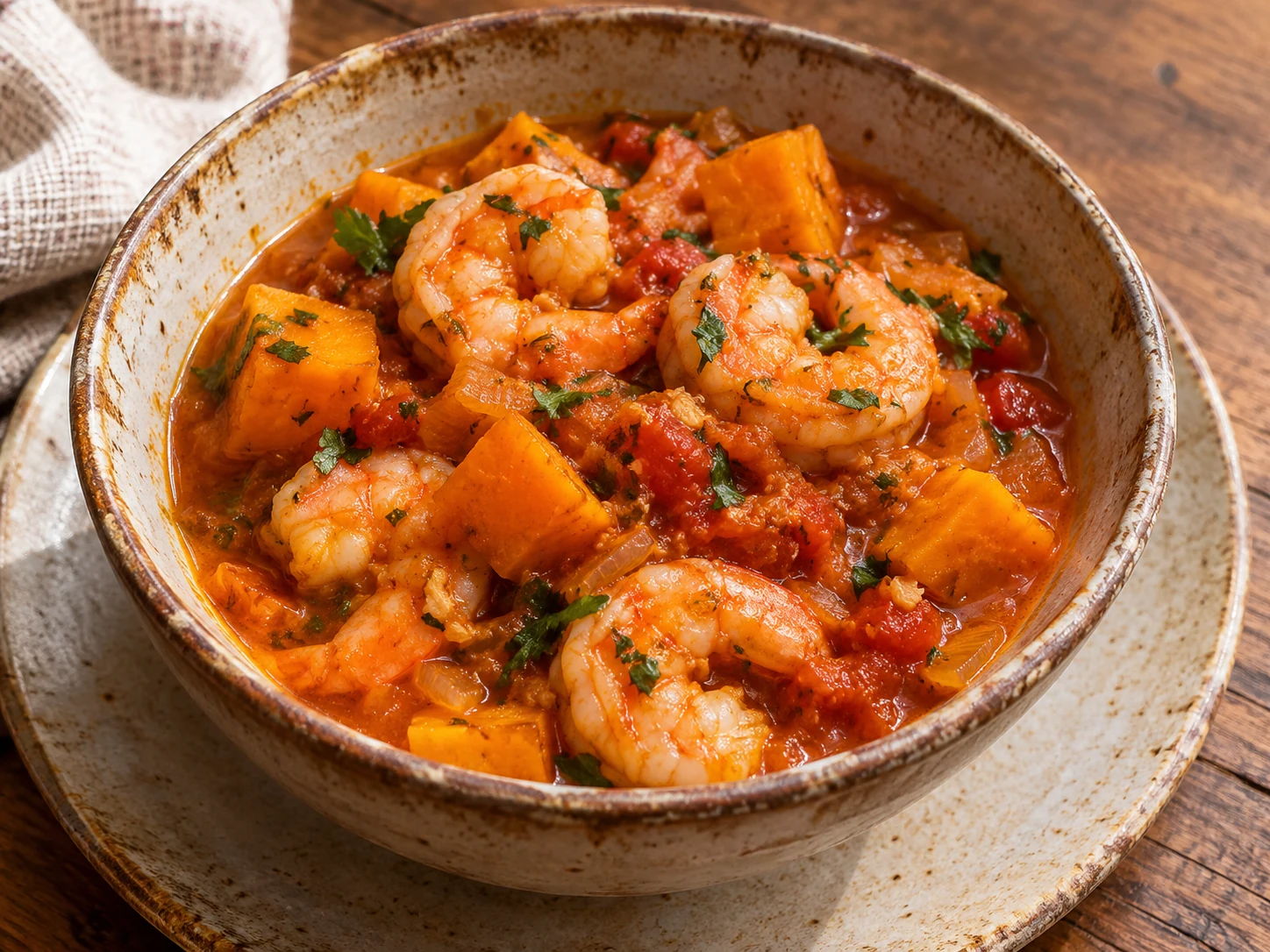
Prawns simmered with sweet potato and ginger
Here the prawns simmer only during the last few minutes of a sweet potato, tomato and ginger base.
Ingredients
- 600 g raw shelled, drained prawns
- 600 g peeled sweet potato
- 300 g tomatoes
- 150 g peeled onion
- 15 g prepared fresh ginger
- 6 g peeled garlic
- 15 g sunflower oil
- 400 ml water
- 20 g lime juice
- 10 g fresh coriander
- 2 g salt
- A minute pinch of gindungo, optional, offered separately
Preparation
Cut sweet potato into 2 cm cubes, dice tomatoes and finely chop onion. Grate garlic and ginger. Keep prepared prawns chilled.
Soften onion in oil for 8 minutes over medium heat. Add garlic and ginger for 1 minute, then tomatoes for 6 minutes.
Add sweet potato and water. Simmer half-covered around 15–20 minutes until cubes are almost fully tender.
Check sauce; reduce without prawns if needed, or loosen with a spoonful of hot water. Add prawns and cook gently 3–5 minutes according to size, turning if necessary.
Check for an opaque centre and complete cooking, or 63 °C with a clean thermometer. Remove from heat immediately.
Add salt, lime juice and coriander. Divide among four plates and serve immediately; offer gindungo separately if desired.
Introduction
Here the prawns simmer only during the last few minutes of a sweet potato, tomato and ginger base. The title describes a saucy dish, not lengthy shellfish cooking: adding them at the start would make them tough before the cubes softened. The aim is a short sauce coating the spoon, recognisable sweet potato pieces and prawns just cooked through. Lime finishes everything off the heat.
This contemporary creation uses products of the Angolan table and its marine supplies without claiming a traditional name. The four portions already include starch and a portion of shellfish. The ginger quantity gives a noticeable but gentle aroma. There is no need automatically to strengthen it with chilli: sweet potato sweetness and tomato acidity should remain perceptible.
Cultural context
This recipe is a contemporary creation inspired by ingredients from the Angolan table, not an attested traditional recipe. The references document the products and their context; they are not the source of the proposed formula. The proportions and method are an original editorial proposal. The institutional texts cited provide agricultural or cultural context and do not establish a traditional origin for this formula.
https://www.fao.org/4/j2771p/j2771p00.htm https://www.embassyangolatr.org/tr/angola/cultura
Tips
Weigh raw prawns without shells or heads.
Keep shellfish chilled until adding.
Soften sweet potato before adding prawns.
Do not extend cooking to reduce sauce after adding prawns.
The dish contains crustaceans; check prepared products too.
Planning
Provide six hundred grams of raw shelled prawns, without heads or hard tail shells, weighed after draining. This is not six hundred grams of whole prawns bought with shells. Ask the seller for an appropriate quantity if preparing them at home. An already cooked product is used differently: it would need only final reheating and change the organisation described. Choose fairly uniform medium or large prawns so portions cook together.
Thaw prawns in the refrigerator in a container that collects liquid. Do not speed this up on the worktop or in hot water. Sort them and remove the visible intestinal thread if necessary with a clean small knife. Gently pat dry, cover and return to the cold until the vegetables finish cooking. Clean hands, board and utensils after handling the raw product and before touching herbs intended for serving.
Weigh sweet potato peeled. Choose firm flesh without mould spots and cut roughly two-centimetre cubes. Very small cubes disintegrate in the sauce before prawns arrive; large pieces delay the meal and make checking less uniform. Keep cubes briefly in cold water only if preparation requires, then drain well. This holding water is not the water measured for simmering and does not enter the pan.
Chop onion and grate garlic and peeled ginger. Ginger should be fresh and firm, not a dried-out root leaving long strings. Dice tomatoes, retaining their juices and removing only the hard stalk attachment. Choose a sauté pan wide enough to hold cubes in one or two layers without crushing. A narrow saucepan requires deep stirring that breaks sweet potato as it softens. Prepare a well-fitting lid to control evaporation.
Soften onion in oil over medium heat for eight minutes, then add garlic and ginger for one minute. Add tomatoes and let them soften for six minutes, stirring the base. This builds a foundation before water is added; shortening it produces mostly watery sauce with dominant onion. The base must not blacken. If tomatoes lack juice, reduce heat slightly and use a spoonful of the planned four hundred millilitres of water to loosen the cooking juices.
Add cubes and remaining water, then half-cover. Maintain a gentle simmer for around fifteen to twenty minutes. Check sweet potato with a knife tip: it must be almost fully tender before prawns are added. Stir by sliding a wide spatula under the cubes rather than turning vigorously. If liquid falls too fast, reduce heat and add a spoonful of hot water. If sauce is very runny, reduce it for a few minutes without prawns rather than prolonging their cooking later.
Take prawns out of the refrigerator only once the base is ready. Distribute them in the simmering sauce and mix gently to expose them to heat. Usually allow three to five minutes according to size and starting temperature, without vigorous boiling. Turn if not covered. The centre must be opaque and firm without becoming hard; a clean thermometer can confirm sixty-three degrees at the centre of a large prawn. A pink exterior is insufficient if the centre remains translucent.
As soon as cooked, remove from heat and stir in salt and lime juice. Taste a cooled spoonful of sauce before adjusting. Seafood may supply salt depending on treatment; check the composition of prepared prawns rather than adding salty stock. Scatter washed, dried, chopped coriander. Do not leave the pan on a still-hot hob: residual heat keeps cooking prawns even when sauce is no longer visibly boiling.
Serving
Divide immediately among four deep plates, lifting cubes, then distribute prawns to balance portions. Add only enough sauce to surround sweet potato, without turning the dish into soup. A green salad or lightly seasoned vegetables give fresh contrast; their quantities and values are excluded. Bread or rice remain optional, since sweet potato already provides starch.
For advance organisation, prepare the vegetable base alone, cool rapidly and refrigerate. Reheat to a full simmer before adding raw prawns at the last moment. Do not precook prawns and leave them waiting in sauce, and do not mix raw product with cooked leftovers. Check sweet potato tenderness again after reheating, since it may break more easily the next day.
Storage
Cool leftovers rapidly in a shallow container, refrigerate at 4 °C or below and eat within 24 hours. Reheat only once until thoroughly hot at the centre. Do not keep a portion that has stood at room temperature for a long time.
Variations
Squash cubes may replace some sweet potato, but often cook faster and release more water. Add them later or reduce their size only after observing their texture. Another crustacean requires reassessing edible weight, time and title; keeping the same weight of whole shell-on product is insufficient.
A tiny pinch of gindungo may be offered separately to diners wanting heat. It is not essential to the formula and is not counted when minute. Coriander may be omitted without replacing it with lots of powdered herbs. For stronger ginger aroma, reserve a few fine gratings for the finish, taken from the planned fifteen grams rather than added without measure.
Nutrition notes
Estimated values per serving, excluding accompaniments. Calculated from edible weights and reference foods; brands, cooking and actual yield may change the results. All fats are counted in full. Where energy is not provided in the table, it is estimated from protein and carbohydrate (4 kcal/g), fat (9 kcal/g) and fibre (2 kcal/g). Optional spices in very small quantities are not counted. All added oil and salt are counted; water and optional spices in minute quantities are excluded. Moisture content can also change the nutritional intake.
Conclusion
Serve as soon as the described textures are obtained and adjust the final seasoning on the plate. This contemporary editorial creation is presented neither as an attested traditional recipe nor as a kitchen-tested formula. Enjoy your meal!
Enjoy your meal
Enjoy your meal!