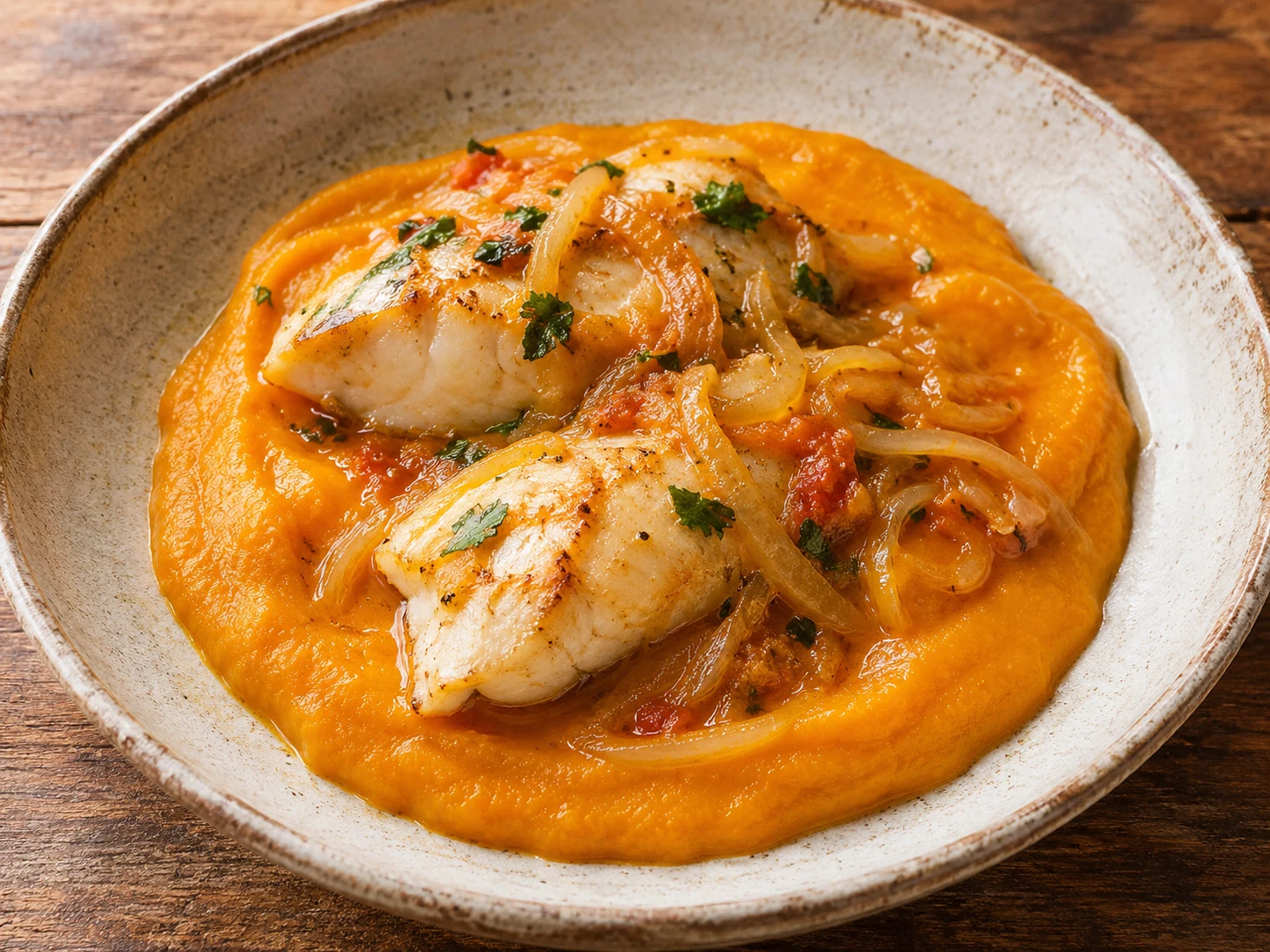
Fish fillets with creamy squash purée
Here the squash cream is a soft vegetable purée without dairy cream.
Ingredients
- 600 g raw skinless boneless pollack or pollock fillets
- 800 g butternut squash flesh
- 150 g peeled onion
- 6 g peeled garlic
- 15 g sunflower oil
- 150 ml water, plus small adjustments if necessary
- 20 g lemon juice
- 10 g fresh parsley
- 2 g salt
- A little black pepper, optional
Preparation
Peel and cut squash into 2 cm cubes. Slice onion and chop garlic. Check fish for bones and keep chilled.
Reserve 5 g oil. Soften onion in the remaining 10 g for 8 minutes, then add garlic for 1 minute.
Add squash and water, cover and cook gently around 20 minutes until fully tender. Check the base does not dry.
Blend off the heat, adjust with a little hot water if needed, then add lemon and 1 g salt. Keep covered and hot without boiling.
Heat the reserved 5 g oil in a frying pan. Season fish with 1 g salt and a little pepper; cook 4–5 minutes on one side then 2–4 on the other according to thickness.
Check for opaque flesh that flakes easily, or 63 °C at the centre with a clean thermometer. Divide cream among four plates, add fish and finish with parsley.
Introduction
Here the squash cream is a soft vegetable purée without dairy cream. It receives separately cooked white fish fillets, preserving both the squash’s sweetness and the fish’s texture. Some cooking water adjusts the consistency; lemon is added after blending for a clear contrast without making the base sour. Parsley is a fresh finish, not a thick layer of herbs.
This contemporary proposal uses products present in Angolan cooking and claims no attested traditional recipe. The four plates combine a generous amount of squash with a portion of fish. They can make a light meal or receive an accompaniment according to appetite. The word cream describes the blended texture and does not mean that butter, dairy cream or cheese should be added.
Cultural context
This recipe is a contemporary creation inspired by ingredients from the Angolan table, not an attested traditional recipe. The references document the products and their context; they are not the source of the proposed formula. The proportions and method are an original editorial proposal. The institutional texts cited provide agricultural or cultural context and do not establish a traditional origin for this formula.
https://www.fao.org/4/j2771p/j2771p00.htm https://www.embassyangolatr.org/tr/angola/cultura
Tips
Weigh squash without skin or seeds.
Keep raw fillets chilled while making the purée.
Blend only completely tender squash.
Reserve the fish’s 5 g oil before starting.
Check the centres of the thickest portions.
Planning
Choose a butternut squash with firm flesh and no soft or mouldy areas. Weigh eight hundred grams after removing skin, seeds and central fibres; a whole fruit of that weight will not supply the amount needed. Cut it on a stable board with a suitable knife, without forcing a blade that is too small. Check the freshness of a precut piece and refrigerate until use. Cut the flesh into even two-centimetre cubes.
Use six hundred grams of skinless, boneless pollock fillets. Pollack is this formula’s nutritional reference food. Cod or hake may work in the kitchen, but their nutrients and cooking speed differ. Prepare four portions of similar thickness. Feel for bones with your fingertips and remove them with clean tweezers. After refrigerator thawing, drain and pat the fish dry to avoid excessive water in the pan.
Slice onion and chop garlic. Reserve five grams of oil for cooking the fish and use the other ten in a heavy-based saucepan. Soften the onion over medium heat for eight minutes without browning. Pieces should bend under the spoon before squash is added. If the base dries, add a spoonful of the measured water and reduce heat. Add garlic for just one minute: lengthy dry cooking would give bitterness that overwhelms the cream.
Add the cubes and one hundred and fifty millilitres of water. Cover and cook gently for about twenty minutes, stirring two or three times to distribute moisture. The aim is covered cooking with little liquid, not a large pan of boiled vegetables. Check the base after ten minutes. If steam escapes too rapidly, add a spoonful of water rather than let it catch; remember that correction when blending. Squash must mash very easily before using a blender.
Remove from the heat to blend and keep the blender head submerged. A small volume of hot liquid can splash more than a large soup if the blade approaches the surface. Pulse, scrape the sides and blend again until smooth. With an enclosed blender, follow the appliance instructions for hot food and work in small quantities. Add hot water only if necessary, spoon by spoon. The cream should support the fish while spreading gently in a deep plate.
Stir half the salt and the lemon juice into the purée, then taste a cooled spoonful. Keep covered over very low heat while cooking the fish, stirring to stop excessive thickening on the base. If it waits too long, a dry skin forms and mixes in poorly; covering and minimising the wait are better. Do not fix overly runny purée by boiling it throughout the fish’s cooking: that increases burning risk and disrupts service.
Heat a nonstick frying pan large enough for four portions and distribute the reserved five grams of oil. Season fish with remaining salt and a little pepper. Lay fillets without overlapping; use two pans if necessary. Cook gently four to five minutes on the first side and two to four on the other, depending on thickness. Turn with a wide spatula without pressing. The centre must become opaque and flake; a clean thermometer can confirm sixty-three degrees at the centre.
If a portion breaks slightly, serve it in large pieces rather than trying to rebuild it through repeated handling. Slight colouring is pleasant but a dark crust is not the goal. Remove each piece as soon as ready to avoid drying thinner ones while waiting for others. Since the sauce is already hot, plating can follow immediately. Wash and dry parsley before chopping; very wet leaves would dilute the cream’s surface.
Serving
Pour a quarter of the cream into each deep plate and place fish on top. Distribute parsley without hiding the fillet. Offer some rice or already cooked cassava if desired, stating that this accompaniment is excluded from quantities and nutritional values. The dish does not need another fatty coating: squash already provides a soft base.
To prepare ahead, keep only the cream chilled after rapid cooling. Reheat with a little water before cooking fish at the last moment. Do not leave cooked fillets waiting in hot purée for long: they would crumble and lose moisture. Organise pan cooking around the actual mealtime rather than reheating everything repeatedly.
Storage
Cool leftovers rapidly in a shallow container, refrigerate at 4 °C or below and eat within 24 hours. Reheat only once until thoroughly hot at the centre. Do not keep a portion that has stood at room temperature for a long time.
Variations
Another squash can replace butternut, but its water content will change the liquid needed. With a very watery variety, begin with less water and add more later; do not impose a fixed time on a different vegetable. Sweet potato produces a denser purée and makes another recipe that should be named accordingly.
Parsley can be omitted or replaced by a little fresh coriander. Add lemon gradually if squash is not very sweet. Do not automatically add sugar to correct excessive acidity: instead reserve some juice for serving. A dairy-cream version would alter allergens and the estimate and would not match this formula.
Nutrition notes
Estimated values per serving, excluding accompaniments. Calculated from edible weights and reference foods; brands, cooking and actual yield may change the results. All fats are counted in full. Where energy is not provided in the table, it is estimated from protein and carbohydrate (4 kcal/g), fat (9 kcal/g) and fibre (2 kcal/g). Optional spices in very small quantities are not counted. All added oil and salt are counted; water and optional spices in minute quantities are excluded. Moisture content can also change the nutritional intake.
Conclusion
Serve as soon as the described textures are obtained and adjust the final seasoning on the plate. This contemporary editorial creation is presented neither as an attested traditional recipe nor as a kitchen-tested formula. Enjoy your meal!
Enjoy your meal
Enjoy your meal!