Corn salad with mango and ginguba
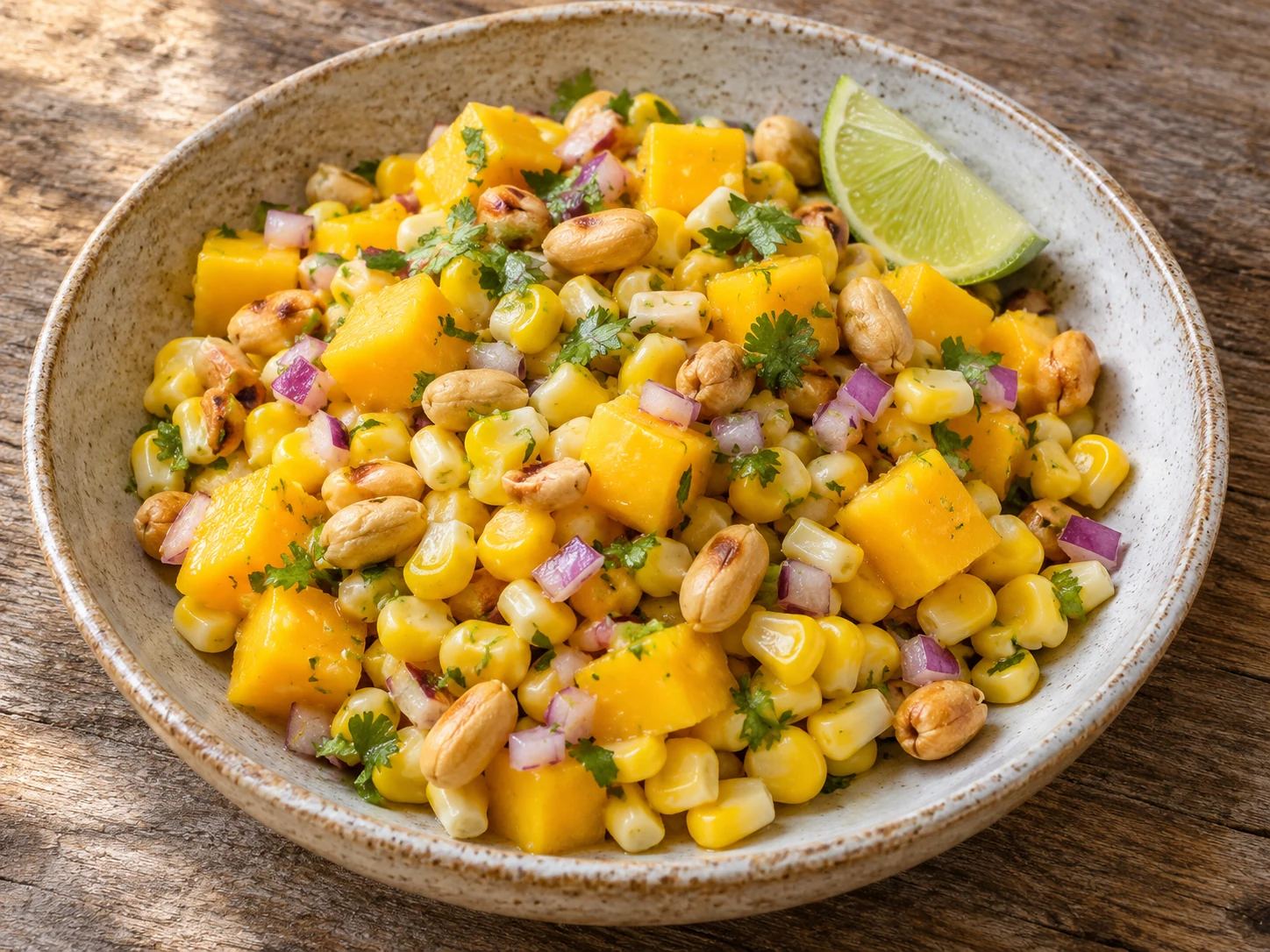
Cooked corn, firm mango and roasted ginguba come together in a fresh lime-dressed salad where each ingredient keeps its texture.
Ingredients
- 500 g cooked, drained corn
- 350 g ripe but firm mango flesh
- 60 g unsalted roasted shelled peanuts
- 60 g onion
- 15 g fresh parsley
- 5 g fresh ginger
- 35 g lime juice
- 20 g olive oil
- 2 g salt
- 1 optional pinch of gindungo
Preparation
Drain and weigh already cooked corn. Wash and peel mango, weigh 350 g flesh and cut into 1.5 cm cubes.
Slice onion, grate ginger and chop washed, thoroughly dried parsley. Coarsely crush roasted peanuts and reserve separately.
Mix lime juice with salt and ginger, then whisk with oil. Retain some allocated juice if mango is already very acidic.
Mix corn, onion and parsley with dressing in a large bowl. Add mango, gently lifting with a spatula.
Taste a complete mouthful, adjust with reserved juice and add optional gindungo. Incorporate most ginguba only when serving.
Divide into four portions and scatter remaining pieces from the specified 60 g. Serve promptly and keep waiting portions cool.
Introduction
This salad puts corn at the centre without making it merely a sweet base. Cooked kernels supply soft texture, ripe but firm mango gives juicy cubes and roasted ginguba adds a crunchy contrast. Ginguba here means peanut: its presence must be announced to anyone concerned by this allergy. Lime, onion and a little ginger balance the fruit; neither sugar nor commercial sauce is needed.
Quantities make four generous side servings or light plant-based lunches, to complement according to need. This contemporary creation draws inspiration from products used in Angola without provincial attribution or presentation as a collected tradition. All corn is cooked before assembly and peanuts are purchased roasted without salt. No final cooking makes preparation important: draining, drying and keeping components cool matter as much as dressing proportions.
Cultural context
Angola’s embassy in Türkiye mentions ginguba and maize among products in its presentation of Angolan food. The 2004 FAO/WFP report also describes the country’s food crops. These references contextualize ingredients; they do not attest this mango salad, quantities or dressing. Raw assembly with already cooked kernels and late peanut addition are contemporary editorial decisions. Context sources: https://www.embassyangolatr.org/tr/angola/cultura and https://www.fao.org/4/j2771p/j2771p00.htm
Tips
Weigh corn after draining and mango after peeling.
Choose fruit that keeps neat cubes.
Keep ginguba pieces rather than powder.
Add peanuts at the last moment to preserve crunch.
Declare the allergen even if its quantity seems small.
Planning
Corn weight means five hundred grams cooked and drained, not a can’s entire contents with liquid. Rinse plain canned corn if necessary, then let it drain in a colander a few minutes before weighing. Frozen corn can be used after complete cooking according to packet directions and prompt cooling. Fresh corn on the cob also needs prior cooking; then detach kernels over a large dish to prevent scattering. Dried kernels are not a direct replacement.
Choose fragrant mango that yields slightly under the fingers yet remains firm enough to cut neatly. Very soft mango becomes sauce and erases distinctions between ingredients. Wash before peeling. Cut the two cheeks either side of the stone, remove skin and cut roughly one-and-a-half-centimetre cubes. Recover flesh around the stone only if not too fibrous. Weigh three hundred and fifty grams of usable flesh, excluding skin and stone.
Check peanuts are roasted and unsalted. Sixty grams means edible kernels without shells. Discard anything rancid-smelling, visibly mouldy or poorly stored; heating cannot repair spoiled raw material. Coarsely chop with a knife on a stable board or crush in a mortar with a few presses. Do not make powder: small pieces should remain visible and crunch under the teeth. Keep separate until the final step to preserve this contrast.
Slice onion finely, then taste. If very aggressive, rinse briefly under cold water and drain thoroughly in a clean cloth or fine sieve. Grate ginger instead of cutting sticks: the five grams should flavour all dressing without imposing a fibrous mouthful. Wash parsley, dry and chop with a knife. Dripping herbs would dilute dressing and hasten a watery layer at the bottom of the bowl.
Squeeze lime and weigh the juice. Combine juice, salt and ginger in a bowl, stir, then whisk in oil. Dressing need not stay perfectly emulsified; stirring just before pouring suffices. Taste with a corn kernel and small mango piece rather than alone: a sharp dressing softens against fruit. Mangoes vary in sugar and acidity; retaining some allocated juice until the final check avoids excessive correction.
First mix corn, onion and parsley with dressing. Add mango cubes and lift with a broad spatula without crushing against the bowl. This sequence distributes seasoning over kernels before fragile fruit enters. Check the bowl bottom: if already very wet, serve with a broad spoon rather than mixing repeatedly. Add ginguba only at serving, reserving a few pieces to distribute over four portions. The assembled salad does not benefit from hours of maceration.
Serving
Serve cool without being icy, on four plates with visible mango and ginguba pieces. With grilled fish it acts as a side; adjust portions to the rest of the meal. For a more substantial plant-based lunch, offer cooked beans separately and count them as additional intake. On a buffet, keep a refrigerated reserve and replenish small quantities. Explicitly announce peanuts before placing the dish on the table.
Storage
Keep components separately refrigerated at 4 °C or below and assemble shortly before eating. Eat assembled salad within 24 hours; mango may soften and ginguba lose crunch. Keep dry kernels separately in a clean closed container according to packaging. Do not leave the dish long at room temperature, even with citrus dressing. Transport cold if eating elsewhere.
Variations
Replacing parsley with fresh coriander changes aroma. Some well-drained cucumber may replace part of the mango to reduce sweet contrast, but rename the salad accordingly. Cashews are not a safe substitute for every allergy and change nutritional calculations. For a peanut-allergic guest, do not simply remove pieces from an already mixed dish: prepare a separate portion with clean utensils and ingredients suited to their situation.
Nutrition notes
Corn and mango contribute carbohydrate, peanuts fat and some protein. These descriptions are not health promises. Per-serving estimates use edible weights, exclude accompaniments and count all oil. Brands, draining and yield can change results. Optional tiny spices are excluded. If reference energy is absent, calculate using protein and carbohydrate at 4 kcal/g, fat at 9 kcal/g and fibre at 2 kcal/g. Unsalted roasted peanuts are counted fully, including those reserved for topping plates.
Conclusion
The intended result is separate kernels, clearly defined fruit and crunchy peanuts. Adjusting seasoning on a complete mouthful and keeping ginguba until the end preserves the contrast. This editorial formula is not presented as kitchen-tested.
Enjoy your meal
Enjoy your meal!