Cassava salad with mackerel and lime
Commercially prepared cooked cassava and boneless cooked mackerel meet in a citrus-dressed salad with tomato, onion and parsley.
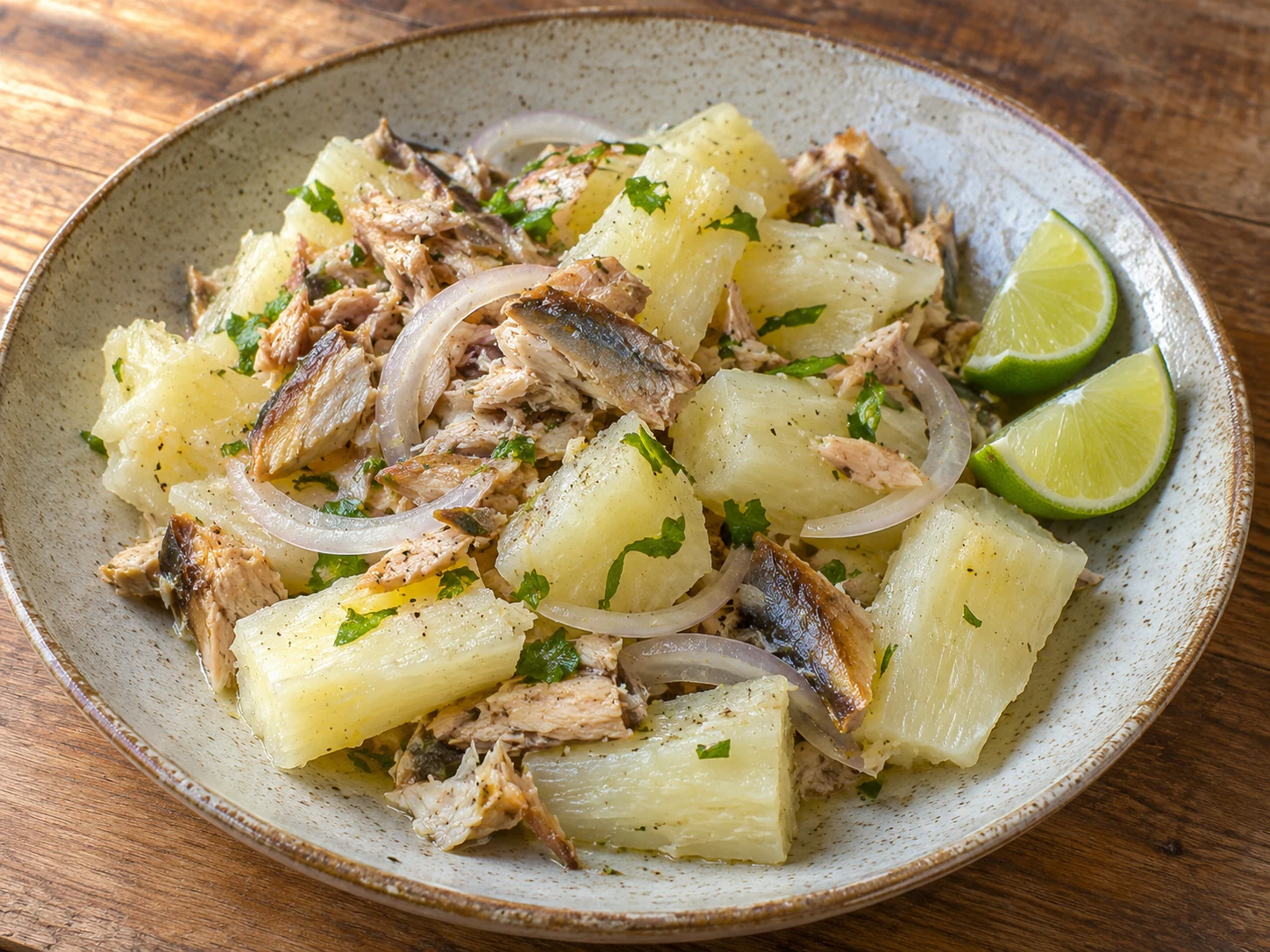
Ingredients
- 600 g commercial fully cooked cassava, ready to reheat, usable weight
- 300 g fully cooked mackerel flesh, boneless and without sauce
- 250 g tomatoes
- 60 g onion
- 15 g fresh parsley
- 25 g olive oil
- 35 g lime juice
- 2 g salt
- 1 optional pinch of pepper
Preparation
Check cassava is commercial, fully cooked and ready to reheat. Do not use merely peeled raw cassava. Reheat 600 g following manufacturer instructions, longer than 10 minutes if needed.
Drain if needed and let steam escape on a clean dish. Cut tender cassava into 3 cm pieces and remove any hard fibre in the prepared product.
Check the 300 g already cooked mackerel with your fingers, remove every bone and separate broad flakes. Keep refrigerated during other preparation.
Cut tomatoes, thinly slice onion and chop washed, dried parsley. Mix lime and salt in a bowl, then whisk with oil.
Gently coat barely warm cassava with some dressing. Add tomato, onion and parsley, then mackerel and remaining dressing.
Lift with two spoons without crushing. Taste fish and cassava together, add pepper if desired and divide into four portions. Serve promptly or keep cold.
Introduction
This salad contrasts firm cassava flesh with broad flakes of strongly flavoured fish. Lime, tomato and parsley add freshness without attempting to turn fish into an acid-treated raw preparation. Mackerel is fully cooked before assembly. Cassava is also purchased as an identifiable commercial food already cooked or frozen precooked, explicitly ready to reheat. This is not a guide to processing raw roots.
The quantities make four main-course portions. The root supplies starch; fish should be distributed in recognizable pieces rather than crumbled until invisible. Serve slightly warm or cool, but do not leave it long at room temperature. This contemporary creation draws inspiration from produce used in Angola without claiming a historical speciality’s name. Precision depends on choosing prepared products, checking bones and assembling gently, rather than a prolonged marinade.
Cultural context
Cassava is among the major crops described in the FAO/WFP report on Angola dated 6 August 2004. This places the root in its food context; it does not document this mackerel salad. Choosing already prepared cassava, the proportions and seasoning are contemporary editorial decisions. No traditional-recipe status or provincial speciality is claimed. Context source: https://www.fao.org/4/j2771p/j2771p00.htm
Tips
Check cassava is labelled fully cooked and ready to reheat.
Follow manufacturer directions beyond the indicative time.
Look for bones even in fillets labelled boneless.
Add mackerel last to preserve flakes.
Lime replaces neither fish cooking nor refrigeration.
Planning
Read cassava packaging before purchase. Select only an identifiable commercial product already fully cooked and ready to reheat following manufacturer instructions. Some frozen bags are merely peeled and still raw: they are unsuitable for this procedure. The words “frozen” or “cassava pieces” are therefore insufficient. Do not use fresh roots, bitter varieties or products of uncertain cooking status. This recipe provides no detoxification or raw-cassava processing procedure.
Weigh six hundred grams of usable cooked cassava, after draining if necessary. Reheat exactly as directed on the packet, without treating the recipe’s ten minutes as a guarantee for every product. Follow any longer instructions and adapt your schedule. Pieces must be tender in the centre. Then let steam escape on a clean dish and cut into roughly three-centimetre pieces. Remove a hard central fibre only if present in the already prepared product. Do not incorporate any reheating water into the dressing.
Choose fully cooked, cooled mackerel without sauce, such as fillets baked beforehand or well-drained plain canned mackerel. The three hundred grams refers to flesh without tough skin or bones, not whole fish. Feel every piece with clean fingers and remove any detectable bone, even from a product labelled “boneless”. Separate broad flakes. Smoked or heavily salted fish would produce a different recipe: it is not an automatic replacement at the same weight with the same seasoning.
Wash tomatoes and herbs, then dry thoroughly. Cut tomato into medium cubes; if very watery, let some liquid drain without squeezing all the flesh. Slice onion very finely to avoid large pungent mouthfuls. A brief rinse can soften an aggressive onion, but then drain thoroughly. Chop parsley with a knife just before assembly. Wet herbs or waterlogged onion would dilute the lime and oil mixture.
Prepare dressing in a separate bowl. First combine lime juice and salt for better distribution, then whisk with oil. Start assembly with cassava barely warm, never piping hot. Turn gently with some dressing to coat several faces. Very hot root could warm all the fish and soften tomatoes; nevertheless, a long wait on the worktop is not an appropriate cooling method. Arrange other preparations while reheating.
Add tomato, onion and parsley, then lay mackerel in last. Use two large spoons to lift from the bottom; avoid rapid movements that crush the root and shred fish. Two or three turns generally suffice. Taste a bite containing cassava and fish before adjusting salt. Add optional pepper or some of the allocated lime according to the fruit’s actual acidity. Dressing seasons the dish but does not make fish or cassava stable outside refrigeration.
Serving
Present in a wide dish, checking that every portion receives fish and cassava. Add leafy salad if desired; a large additional serving of bread or rice is unnecessary to the dish’s principle. To serve cool, cool prepared components promptly and refrigerate before assembly. Bring out only at mealtime. On a buffet, replenish small quantities instead of leaving the whole dish on the table.
Storage
Keep components and salad refrigerated at 4 °C or below and eat within 24 hours. Cool reheated cassava promptly in a shallow dish before storage. Do not refrigerate a dish for the following day after it has stood long on a buffet. For taking away a portion, use an insulated container with a cold source and maintain the cold chain.
Variations
Already cooked white fish fillets give a gentler version that should be named accordingly. Replace some tomato with drained cucumber if desired. To prepare ahead, store dressing and fish separately from cassava, then assemble shortly before eating. Another citrus juice changes acidity: add gradually. Do not replace cooked mackerel with raw fish; lime does not replace cooking. Raw cassava is never a direct variation of the precooked product described here.
Nutrition notes
Mackerel contributes protein and fat, cassava carbohydrate. These are descriptive observations without medical promises. Per-serving estimates use edible weights, exclude accompaniments and count all oil. Brands, cooking and yield change results; optional tiny spice quantities are excluded. If energy is missing, protein and carbohydrate provide 4 kcal/g, fat 9 kcal/g and fibre 2 kcal/g. As no precooked-cassava reference is available here, Ciqual’s raw-root composition serves only as a nutritional proxy for the cooked product’s weight; hydration may cause a substantial difference. This calculation choice does not authorize using raw cassava in the recipe.
Conclusion
Even fish distribution, tender root pieces and adjusted lime suffice for a clearly defined salad. Do not seek a crushed texture or long maceration. This editorial formula is not presented as kitchen-tested.
Enjoy your meal
Enjoy your meal!