Sweet potato and ginguba bread rolls
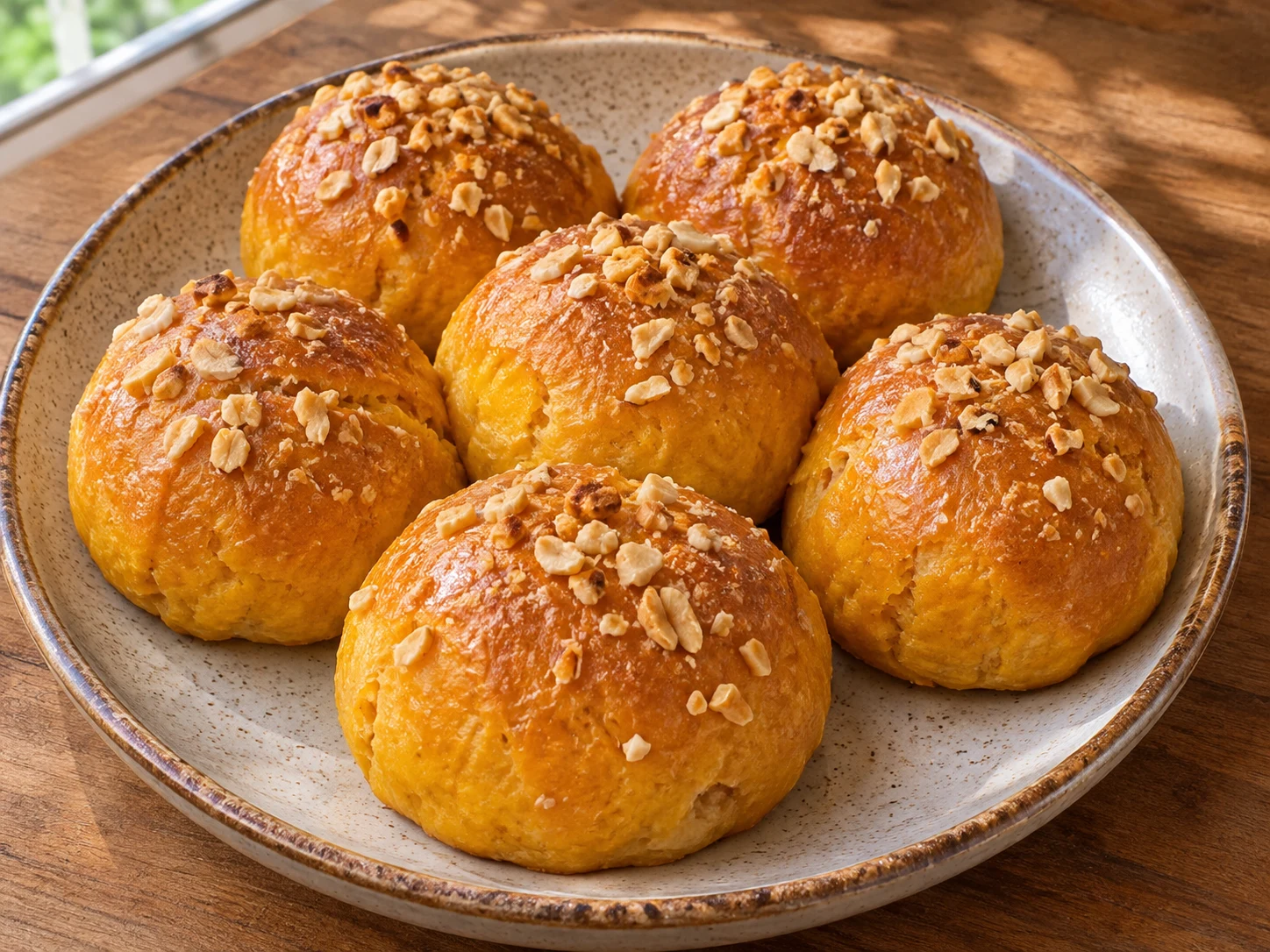
Cooked sweet potato goes into a yeasted wheat dough here, while chopped ginguba gives texture to the crust.
Ingredients
- 350 g wheat flour
- 200 g cooked, cooled sweet potato mash
- 7 g dried baker’s yeast
- About 120 ml lukewarm water
- 50 g unsalted roasted chopped peanuts
- 20 ml oil
- 5 g salt
Preparation
Cook and mash the sweet potato, then allow it to cool.
Combine flour, yeast according to its directions, mash, oil, salt and water added gradually.
Knead for 8–10 minutes until soft.
Cover and rise for about 1 hour, until clearly increased in volume.
Shape eight rolls, add the peanuts on top and rise for another 30–45 minutes.
Bake at 190 °C for about 20–25 minutes and cool on a rack.
Introduction
Cooked sweet potato goes into a yeasted wheat dough here, while chopped ginguba gives texture to the crust. These rolls remain breads: their structure depends on kneading and baker’s yeast, not cake baking powder. The mash adds moisture and a colour that varies with the variety. This contemporary creation is inspired by products found on the Angolan table, without claiming to reproduce a traditional regional bread. Shaping produces eight rolls, to be regarded as eight bread portions rather than eight complete meals.
Water is added gradually because two sweet potato mashes of the same weight may contain different amounts of moisture. A very dry mash absorbs more liquid than boiled flesh that has not drained sufficiently. The stated one hundred and twenty millilitres are therefore an initial amount to adjust cautiously. The main guide is a soft, slightly tacky but manageable dough that becomes more even with kneading. Adding excess flour to make it immediately dry can produce heavy breads after baking.
Cultural context
This recipe is a contemporary creation inspired by ingredients from the Angolan table, not an attested traditional recipe. The references document the products and their context; they are not the source of the proposed formula. The proportions and method are an original editorial proposal. The institutional texts cited provide agricultural or cultural context and do not establish a traditional origin for this formula.
https://www.fao.org/4/j2771p/j2771p00.htm https://www.embassyangolatr.org/tr/angola/cultura
Tips
Weigh cooked, cooled mash with no additions.
Use baker’s yeast, not baking powder.
Add water gradually.
Observe volume during rising rather than the clock alone.
Cool the rolls on a rack before storing.
Planning
Choose bread wheat flour or an ordinary flour suitable for a yeasted dough. Cook the sweet potato, drain if necessary, mash, then cool before weighing. The two hundred grams refer to the finished mash, without skin or added milk or butter. Hot mash can damage the yeast; check that it has lost its heat before incorporating it. The peanuts are roasted and unsalted, then chopped to adhere to the surface without forming large lumps.
Dried baker’s yeast is not interchangeable with baking powder. Some dried yeasts go directly into flour, while others need rehydrating: follow the packet. Measure the salt separately and distribute it through the dough rather than pouring a heap onto yeast being rehydrated. Use lukewarm, not scalding, water. The recipe contains wheat and peanuts; no egg or milk is included in the basic glaze. The shiny appearance of some commercial breads does not justify automatically adding an ingredient that is not listed.
Combine flour, yeast according to its directions, cooled mash, oil and salt in a bowl. Start by adding some of the lukewarm water and mixing, then add the rest gradually. Once the dough comes together, knead for about eight to ten minutes on a clean surface or with a suitable mixer. It should become softer and more cohesive. A dough containing mash does not feel exactly like a simple white bread dough; do not try to dry it out completely with flour.
Form a ball and place in a covered container away from draughts. Leave to rise for about one hour, or until clearly increased in volume. Time depends on temperature, yeast and dough. A cool room slows the rise; an excessively warm place can accelerate it at the expense of consistent control. Volume and softness are more reliable guides than an exact hour. Do not place the container against a scorching heat source to save a few minutes.
Gently fold the dough down to redistribute the gases, then divide into eight similar portions. Shape rolls by drawing the edges under each ball without tearing the surface. Place on a baking-paper-lined tray with room for the second rise. Very lightly moisten the tops if necessary to attach the ginguba, then distribute the pieces. Cover and rise for another thirty to forty-five minutes, until the pieces are puffier and softer.
Preheat the oven to one hundred and ninety degrees and bake for about twenty to twenty-five minutes. The surface should colour without the peanuts becoming dark and bitter. If they brown quickly, protect the tops near the end of baking. Check that a roll is baked inside, without a wet doughy mass. Transfer to a rack and cool before enclosing: steam must escape to avoid a damp crust. Cutting immediately after baking may suggest a sticky crumb when the bread still needs time to stabilise.
Serving
Serve the rolls with a meal or as a snack according to appetite. Divide the surface ginguba among the eight pieces to keep portions comparable. For short storage, wait until completely cool before placing in a suitable container. Some may be frozen once cold and later reheated in the oven. Crumb containing sweet potato remains moist; do not assume it keeps for a long time in a hot room. Discard any mouldy bread rather than merely removing the visible patch.
Storage
Allow to cool completely before storing in a clean, dry container. Freeze some if necessary. Do not enclose pieces while still warm. Discard any product showing mould or an unusual smell.
Variations
Some wheat flour may be replaced with millet flour, but structure and hydration must be reassessed; this entry does not provide a gluten-free formula. Omitting peanuts removes their topping without guaranteeing freedom from contamination in an environment where they have been handled. Seeds can produce another crust, to be named according to the product. Pumpkin mash has more variable moisture and cannot replace the same weight without adjustment. Larger breads need a different baking time and should not simply be removed at the time intended for eight small pieces.
Nutrition notes
Estimated values per serving, excluding accompaniments. Calculated from edible weights and reference foods; brands, cooking and actual yield may change the results. All fat is counted. Where energy is unavailable in the table, it is estimated from protein and carbohydrate (4 kcal/g), fat (9 kcal/g) and fibre (2 kcal/g). Very small optional quantities of spices are not counted.
Conclusion
The desired result depends on the textures described and seasoning adjusted at serving time. This editorial formula is not presented as kitchen-tested. Enjoy your meal!
Enjoy your meal
Enjoy your meal!