Cassava flour crêpes with banana
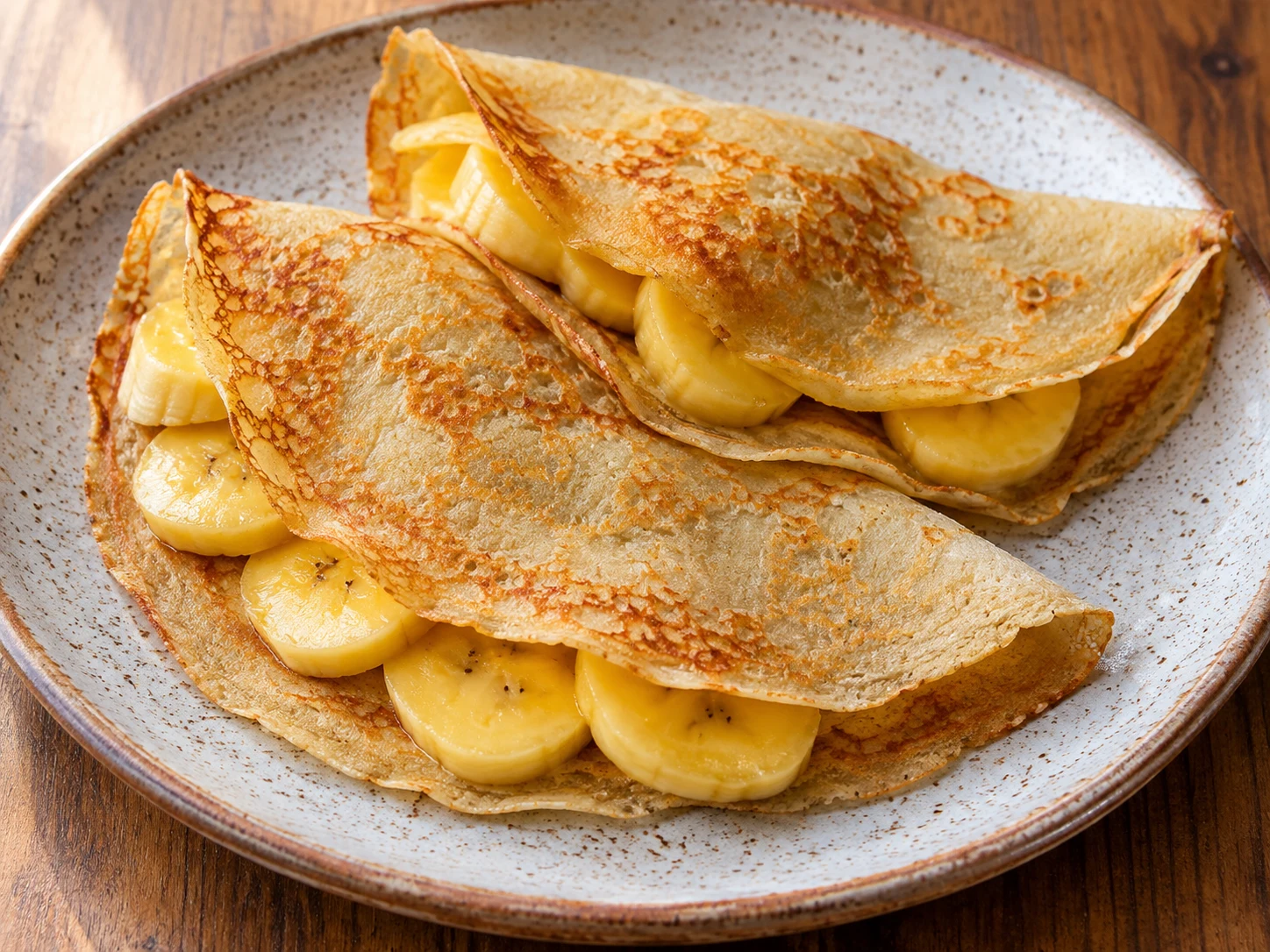
These thin crêpes use food-grade cassava flour, eggs and milk.
Ingredients
- 120 g finely milled food-grade cassava flour, not starch
- 2 eggs
- 300 ml pasteurised milk
- 20 ml oil
- 400 g peeled dessert bananas
- 1 g salt
- Extra water according to absorption
Preparation
Beat eggs and milk, then gradually incorporate flour and salt.
Add 10 ml oil and rest for 15 minutes.
Adjust fluidity with a few spoonfuls of water if necessary.
Heat a nonstick frying pan, then heat a nonstick pan, lightly oil with the remaining oil and cook eight thin crêpes for about 2 minutes on the first side and 1 minute on the other, until fully cooked.
Top with sliced bananas and serve immediately.
Introduction
These thin crêpes use food-grade cassava flour, eggs and milk. Dessert banana provides a simple filling, added after cooking. They differ from cassava cake or fritters: the batter remains fluid and each piece is cooked on both sides in a frying pan. This is a contemporary creation inspired by products of the Angolan table, without attribution to a particular family tradition. The proposed quantities make about eight crêpes, or four servings of two, depending on pan diameter and the amount poured each time.
Cassava flour is not the same as tapioca starch. The former retains more characteristics of the processed root, whereas the latter is mainly starch. They cannot be directly exchanged at equal weight in this formula. Absorption also varies with product fineness. Resting the batter therefore lets you observe its actual consistency before cooking. The intended result is a supple crêpe, cooked in the centre and strong enough to fold around banana.
Cultural context
This recipe is a contemporary creation inspired by ingredients of the Angolan table, not an attested traditional recipe. The references document the products and their context; they are not the source of the proposed formula. The proportions and method are an original editorial proposal. The institutional texts cited provide agricultural or cultural context and do not prove a traditional origin for this formula.
https://www.fao.org/4/j2771p/j2771p00.htm https://www.embassyangolatr.org/tr/angola/cultura
Tips
Use cassava flour, not an equal weight of tapioca starch.
Stir batter after resting and between batches.
Wait for the first side to set before turning.
Adjust water in small amounts.
The filling uses a dessert banana, not a plantain.
Planning
Choose finely milled cassava flour sold as food and accompanied by clear instructions. This recipe does not describe making flour from a fresh root. An unidentified product or one intended for another use is unsuitable. Keep flour dry and discard it if it has an abnormal smell or appearance. Check that it is not mixed with other flours when a particular dietary constraint must be considered.
The eggs are medium to large and the milk pasteurised, plain and unsweetened. Filling bananas are ripe dessert bananas, still firm enough to slice. They are not plantains, whose texture and use would be different. The four hundred grams refer to peeled flesh. The recipe contains no added sugar: sweetness comes from banana. It contains milk and eggs; the absence of wheat should not be confused with a general guarantee that every product is free from gluten contamination.
Beat eggs in a bowl, add some milk, then whisk in flour gradually. Complete with remaining milk, salt and the ten millilitres oil intended for the batter. Scrape the sides so no pockets of dry flour remain. Rest for about fifteen minutes, then stir again: flour can settle and absorb some liquid while waiting. Batter should flow in a thin enough ribbon to spread when the pan is tilted.
If too thick, add water by spoonfuls, mixing between additions. Do not immediately pour in a large glass, which could make batter too runny and fragile. Prepare a plate for cooked crêpes and a small cup to distribute cooking oil. Heat a medium nonstick pan over medium heat. Lightly oil it, then pour a small ladle of batter and tilt to form an even layer. A very thick crêpe does not cook at the same rate and may remain wet in the centre.
Cook about two minutes on the first side, until the surface loses its liquid appearance and edges loosen. Slide a wide spatula underneath before turning. Cook about one more minute on the other side, checking that it sets and lightly colours. Time depends on diameter, thickness and the pan. The first crêpe is a guide for adjusting heat and batter quantity, but the formula is not presented as validated through a previous kitchen trial.
If a crêpe tears, wait until the next one has set further before turning and check that its layer is not too thick. Batter that sticks despite a hot pan may need a little extra oil taken from the stated quantity. Reduce strong heat that browns edges before the centre sets. Stir batter between batches to keep flour evenly distributed. Stack cooked pieces on a clean plate and cover lightly to preserve suppleness without making them soggy.
Serving
Slice bananas just before serving, distribute rounds over crêpes and fold without squeezing tightly. Two pieces form a serving at the stated yield. Serve immediately, with an unsweetened drink according to the meal’s usual practice. Chocolate, sugar or honey toppings are adaptations and are not included in the recipe’s nutritional calculation. To prepare crêpes ahead, cool promptly, refrigerate and reheat briefly before adding freshly sliced bananas. A long wait with the filling would reduce both structure and freshness.
Storage
Cool leftovers promptly in a shallow container, refrigerate at 4 °C or below and eat within 48 hours. Reheat preparations intended to be eaten hot only once, until thoroughly hot in the centre. For salads, keep the dressing and crunchy components separately where possible.
Variations
Banana may be replaced with cooked, drained pineapple wedges, changing the filling’s name. An unsweetened plant drink can alter the batter’s flavour and structure; it needs checking and is not an automatic nutritional equivalent of milk. Removing eggs is not compensated for simply by adding more water. For smaller crêpes, reduce the amount of batter poured and begin checking earlier. Do not turn this size variation into an additional recipe counted separately in the volume.
Nutrition notes
Estimated values per serving, excluding accompaniments. Calculated from edible weights and reference foods; brands, cooking and actual yield may change the results. All fat is counted. When energy is not provided in the table, it is estimated from protein and carbohydrate (4 kcal/g), fat (9 kcal/g) and fibre (2 kcal/g). Very small optional quantities of spices are not counted.
Conclusion
The intended result depends on the textures described and on seasoning adjusted at serving. This editorial formula is not presented as kitchen-tested. Enjoy your meal!
Enjoy your meal
Enjoy your meal!