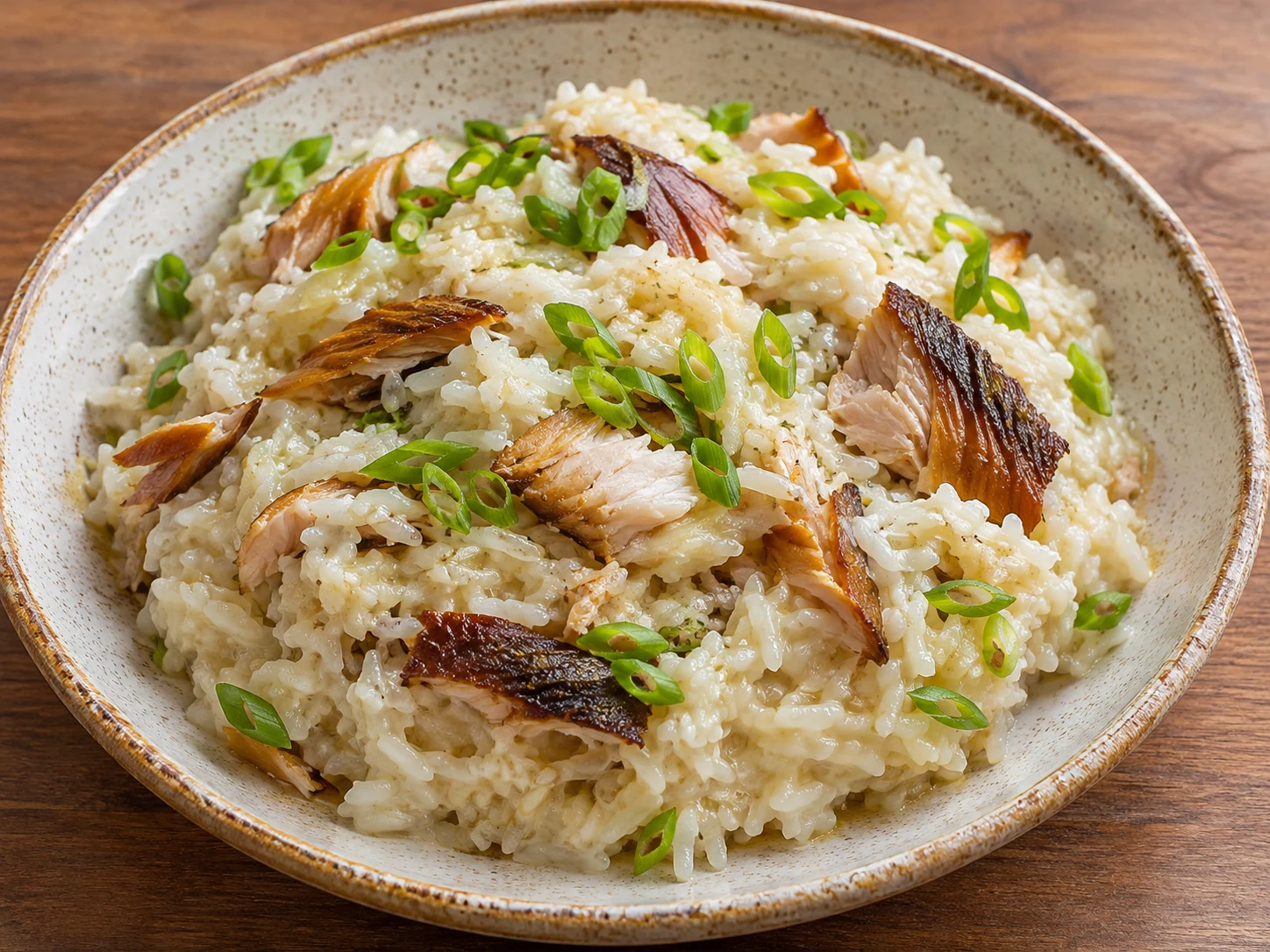
Coconut rice with smoked fish
This rice combines coconut milk with smoked fish that is already cooked and ready to eat according to its label.
Ingredients
- 250 g dry long-grain rice
- 250 g smoked fish flesh, already cooked and ready to eat according to the label
- 250 ml unsweetened coconut milk
- 400 ml water, adjusted to the rice
- 100 g onion
- 10 ml oil
- 2 spring onions
- Up to 1 g salt after tasting
- Pepper
Preparation
Check that the smoked fish is already cooked and ready to eat. Remove skin and bones, flake and keep chilled.
Soften onion in oil, add rinsed drained rice and stir for 1 minute.
Pour in coconut milk and water, cover and cook gently according to the rice packaging, adjusting water if necessary.
Shortly before cooking finishes, fold in the already-cooked fish and heat thoroughly under the lid.
Check rice is tender and taste it with fish before adding salt. Rest off heat for 5 minutes, then separate grains and add spring onions.
Introduction
This rice combines coconut milk with smoked fish that is already cooked and ready to eat according to its label. The fish is flaked and added near the end to heat through without breaking into excessively fine fibres. Rice absorbs some coconut milk and retains a soft texture, without aiming for the creaminess of a sweet rice pudding. This contemporary proposal is inspired by rice and fishery products used in Angolan cuisines; it is not presented as an old regional formula. The quantities make four main-course servings.
The fish must be chosen precisely. The word smoked does not by itself mean that the product is cooked or can be eaten directly. This recipe uses only smoked fish sold already cooked and ready to eat. A product needing thorough cooking would require a different schedule. Salt content varies greatly: the small quantity of added salt is introduced only after tasting rice and fish together. Coconut milk must remain unsweetened to preserve the dish’s savoury character.
Cultural context
This recipe is a contemporary creation inspired by ingredients of the Angolan table, not an attested traditional recipe. The references document the products and their context; they are not the source of the proposed formula. The proportions and method are an original editorial proposal. The institutional texts cited provide agricultural or cultural context and do not prove a traditional origin for this formula.
https://www.fao.org/4/j2771p/j2771p00.htm https://www.embassyangolatr.org/tr/angola/cultura
Tips
For this formula, use only already-cooked smoked fish that is ready to eat.
Check for bones before incorporating.
Add salt only after tasting fish and rice together.
Adjust water and time to the chosen rice.
Cool leftovers rapidly and consume refrigerated within twenty-four hours.
Planning
Choose a long-grain rice with a known absorption cooking method. The two hundred and fifty grams are weighed dry. Precooked rice, brown rice and ordinary long-grain rice do not need the same water or time. The proposed mixture starts with two hundred and fifty millilitres coconut milk and four hundred millilitres water; adjust this to the rice and pan, with a small supply of hot water available. Thick coconut milk provides less free water than a very diluted coconut drink.
Buy smoked fish from a controlled supply chain, check that it is labelled ready to eat and observe its date and storage temperature. Weigh the flesh after removing skin and bones. Pick it over carefully even when sold as a fillet. The smoked fish used as the nutritional reference is an approximate food; actual brand values may differ substantially, especially for salt. Wash the spring onions and remove damaged parts. They go in at the end to retain a fresher aroma than the cooking onion.
Rinse rice if the chosen product calls for this, then drain. Chop the cooking onion and soften in oil over medium heat. Add rice and stir for one minute to distribute oil around the grains, without aiming for brown colouring. Pour in coconut milk and measured water. Stir once to loosen grains from the base, bring to a simmer, then reduce heat and cover.
The liquid should simmer gently. A strong boil evaporates water too quickly and may leave firm grains over an already-dry base. Follow the rice’s time and check near the end rather than lifting the lid every two minutes. If liquid is lacking while grains are still hard, add a few spoonfuls of hot water and continue covered. If rice is already tender but too wet, remove the lid and briefly let excess steam escape over very low heat.
During cooking, flake the already-cooked fish into pieces large enough to remain recognisable. Do not leave it at room temperature for long: prepare quickly and return to the refrigerator if it must wait. A few minutes before the rice finishes cooking, distribute the fish in the saucepan and fold in gently. Cover again to heat it completely. Cooking too long after this addition dries it out and distributes a very dominant smoky flavour throughout the dish.
Taste a bite combining rice and fish before adding optional salt. Remove from heat and rest for five minutes, covered, then gently separate grains with a fork. Add finely sliced spring onions at serving. The rice should be tender and soft, with no burnt base. If some has stuck, take the top portion without scraping the brown layer. For advance preparation, rice must cool rapidly; it must not remain lukewarm in a large saucepan for several hours.
Serving
Divide rice among four deep plates, with visible fish pieces in each serving. Separately cooked greens or a cucumber salad complete the meal without adding another rich preparation. A little lemon can be offered separately, but it is not needed to mask the smoky taste. Serve immediately after resting. If some is uneaten, promptly divide into shallow containers and refrigerate. Reheat only once until fully hot in the centre, with a little water if the rice has firmed up.
Storage
Cool leftovers promptly in a shallow container, refrigerate at 4 °C or below and eat within 24 hours. Reheat preparations intended to be eaten hot only once, until thoroughly hot in the centre. For salads, keep the dressing and crunchy components separately where possible.
Variations
Fresh fish cooked separately can replace the smoked product, but the dish should then be renamed and salt reassessed. A very diluted coconut drink cannot replace thick coconut milk without changing the liquid and texture. For a more plant-based version, some fish can be replaced by cooked black-eyed peas, acknowledging that this is an adaptation. Gindungo can be offered separately. Avoid accumulating smoky or very salty sauces: the dish’s interest remains the contrast between coconut’s sweetness, rice and the fish’s flavour.
Nutrition notes
Estimated values per serving, excluding accompaniments. Calculated from edible weights and reference foods; brands, cooking and actual yield may change the results. All fat is counted. When energy is not provided in the table, it is estimated from protein and carbohydrate (4 kcal/g), fat (9 kcal/g) and fibre (2 kcal/g). Very small optional quantities of spices are not counted.
Conclusion
The intended result depends on the textures described and on seasoning adjusted at serving. This editorial formula is not presented as kitchen-tested. Enjoy your meal!
Enjoy your meal
Enjoy your meal!