Aubergines stuffed with corn and beans
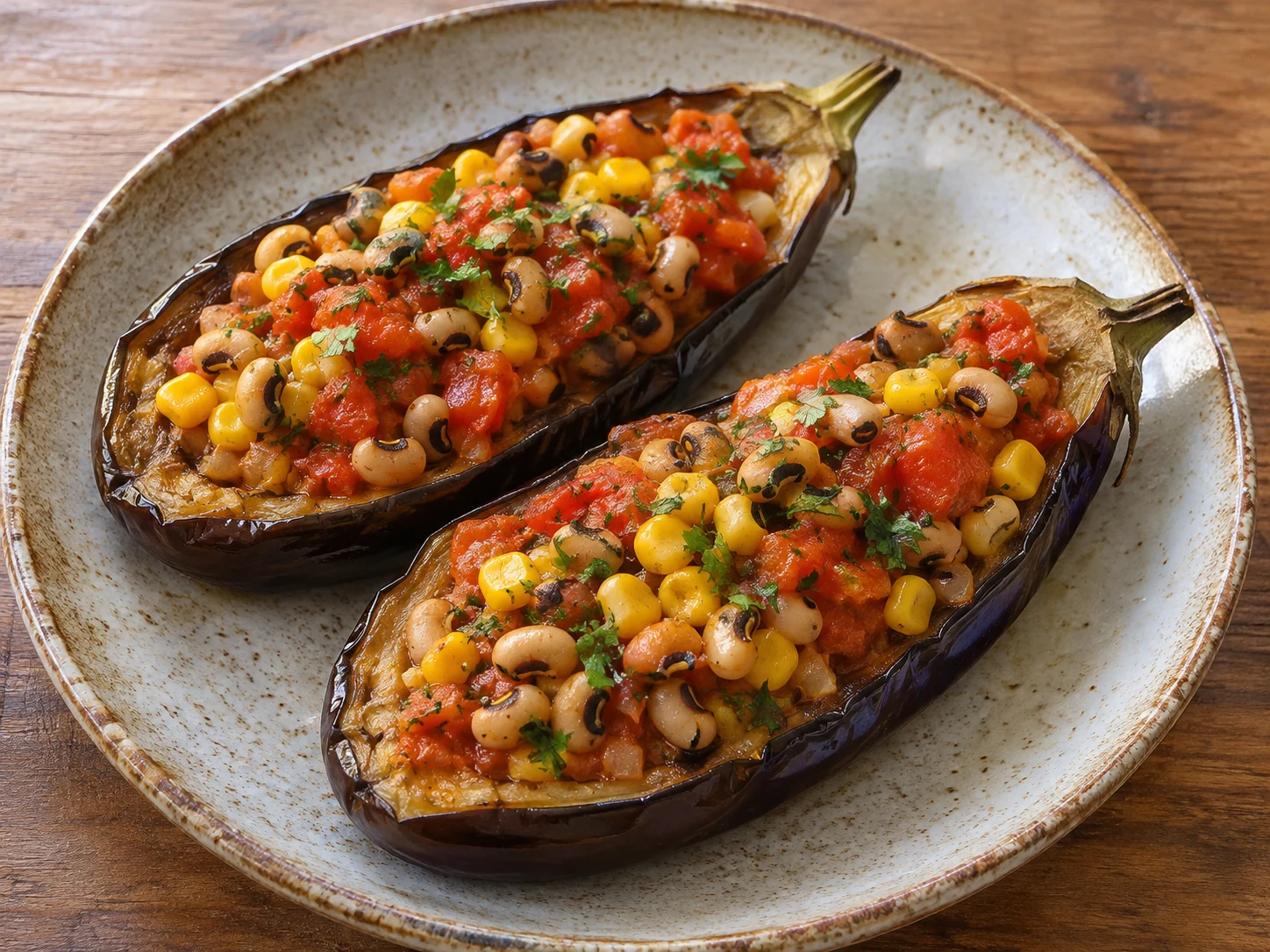
The aubergines are first roasted in halves, then filled with a mixture of corn, black-eyed peas and tomato.
Ingredients
- 2 large aubergines, about 800 g
- 250 g cooked drained corn
- 300 g cooked drained black-eyed peas
- 300 g tomatoes
- 120 g onion
- 25 ml oil
- 1 garlic clove
- 3 g salt
- Pepper
Preparation
Halve the aubergines, score the flesh without piercing the skin and brush with 10 ml oil.
Cook at 200 °C for about 30 minutes.
Soften the onion in the remaining 15 ml oil, add garlic and tomato and cook for 10 minutes.
Scoop out some cooked aubergine flesh and mix with the tomato base, corn and beans.
Fill the shells, add salt and bake for another 15 minutes.
Introduction
The aubergines are first roasted in halves, then filled with a mixture of corn, black-eyed peas and tomato. Some of their flesh goes into the filling and holds it together without cheese or cream. The skin provides a structure that makes serving easier, while the grains remain recognisable. This contemporary preparation is inspired by products of the Angolan table and does not claim the name of a heritage dish. Two large aubergines give four halves, or four servings to supplement according to appetite and the rest of the meal.
The initial cooking must not be shortened enough to leave the flesh hard. An insufficiently roasted aubergine is difficult to scoop out and remains firm beneath a filling that is already ready. Conversely, a completely emptied or overcooked shell tears when lifted. The method therefore keeps a layer of flesh against the skin and finishes everything with a short return to the oven. Tomato moisture is reduced separately so that the filling stays cohesive without becoming watery.
Cultural context
This recipe is a contemporary creation inspired by ingredients of the Angolan table, not an attested traditional recipe. The references document the products and their context; they are not the source of the proposed formula. The proportions and method are an original editorial proposal. The institutional texts cited provide agricultural or cultural context and do not prove a traditional origin for this formula.
https://www.fao.org/4/j2771p/j2771p00.htm https://www.embassyangolatr.org/tr/angola/cultura
Tips
Cook aubergine until tender before scooping.
Keep flesh against the skin for support.
Weigh corn and black-eyed peas after draining.
Reduce an overly watery filling before stuffing.
Lift the halves with a wide spatula.
Planning
Choose two firm aubergines, wide enough to hold a filling and weighing close to eight hundred grams in total. Their skin should be supple, with no mouldy area or significant collapse. Wash them and remove the stalk if it hinders assembly, then split lengthwise. The weights of corn and black-eyed peas refer to cooked, drained products. Plain canned versions are suitable after rinsing if necessary. Dried beans or dried corn cannot be placed directly in the aubergines.
The tomatoes are ripe and cut into small dice. Very watery flesh needs longer reduction in the pan. Chop the onion finely enough to incorporate into the filling without large pieces. Garlic is used in a small quantity to retain the aubergine’s flavour. Prepare a tray or dish that holds the four halves without wedging them tightly. A container that is too small makes filling awkward and stops heat reaching the sides evenly.
Preheat the oven to two hundred degrees. Score the flesh of each half in a criss-cross pattern with a knife tip, without piercing the skin. These cuts help heat penetrate and make the flesh easier to remove later. Distribute the specified ten millilitres of oil over the cut faces. Place aubergines on a tray and cook for about thirty minutes, until the flesh crushes under a spoon. Adjust to their width: a large, thick half can need longer than a long, thin aubergine.
During this cooking, soften the onion in the remaining fifteen millilitres of oil. Add garlic, then tomatoes, and cook for about ten minutes, stirring. The mixture should lose some water but remain supple. Add the already-cooked corn and black-eyed peas, then warm gently. Do not crush the beans with the back of the spoon: a few broken beans bind the mixture naturally, but a uniform purée is not the intended texture.
Remove aubergines from the oven and let their fiercest steam escape. Scoop out some flesh with a spoon without scraping down to the skin. Keep a small supporting thickness along the sides and bottom. Cut the removed flesh into small pieces and add to the filling. Add salt and pepper after this addition, as the aubergine changes both volume and the perception of salt. If the mixture looks very liquid, return it to the frying pan for a few minutes before filling.
Fill the shells without packing firmly and distribute the filling evenly. Return to the oven for about fifteen minutes, until fully hot in the centre and the exposed ingredients have lightly coloured. The aubergines do not need a thick brown crust. If the corn kernels dry too quickly, cover lightly for part of the cooking. Use a wide spatula to transfer each half afterwards: the hot skin is more fragile than at the start. A short rest makes serving easier without imposing a long wait.
Serving
Serve half an aubergine per person with a crunchy salad or vegetables according to appetite. Black-eyed peas and corn already provide a substantial base; rice or bread can complete a larger meal but is not included in this recipe. At a table with several dishes, portions may be divided after cooking, taking care to keep filling with each piece. The shells and filling can be prepared ahead if cooled promptly and kept separately in the refrigerator. Cold components need longer reheating, until thoroughly hot in the centre.
Storage
Cool leftovers promptly in a shallow container, refrigerate at 4 °C or below and eat within 48 hours. Reheat preparations intended to be eaten hot only once, until thoroughly hot in the centre. For salads, keep the dressing and crunchy components separately where possible.
Variations
Cooked red beans can replace black-eyed peas in a clearly named variation. A small amount of gindungo can be added to the tomato. Courgette flesh is not a direct replacement for aubergine: it contains more water and needs different management of the filling. Cheese remains optional in an adaptation, but changes the allergens and nutritional values. A version with cooked fish requires checks for bones and attention to storage, and becomes a different dish. Keeping the plant-based formula here preserves the contrast between grains and roasted flesh.
Nutrition notes
Estimated values per serving, excluding accompaniments. Calculated from edible weights and reference foods; brands, cooking and actual yield may change the results. All fat is counted. When energy is not provided in the table, it is estimated from protein and carbohydrate (4 kcal/g), fat (9 kcal/g) and fibre (2 kcal/g). Very small optional quantities of spices are not counted.
Conclusion
The intended result depends on the textures described and on seasoning adjusted at serving. This editorial formula is not presented as kitchen-tested. Enjoy your meal!
Enjoy your meal
Enjoy your meal!