Millet patties with sweet potato leaves
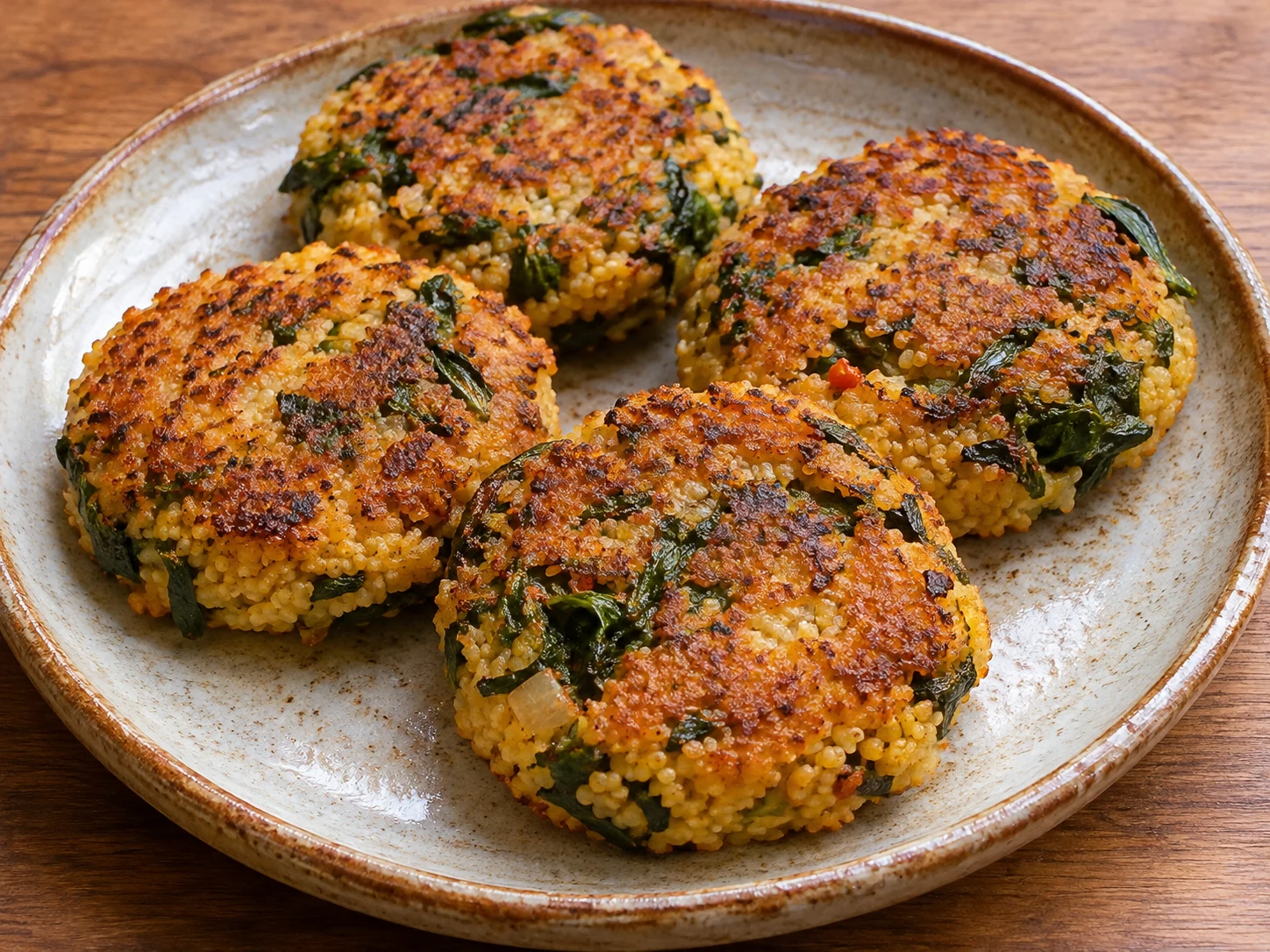
These patties bring together cooked millet grains, sweet potato leaves and a small quantity of millet flour.
Ingredients
- 180 g dry hulled millet
- 300 g food-grade sweet potato leaves
- 2 eggs
- 40 g millet flour
- 80 g onion
- 25 ml oil
- 2 g salt
- Cooking water
Preparation
Cook the millet according to its packaging, drain if necessary and let cool to lukewarm.
Wash the edible sweet potato leaves, remove tough stems and cook them in boiling water for 10 to 15 minutes until tender.
Drain, squeeze and chop.
Soften the onion in 5 ml oil.
Mix millet, leaves, onion, eggs and flour.
Form eight patties and cook in the remaining 20 ml oil for about 5 minutes per side, until fully set.
Introduction
These patties bring together cooked millet grains, sweet potato leaves and a small quantity of millet flour. Eggs bind the mixture, and pan-frying creates a lightly coloured surface. The texture should remain more rustic than a purée: the grains are recognisable and the leaves are distributed in small fragments. The recipe is a contemporary creation inspired by cereals and leaves eaten in Angolan cuisines; it is not described as shaped funge or as a traditional recipe collected in a particular province. Eight patties make four servings.
Draining is the decisive step. Millet that is too wet or leaves that have not been squeezed sufficiently produce a mixture that is difficult to shape. Adding a great deal of flour to correct this makes the patties heavy and masks the vegetables. It is better to prepare each component properly before combining them. The recipe also allows the leaves and millet to cook in parallel, then cool to lukewarm before the eggs are introduced.
Cultural context
This recipe is a contemporary creation inspired by ingredients of the Angolan table, not an attested traditional recipe. The references document the products and their context; they are not the source of the proposed formula. The proportions and method are an original editorial proposal. The institutional texts cited provide agricultural or cultural context and do not prove a traditional origin for this formula.
https://www.fao.org/4/j2771p/j2771p00.htm https://www.embassyangolatr.org/tr/angola/cultura
Tips
Identify sweet potato leaves unambiguously.
Drain and squeeze the leaves before mixing.
Let the components cool to lukewarm before adding eggs.
Shape patties of equal thickness.
Wait for the first side to set before turning.
Planning
Buy hulled millet intended for human consumption and check the product’s cooking instructions. Millet flour is used in a small quantity as a binder; it does not replace the cooked grains at the same weight. Pearl millet is called massango in the Angolan context, whereas massambala refers to sorghum. This recipe uses an identifiable food-grade millet and does not claim that every species or grind absorbs exactly the same amount of liquid.
The leaves must come from a food supply chain and be identified as sweet potato leaves. Never confuse them with ordinary potato leaves, which are unsuitable for this recipe. Remove tough stems, damaged areas and any dirt, then wash thoroughly. The three hundred grams refer to prepared leaves before cooking. Leaves sold for ornamental use, or whose treatment is unknown, are unsuitable. Use whole eggs with intact shells; they are the main allergen in the formula.
Cook the millet according to its packaging, with a quantity of water suited to its grind and degree of hulling. The aim is tender grains that have absorbed the liquid without forming a soup. If water remains at the end, drain and briefly spread the grains in a dish to let excess steam escape. Do not add the eggs immediately to a piping-hot mass. Let it cool to lukewarm while preparing the leaves and onion.
Bring a saucepan of water to the boil and cook the prepared leaves until tender, generally ten to fifteen minutes depending on their thickness. Drain them, then squeeze carefully once cool enough to handle. Chop finely afterwards. A handful of leaves that still releases plenty of water needs further draining. Soften the chopped onion in the specified five millilitres of oil without browning it strongly, then let it cool to lukewarm too.
Combine millet, leaves, onion, beaten eggs, flour and salt in a bowl. Mix until evenly distributed, without trying to make a completely smooth paste. Rest for a few minutes so the flour absorbs moisture. Form eight portions and flatten into patties of similar thickness. If the mixture falls apart, first check for excess water and allow a little more resting time. An overly thick patty colours before its centre sets; a very thin one dries quickly. One and a half centimetres is a practical guide, adjusted to the actual consistency.
Heat a nonstick frying pan with some of the remaining oil. Add a few patties without crowding and let their first side set before moving them. Cook for about five minutes per side over medium heat, distributing the oil across the batches. Turn with a wide spatula rather than small tongs that would cut them. The centre must be set and thoroughly hot, with no still-wet egg mixture. If the surface browns too quickly, reduce the heat and continue more gently. Time depends on thickness and the pan’s material.
Serving
Serve two patties per person with a reduced tomato sauce offered separately and a fresh salad. Do not pour the sauce over them long before serving, as it would soften the surface. A wide plate lets the patties lie side by side. For a buffet, hold them briefly on a rack rather than stacking them in a closed container. Trapped steam moistens the crust. Patties prepared ahead should be cooled promptly and refrigerated; reheat until thoroughly hot in the centre while limiting drying.
Storage
Cool leftovers promptly in a shallow container, refrigerate at 4 °C or below and eat within 48 hours. Reheat preparations intended to be eaten hot only once, until thoroughly hot in the centre. For salads, keep the dressing and crunchy components separately where possible.
Variations
Edible spinach can replace sweet potato leaves after cooking and squeezing, but the name must then change. Whole sorghum cannot replace millet without adapting its initial cooking. A small pinch of gindungo may be distributed through the mixture for extra heat. Omitting the egg requires another binder and fresh recipe development; an extra spoonful of water does not replace it. An oven version is possible, but produces a different surface and requires separate checks of time and consistency.
Nutrition notes
Estimated values per serving, excluding accompaniments. Calculated from edible weights and reference foods; brands, cooking and actual yield may change the results. All fat is counted. When energy is not provided in the table, it is estimated from protein and carbohydrate (4 kcal/g), fat (9 kcal/g) and fibre (2 kcal/g). Very small optional quantities of spices are not counted.
Conclusion
The intended result depends on the textures described and on seasoning adjusted at serving. This editorial formula is not presented as kitchen-tested. Enjoy your meal!
Enjoy your meal
Enjoy your meal!