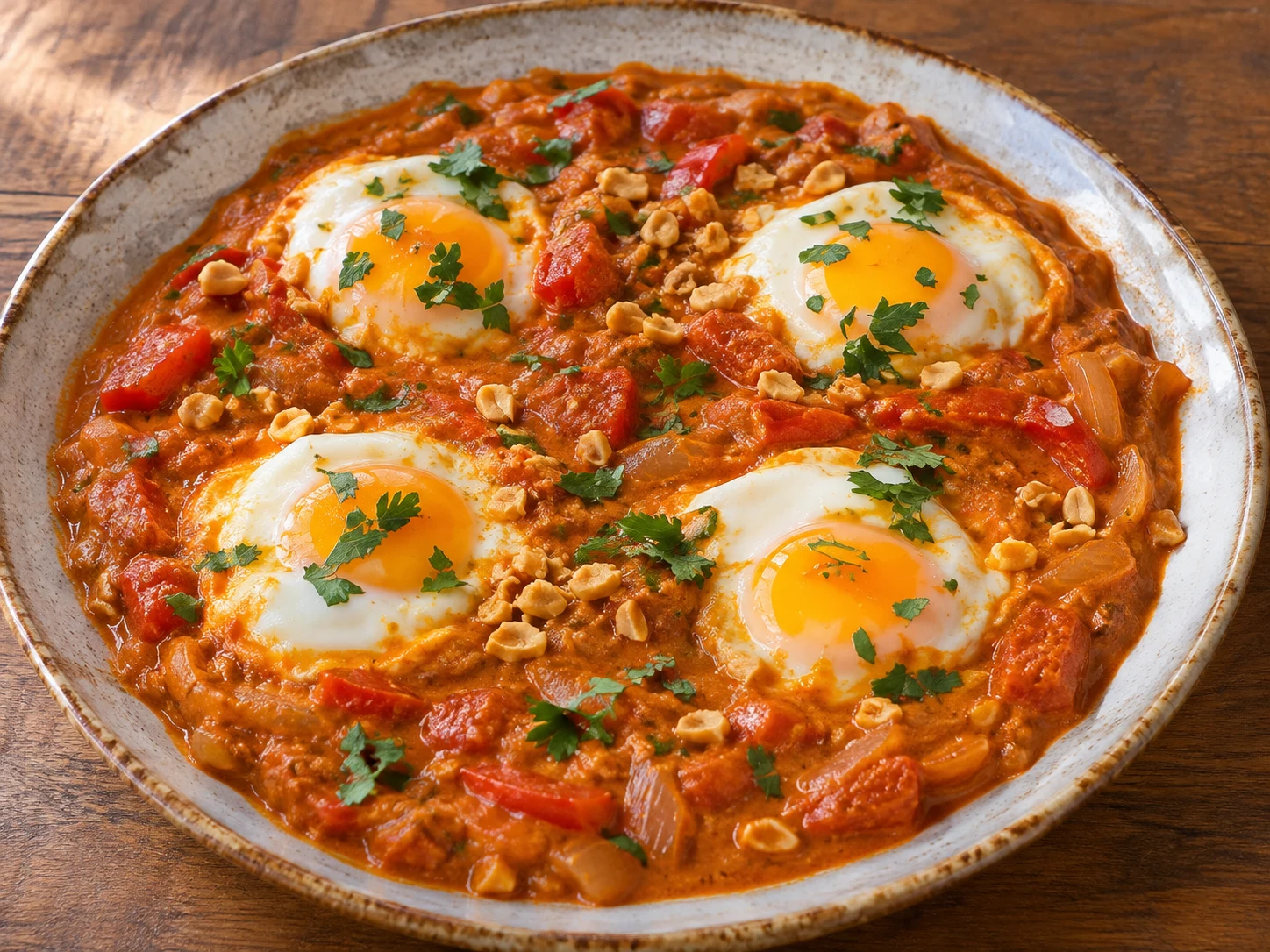
Eggs poached in tomato and ginguba sauce
The eggs are placed in an already-cooked tomato and ginguba sauce, then finish gently under a lid.
Ingredients
- 8 eggs
- 600 g chopped tomatoes
- 100 g onion
- 60 g pure unsweetened peanut butter
- 15 ml oil
- 150 ml water
- 1 garlic clove
- 2 g salt
- Optional gindungo chilli
Preparation
Soften onion and garlic in oil, add tomato and cook for 12 minutes.
Dilute the peanuts in the water, incorporate and simmer for 10 minutes.
Make eight hollows and crack the eggs separately before sliding them into the sauce.
Cover and cook over low heat until whites and yolks set, about 8 to 12 minutes depending on the pan.
Serve immediately.
Introduction
The eggs are placed in an already-cooked tomato and ginguba sauce, then finish gently under a lid. The preparation is served with a spoon, with whites and yolks set and a sauce supple enough to surround each portion. This contemporary formula draws on ingredients found in Angolan kitchens, but is not presented as a heritage recipe or the Angolan version of another country's dish. The eight eggs yield four portions of two eggs each. Ginguba gives body without needing to pour in cream.
The balance is built before adding the eggs. The tomato must lose its raw sensation, the onion must become tender and the peanut paste must be perfectly dispersed. After poaching, it becomes difficult to correct the sauce without breaking the eggs. Take time to taste the base and adjust its fluidity while it is still alone in the sauté pan. Once the eggs are in place, the main aim is steady heat and gentle steam under the lid.
Cultural context
This recipe is a contemporary creation inspired by ingredients of the Angolan table, not an attested traditional recipe. The references document the products and their context; they are not the source of the proposed formula. The proportions and method are an original editorial proposal. The institutional texts cited provide agricultural or cultural context and do not establish a traditional origin for this formula.
https://www.fao.org/4/j2771p/j2771p00.htm https://www.embassyangolatr.org/tr/angola/cultura
Tips
Prepare and taste the sauce before placing the eggs.
Choose a sauté pan that allows them to be spaced.
Crack each egg into a separate cup.
Maintain a gentle simmer under the lid.
The formula calls for whites and yolks to be fully set.
Planning
Choose fresh eggs with intact shells and store them according to the product's usual instructions. Crack them one at a time into a small clean cup before sliding them into the sauce: this allows a shell fragment to be spotted without searching the whole pan. The eggs are medium to large; very large eggs may require a little longer. The recipe calls for whites and yolks to be fully cooked, rather than a runny finish that would require other precautions depending on the diners.
Use plain chopped tomatoes or the same weight of finely chopped ripe tomatoes. If canned tomatoes are already salted, reduce the added salt. The ginguba paste is pure, unsweetened and stirred smooth in its jar before weighing. Onion and garlic are chopped to distribute through a sauce that will remain chunky. Gindungo is optional; dose it in the base before the eggs so its intensity can be checked. The preparation contains egg and peanuts, two allergens that must be declared.
A wide sauté pan with a lid is more suitable than a small deep saucepan. It allows eight eggs to be spaced without overlapping and the sauce to be distributed in a reasonably even layer. Soften the onion in oil over medium heat without blackening, then briefly add the garlic. Pour in the tomatoes and cook for about twelve minutes. Stir the bottom regularly and reduce the heat if splattering becomes strong. The sauce should concentrate while retaining enough moisture.
Dilute the peanut paste in the one hundred and fifty millilitres of lukewarm water. Start with a small amount of water, stir until smooth, then add the rest. Pour this mixture into the tomatoes and simmer for about ten minutes. At this stage, draw a spoon across the bottom: its trail should close slowly. An immobile, almost pasty sauce may stick beneath the eggs. Loosen it with a few spoonfuls of hot water and taste before proceeding. Salt now, taking account of concentration and the product used.
Make eight small hollows with the back of the spoon without completely exposing the pan bottom. Place one egg in each hollow. If the white spreads a little, this is not a fault; the important thing is to retain identifiable portions. Lower the heat and cover. The sauce should barely simmer around the eggs, not boil strongly and lift the whites. The lid traps steam that helps cook the top without turning the eggs.
Check after about eight minutes, then continue according to egg size and the pan, often up to twelve minutes. The whites must be opaque and set, and the yolks firm in this formula. A very hot hob can burn the bottom before they set: lower the heat, add a little hot water around the edge and cover again if necessary. Do not pour a glass of water directly over the eggs. Once cooked, remove the pan from the heat and serve without waiting for a further lengthy reduction.
Serving
Lift out two eggs per person with a wide spoon, then add sauce around them. Bread, rice or a small piece of cooked cassava may accompany the meal according to habits and appetite. These additions are not counted in this recipe's quantities. A cucumber salad brings freshness without adding another rich sauce. For a large table, use two sauté pans rather than increasing the depth in a vessel that is too small. The sauce can be prepared ahead; reheat it completely before adding fresh eggs at mealtime.
Storage
Cool leftovers quickly in a shallow container, refrigerate at 4 °C or below and eat within 48 hours. Reheat preparations intended to be eaten hot only once, until thoroughly hot at the centre. For salads, keep the dressing and crunchy elements separate where possible.
Variations
A milder version simply omits gindungo. Already-cooked and well-drained vegetable leaves may be distributed in the sauce before the eggs, but change the amount of garnish and the yield. A different seed paste no longer makes a ginguba recipe and is not an automatic substitution for every allergy. If using a different number of eggs, adjust pan size and number of portions rather than keeping the same presentation. The sauce can be served alone with beans, but that adaptation becomes a separate preparation that should be clearly named.
Nutrition notes
Estimated values per serving, excluding accompaniments. Calculated from edible weights and reference foods; brands, cooking and actual yield may change the results. All fat is counted. When the table does not provide energy, it is estimated from protein and carbohydrate (4 kcal/g), fat (9 kcal/g) and fibre (2 kcal/g). Very small optional quantities of spices are not counted.
Conclusion
The intended result depends on the textures described and seasoning adjusted at serving. This editorial formula is not presented as kitchen-tested. Enjoy your meal!
Enjoy your meal
Enjoy your meal!