Oven chicken with maize and ginguba coating
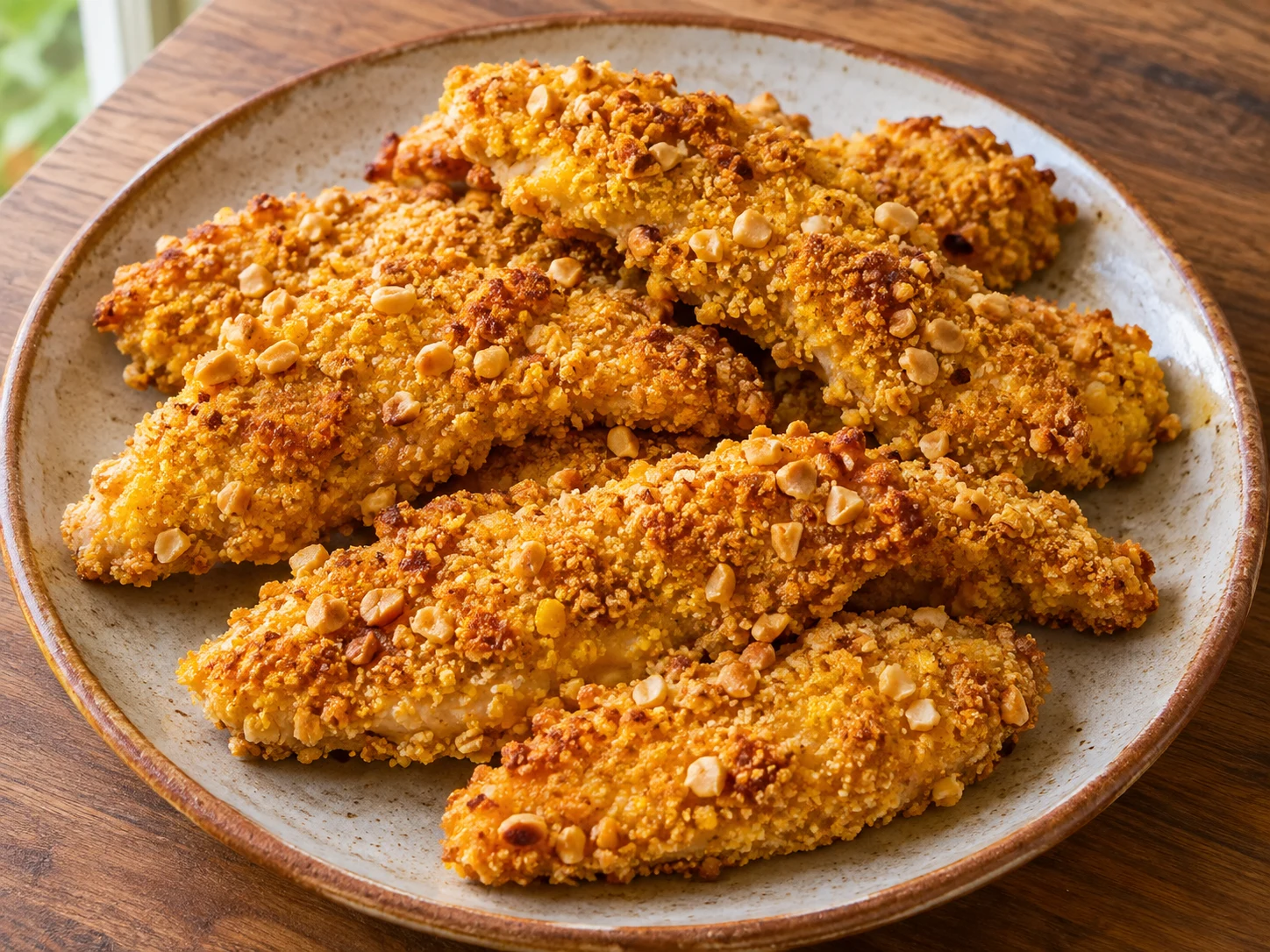
These chicken strips bake in the oven beneath a coating of maize and ginguba.
Ingredients
- 600 g chicken breast fillets
- 80 g fine maize meal
- 60 g unsalted roasted chopped peanuts
- 1 egg
- 30 g plain wheat flour
- 15 ml oil
- 2 g salt
- Black pepper
Preparation
Cut the chicken into thick, evenly sized strips.
Place flour, beaten egg and the maize-peanut mixture in three plates.
Pass the pieces through each preparation in succession, then arrange them on an oiled tray.
Distribute the oil in drops.
Bake at 200 °C for about 20 to 25 minutes, turn halfway through and check that the thickest pieces reach a centre temperature of 74 °C.
Introduction
These chicken strips bake in the oven beneath a coating of maize and ginguba. Wheat flour fixes an initial film to the meat, the egg allows the dry mixture to adhere, and the peanuts give a more irregular texture than ordinary breadcrumbs. Oven cooking avoids the need for a deep-frying bath, but requires the pieces to be well spaced and their centres checked. This contemporary creation uses ingredients found on the Angolan table without claiming the traditional origin of a particular breaded chicken dish. The quantities yield four portions, to accompany with vegetables and a starchy food according to appetite.
The intended result is a thin, lightly golden coating firmly attached to fully cooked meat. A thick layer may look generous but sometimes remains dry on the surface and pasty against the flesh. The pieces are therefore cut into thick strips of similar size, rather than large cubes or very thin slices. Their size determines the actual cooking time. The colour of the maize and peanuts is a texture guide, not sufficient proof that the chicken is cooked.
Cultural context
This recipe is a contemporary creation inspired by ingredients of the Angolan table, not an attested traditional recipe. The references document the products and their context; they are not the source of the proposed formula. The proportions and method are an original editorial proposal. The institutional texts cited provide agricultural or cultural context and do not establish a traditional origin for this formula.
https://www.fao.org/4/j2771p/j2771p00.htm https://www.embassyangolatr.org/tr/angola/cultura https://www.foodsafety.gov/food-safety-charts/safe-minimum-internal-temperatures
Tips
Do not taste the coating after contact with raw chicken.
Use clean tongs for serving.
Check the centres of the thickest pieces.
Do not overlap the strips on the tray.
Meal that is too coarse gives a hard coating and requires another formula.
Planning
Use skinless, boneless chicken fillets and keep them refrigerated until preparation. The six hundred grams refers to trimmed flesh. Do not wash raw chicken under running water: splashes may spread contamination over the worktop. Blot it if necessary with paper suitable for food contact. Separate the board and utensils used for raw meat from those that will hold ready-to-eat foods.
The fine maize meal must be small enough to form a pleasant coating. Coarse polenta would remain harder and require a different formulation. The peanuts are roasted, unsalted and chopped into small fragments, without being ground to a paste. The wheat flour is ordinary flour without added raising agent. Beat the egg in a shallow bowl until smooth. This formula contains wheat, egg and peanuts: all three allergens must be declared, even if the coating appears to consist mainly of maize.
Preheat the oven to two hundred degrees and prepare a rimmed baking tray. Line it with baking paper suitable for this temperature. Arrange the three coating stages in working order: flour, beaten egg, then the mixture of maize, peanuts, salt and pepper. Keep a clean plate for the coated pieces and another area for raw products. A linear arrangement reduces handling and avoids touching handles and jars with soiled hands.
Coat a strip lightly in flour, then shake off the excess. Dip it in the egg and let the surplus drip off before placing it in the dry mixture. Press gently to fix the particles. One hand can handle the wet stages and the other the dry mixture; this limits the accumulation of sticky paste on the fingers. Set each piece on the tray without touching the next. Distribute the oil in small drops rather than creating a puddle under a few pieces.
Bake for about twenty to twenty-five minutes, turning halfway through with clean tongs. Turning allows both sides to dry and colour more evenly. If it tears away the coating, wait a little longer before moving the other pieces: a still-damp crust sticks more to the paper. Avoid compressing the meat with the tongs. If the top colours very quickly, reduce the heat slightly or shield the tray while continuing to cook the flesh.
Check the centre temperature of the thickest pieces with a clean food thermometer. This recipe uses seventy-four degrees Celsius as the chicken benchmark. Insert the probe into the centre of the fleshy part without touching the tray, and check several pieces when sizes differ. Golden coating may surround meat that is still insufficiently cooked. The stated time therefore remains an estimate. After checking, serve with clean utensils and discard leftover flour, egg and coating that touched raw chicken.
Serving
Serve straight from the oven, spreading the strips out without stacking them in a closed container. Accumulated steam would soften the coating. Tomatoes, salad leaves and a lemon dressing served separately provide a simple contrast. The sauce must not be poured over the pieces long in advance. For a buffet, cook and replenish small quantities while keeping uncooked preparations chilled. Avoid leaving a large platter of chicken to become lukewarm throughout the meal. The recipe quantities serve four people and exclude the accompanying sauce.
Storage
Cool leftovers quickly in a shallow container, refrigerate at 4 °C or below and eat within 48 hours. Reheat preparations intended to be eaten hot only once, until thoroughly hot at the centre. For salads, keep the dressing and crunchy elements separate where possible.
Variations
A whole cutlet requires a different cooking time; the change is not simply to omit cutting. A peanut-free version can use a different coating after checking every product and the environment for an allergic person. Rice flour can replace wheat flour in the first stage, but does not automatically make the whole recipe suitable for a gluten-free requirement. A little gindungo can be added to the dry mixture in a small quantity. It seasons the coating without requiring a liquid marinade that would interfere with adhesion.
Nutrition notes
Estimated values per serving, excluding accompaniments. Calculated from edible weights and reference foods; brands, cooking and actual yield may change the results. All fat is counted. When the table does not provide energy, it is estimated from protein and carbohydrate (4 kcal/g), fat (9 kcal/g) and fibre (2 kcal/g). Very small optional quantities of spices are not counted.
Conclusion
The intended result depends on the textures described and seasoning adjusted at serving. This editorial formula is not presented as kitchen-tested. Enjoy your meal!
Enjoy your meal
Enjoy your meal!