Fish parcels with tomatoes and gindungo
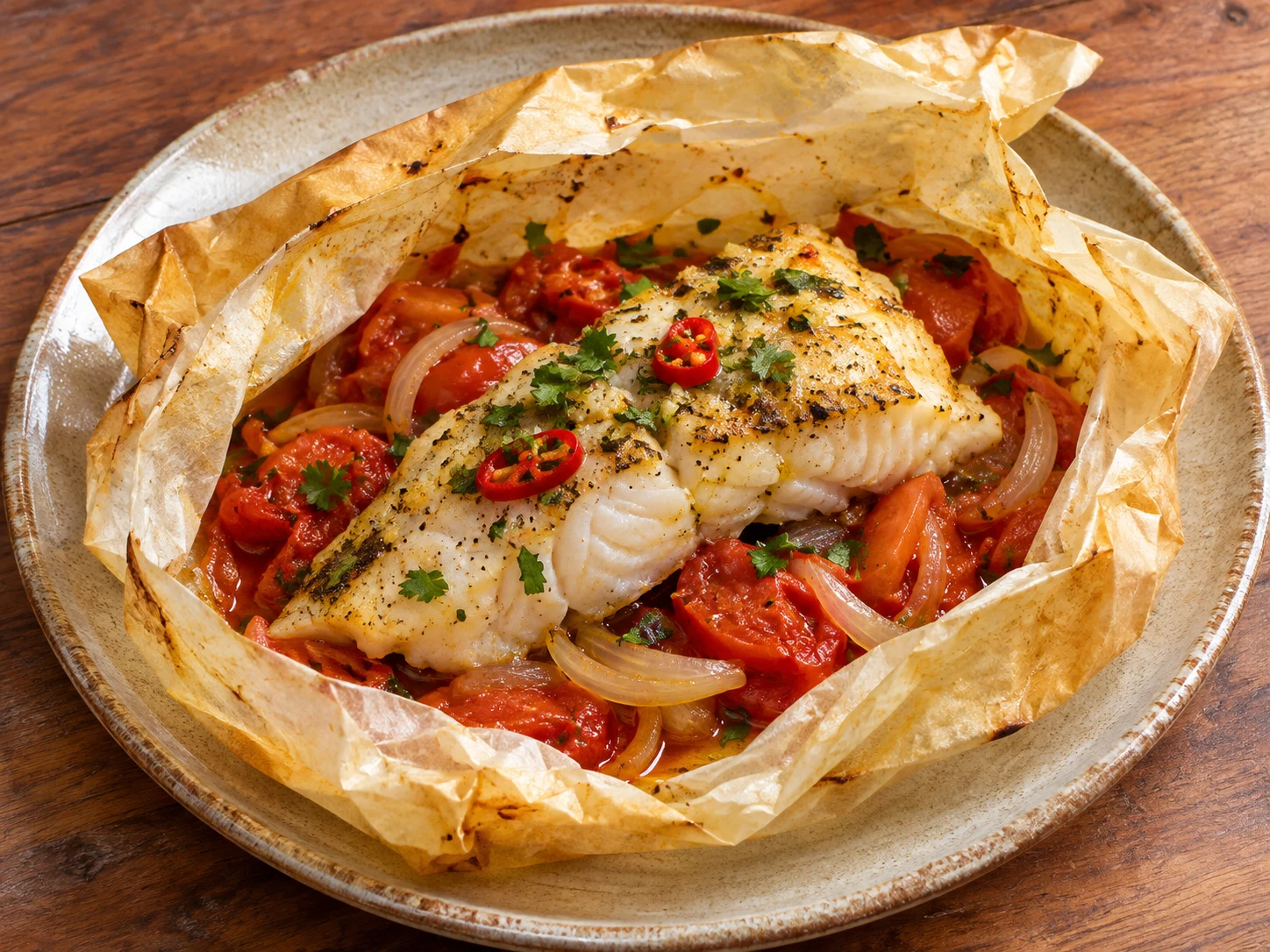
A paper parcel encloses the fish and vegetables in a small pocket of baking paper.
Ingredients
- 600 g boneless white fish fillets
- 350 g tomatoes
- 150 g onion
- 2 garlic cloves
- 15 ml oil
- 15 ml lime juice
- 3 g salt
- Gindungo to taste
Preparation
Preheat to 190 °C.
Finely cut the tomatoes and onion.
Prepare four baking-paper parcels; divide the vegetables among them, then the fillets.
Add garlic, oil, salt and chilli.
Seal, leaving room for steam.
Cook for about 18–22 minutes depending on thickness.
Open carefully away from your face and check that the fish is fully cooked.
Add lime when serving.
Introduction
A paper parcel encloses the fish and vegetables in a small pocket of baking paper. Moisture from the tomatoes is enough to create fragrant steam, while oil rounds out the juices. This formula brings together white fish, tomato, onion and gindungo in a contemporary preparation inspired by products of the Angolan table. It is not presented as an ancient regional technique or as mufete, whose organisation and cooking are different. The four portions are prepared separately so that each cooks with its own topping and can be served without dividing a large, fragile piece.
The key is to retain enough space around the fillet. The paper must neither compress the flesh nor let all the juices leak through a poorly folded opening. Nor is a parcel a wrapping intended to brown the fish: the aim is opaque, supple, fully cooked flesh with a small amount of juice. The tomatoes retain visible colour and the onion becomes tender. Use gindungo sparingly, so that the aroma of the fish remains perceptible even in a spicy version.
Cultural context
This recipe is a contemporary creation inspired by ingredients from the Angolan table, not an attested traditional recipe. The references document the products and their context; they are not the source of the proposed formula. The proportions and method are an original editorial proposal. The institutional texts cited provide agricultural or cultural context and do not establish a traditional origin for this formula.
https://www.fao.org/4/j2771p/j2771p00.htm https://www.embassyangolatr.org/tr/angola/cultura
Tips
Keep raw fish refrigerated until assembly.
Open the parcel away from your face: steam burns even if the paper feels lukewarm.
Slice onion very finely.
Check the thickest fillet and adjust the cooking time.
Do not describe the fish as grilled: it cooks in its own moisture.
Planning
Choose four portions of white fish weighing around one hundred and fifty grams each, fairly thick and similar in size. Hake works, as does another fillet recommended by the fishmonger for gentle cooking. The quantity excludes bones and skin if the latter is not pleasant in this preparation. Feel the fillets with your fingers and remove remaining bones with tweezers. Frozen fish must thaw in the refrigerator and then be thoroughly drained: plentiful water on the tray would dilute the juices instead of enriching them.
The tomatoes must be ripe but still firm enough to cut. Keep their flesh and juice but remove the tough stalk attachment. Slice the onion very finely, because thick slices would stay firm during the fish’s short cooking time. Grate or chop the garlic to distribute it without leaving overpowering pieces. Gindungo may be a powder or an identified chilli; its strength varies with the product. Do not replace a small pinch of powder with a large spoonful of sauce without checking that sauce’s composition and salt content.
Prepare four large sheets of oven-safe baking paper and check the temperature limits stated on the packaging. A sheet that is too short becomes difficult to seal as the topping gains volume. Lay the sheets on the worktop and first divide the tomatoes and onion over one half of each sheet. Leave a wide clear border. Place a fillet on the vegetables, then distribute the garlic, oil, salt and chilli. Reserve the lime juice for serving, allowing more precise final seasoning.
Fold the free half of the paper over and gradually fold the edge, overlapping the small folds. The seal should retain the juice while keeping an air pocket around the fish. Place the parcels on a rimmed tray to catch possible leaks and make the packets easier to remove. Do not use paper that would touch a heating element or project into a very hot area of the oven. Do not place a parcel directly over a flame. Bake at mid-height in an oven preheated to one hundred and ninety degrees.
Start checking around eighteen minutes, then adjust up to twenty-two minutes or longer if thickness requires it. Time is not a guarantee independent of portion size. Transfer one parcel to a plate and carefully open its edge, directing the escaping steam away from face and hands. Check the centre of the fillet: it should be opaque and flake easily. If it is undercooked, close it again and return it to the oven for a few minutes. Avoid relying simply on a long wait after removal to finish uncertain cooking.
If the fish is ready but the onion is still too firm, note that next time it should be cut more finely or precooked. Do not routinely extend the fish’s cooking to compensate for a poorly cut topping. Conversely, a large volume of liquid may indicate insufficiently drained fish or very watery tomatoes. In that case, serve only the useful amount of juice around the fish without turning the plate into soup. Supple flesh and tender vegetables matter more than dramatically puffed paper.
Serving
Place each parcel on a large plate and open it before presenting, or carefully transfer the contents to a deep plate. Add the lime just before the meal. A little plain rice or already cooked cassava can accompany the fish, with vegetables according to appetite. These accompaniments are not included in the recipe quantities. For a large table, assemble the parcels shortly before cooking and keep them chilled in the meantime. Take out only the tray that is about to go into the oven, to avoid leaving raw fish on the worktop for a long time.
Storage
Cool leftovers quickly in a shallow container, refrigerate at 4 °C or below and eat within 24 hours. Reheat dishes intended to be eaten hot only once, until thoroughly hot at the centre. For salads, keep the dressing and crunchy elements separate where possible.
Variations
Some tomatoes can be replaced with thin strips of precooked pepper, retaining enough moisture for steam. A different fish requires reassessing thickness and cooking time and must be correctly named. For a chilli-free version, omit gindungo without compensating with lots of garlic. A spoonful of water may be added per parcel if the tomatoes are not juicy; keep this small adjustment measured. Palm oil is not essential to this creation, and adding it would give a stronger aroma that changes the proposed balance.
Nutrition notes
Estimated values per serving, excluding accompaniments. Calculated from edible weights and reference foods; brands, cooking and actual yield may change the results. All fats are counted in full. Where energy is not provided in the table, it is estimated from protein and carbohydrate (4 kcal/g), fat (9 kcal/g) and fibre (2 kcal/g). Optional spices in very small quantities are not counted.
Conclusion
The desired result depends on the textures described and on seasoning adjusted at serving. This editorial formula is not presented as kitchen-tested. Enjoy your meal!
Enjoy your meal
Enjoy your meal!