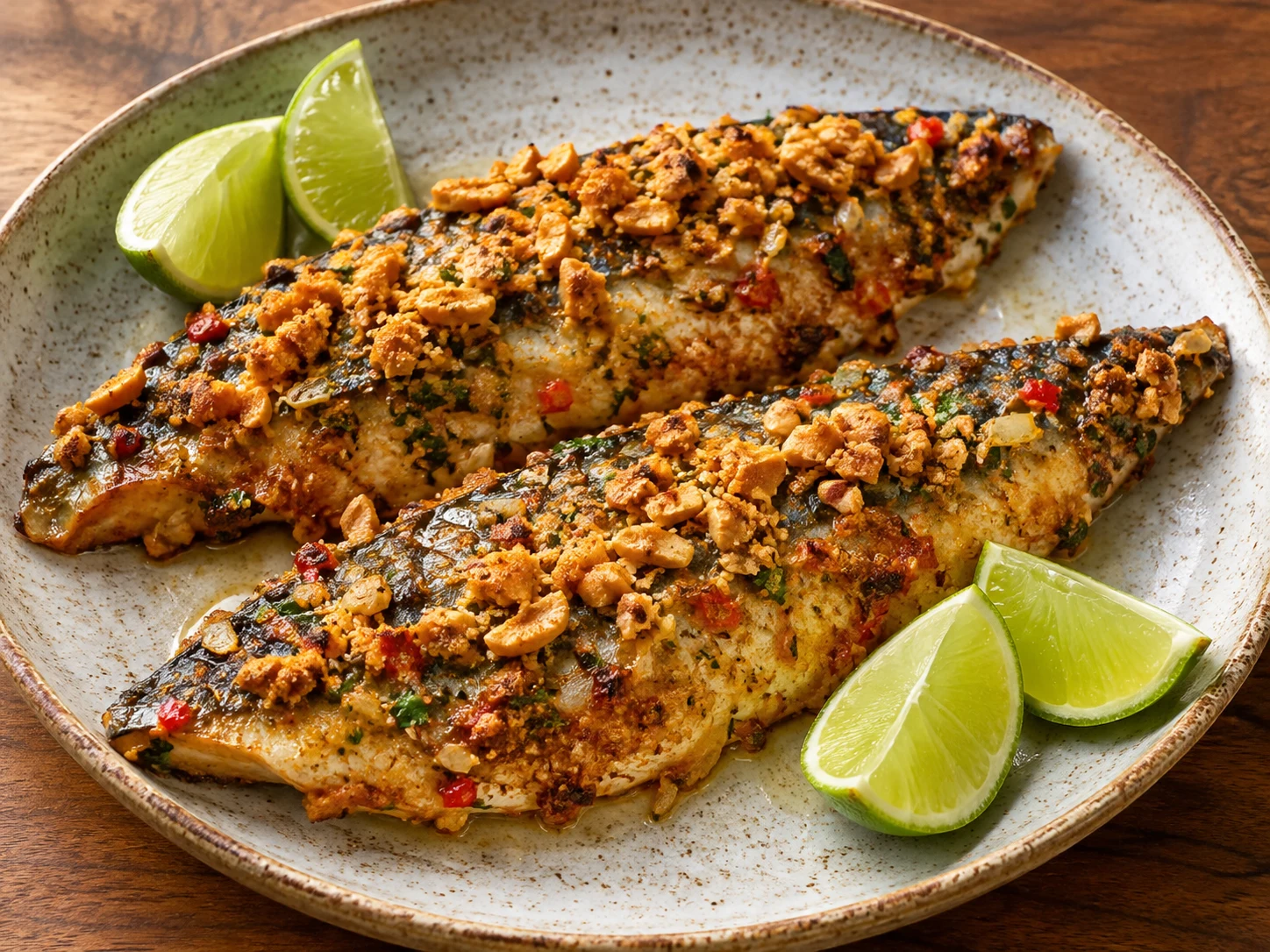
Oven-baked mackerel with a ginguba crust
Mackerel suits a short bake in the oven, preserving its flesh while allowing a crunchy topping to form.
Ingredients
- 600 g skin-on boneless mackerel fillets
- 70 g unsalted roasted peanuts
- 30 g fine corn flour
- 15 ml oil
- 20 ml lime juice
- 1 garlic clove
- 2 g salt
- Black pepper to taste
Preparation
Preheat the oven to 190 °C. Pat the fillets dry and remove remaining bones with tweezers. Lay them skin-side down on a tray lined with baking paper.
Crush peanuts into coarse crumbs without making a paste. Mix with corn flour, finely grated garlic, salt and pepper.
Brush the flesh with 10 ml oil. Distribute the crumb mixture and press lightly with clean fingers, avoiding an overly thick layer.
Drizzle the remaining 5 ml oil in small drops over the crust. Bake 12–18 minutes depending on fillet thickness, until fish is fully cooked and topping lightly coloured.
Check the thickest fillet: the flesh must be opaque and flake easily. If the crust colours too fast, protect it with a sheet of baking paper placed away from any heating element.
Serve immediately with lime juice distributed around the fish or offered separately, so the crust does not become soggy.
Introduction
Mackerel suits a short bake in the oven, preserving its flesh while allowing a crunchy topping to form. The ginguba is crushed, then mixed with a small amount of corn flour. This makes a crust without egg or wheat breadcrumbs, placed on the flesh side of the fillet. The skin stays underneath and protects the fish during cooking. This contemporary recipe is inspired by products of the Angolan table; it does not claim to be a historical variant of mufete or an attested regional recipe.
The six hundred grams of fillets give four portions. This weight refers to the part intended to be eaten, excluding heads, guts and main bones. A whole fish bought at the same weight will therefore not supply the required quantity. Asking the fishmonger to fillet it simplifies preparation but does not remove the need to check for bones. The desired result combines a lightly golden topping with cooked flesh that is still supple. A very dark crust and dry fish signal excessive cooking.
Cultural context
Ginguba is among the products of the Angolan table listed by the Angolan embassy in Türkiye. The 2004 FAO/WFP report also mentions peanuts and maize among food crops. These references clarify the choice of ingredients; they do not describe mackerel coated in this way. The oven method and proportions are a contemporary proposal from this volume. Context sources: https://www.embassyangolatr.org/tr/angola/cultura and https://www.fao.org/4/j2771p/j2771p00.htm
Tips
The recipe contains fish and peanuts.
Keep fillets chilled until preparation.
Do not blend peanuts into a paste.
Add lime at the end to preserve crunch.
Adapt the time to the fillet’s actual thickness.
Planning
Choose fresh mackerel kept chilled, or a frozen product thawed in the refrigerator. This fish requires careful temperature control; cooking does not correct all the consequences of poor storage. Prepare the fillets soon after purchase and avoid leaving them on the worktop throughout the preparation of accompaniments. Fillets of similar sizes cook together more easily. If some are considerably thinner, check them and take them out earlier.
Unsalted roasted peanuts provide a distinct texture. Crush them with a knife or brief pulses in a small food processor. Prolonged blending releases their oil and makes a paste that does not adhere like breadcrumbs. The corn flour is fine food-grade maize flour, not corn starch or coarse polenta meal. It helps distribute the peanut particles and takes on a little colour in the oven. Grate the garlic very finely so there are no large pieces that burn before the fish cooks.
Prepare the topping before taking the fillets out of the refrigerator. Preheat a conventional oven to one hundred and ninety degrees; a fan oven requires earlier checking. Line a tray with baking paper and lay the fillets on it without overlapping. Pat the surface dry with food-safe paper: excess water slows the crust setting and may form liquid on the tray. Do not rinse the fillets under a jet of water that splashes the preparation area.
Brush a thin layer of oil over the flesh, then distribute the mixture. A thickness of a few millimetres is sufficient. Press gently to make contact without crushing the flesh. Add the remaining oil in droplets to help the particles colour evenly. The topping has no egg, so do not try to create a thick shell resembling fried breading. A few crumbs may fall off when serving; this is normal.
Bake in the middle of the oven and start checking thin fillets after twelve minutes. Cooking time depends more on thickness than length. Observe the flesh at the edge and check the centre of the thickest portion. Once cooked, it no longer looks translucent and flakes easily. The crust may be sufficiently coloured before cooking is complete; in that case, protect the top rather than removing fish that is still undercooked. Do not use the grill automatically, because peanuts brown quickly.
Prepare plates and accompaniments during these last few minutes. A wide spatula slipped between the paper and skin lets you move each fillet without bending it. Serve the lime around the fish or in a small dish: poured directly over the crust too early, it softens it. Pepper and salt are already in the topping; taste a small complete bite before adding more seasoning.
Serving
Serve immediately with green vegetables or a tomato salad and a small portion of starch according to appetite. Mackerel and peanuts already provide some richness; an additional fatty sauce is unnecessary. A wide plate leaves space for the accompaniment without piling ingredients on the crust. Do not keep the fillets in the switched-off oven for long, as residual heat continues to dry them. If service is delayed, it is better to postpone putting them in the oven.
Storage
Cool leftovers quickly in a shallow container, refrigerate at 4 °C or below and eat within 24 hours. Reheat dishes intended to be eaten hot only once, until thoroughly hot at the centre. For salads, keep the dressing and crunchy elements separate where possible.
Variations
The method can be applied to another filleted fish, but the cooking time must be reassessed and the title adapted. An almond or seed crust makes a different recipe and does not automatically eliminate all allergy risks. For a more rustic topping, reserve a small proportion of the peanuts in slightly larger pieces without letting them protrude excessively. A touch of gindungo may be added to the crumb mixture; start with a small pinch to preserve the fish’s flavour.
Nutrition notes
Estimated values per serving, excluding accompaniments. Calculated from edible weights and reference foods; brands, cooking and actual yield may change the results. All fats are counted in full. Where energy is not provided in the table, it is estimated from protein and carbohydrate (4 kcal/g), fat (9 kcal/g) and fibre (2 kcal/g). Optional spices in very small quantities are not counted.
Conclusion
The desired result depends on the textures described and on seasoning adjusted at serving. This editorial formula is not presented as kitchen-tested. Enjoy your meal!
Enjoy your meal
Enjoy your meal!