Banana and Ginger Bread Pudding
Moist pudding made with stale bread, ripe banana, and fresh ginger, baked in the oven without alcohol for a simple family dessert.
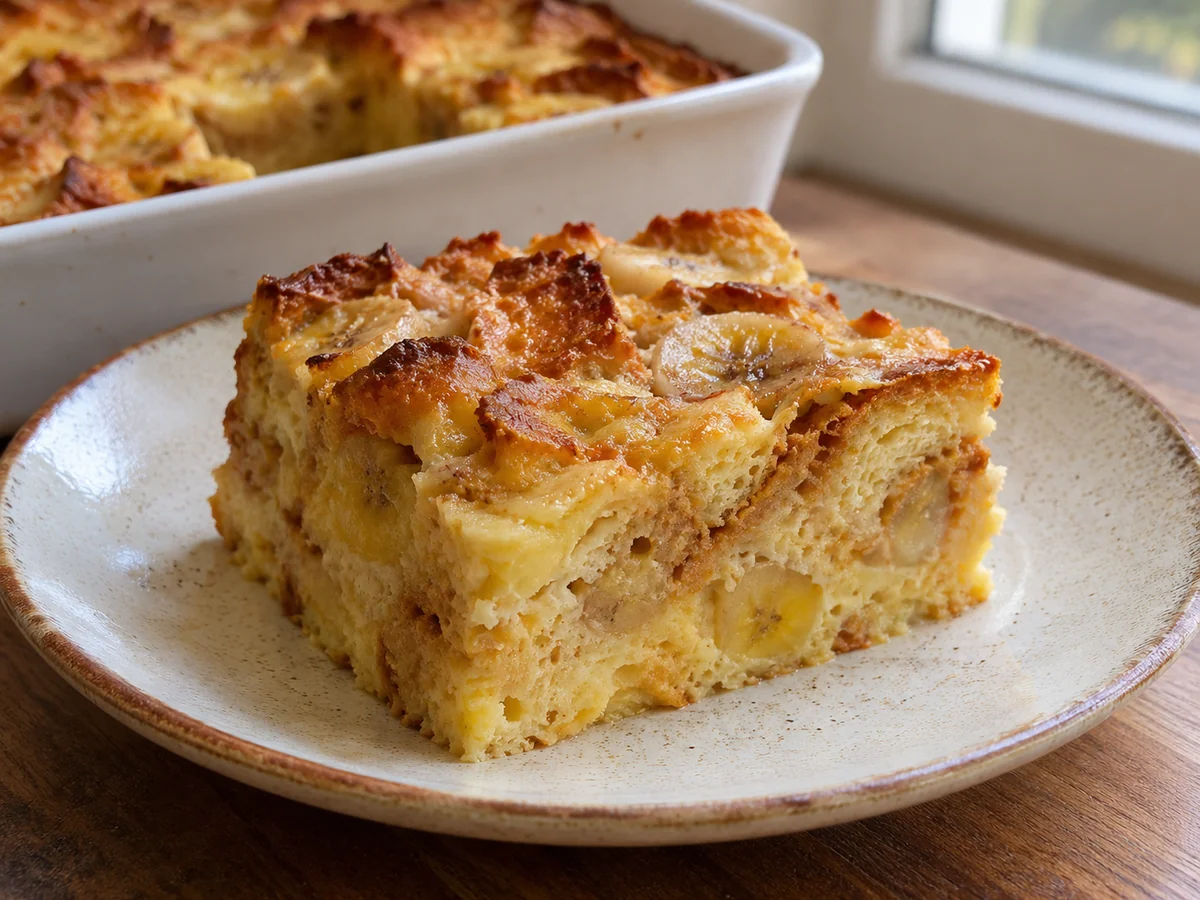
Ingredients
- 250 g of healthy stale bread
- 500 ml of semi-skimmed milk
- 3 eggs
- 250 g of ripe banana flesh
- 60 g of sugar
- 10 g of ginger
- 15 ml of neutral oil
- 1 g of salt
Preparation
Preheat the oven to one hundred seventy degrees Celsius in convection mode. While the oven heats up, cut the stale bread into two-centimeter cubes, removing only the crust if it is excessively hard or dry. Place the cubes in a large salad bowl and pour the five hundred milliliters of cold semi-skimmed milk over them. Mix gently so that each piece is in contact with the liquid, cover the salad bowl with plastic wrap and place in the refrigerator for exactly twenty minutes. This cold hydration step ensures uniform absorption without fermentation starting.
In a second salad bowl, crack the three whole eggs and add the sixty grams of powdered sugar. Whisk vigorously with an electric mixer or by hand for two to three minutes until the mixture lightens, becomes foamy, and forms a ribbon when the whisk is lifted. Meanwhile, peel the fresh ginger using a spoon to avoid wasting the flesh, then grate it finely on a microplane grater to obtain ten grams of aromatic puree without stringy fibers. Incorporate the grated ginger into the egg-sugar mixture by whisking for another thirty seconds.
Peel the very ripe bananas, cut them into chunks, and mash them roughly with a fork in a bowl to obtain two hundred fifty grams of smooth puree, without hard pieces. Pour this banana puree into the egg-sugar-ginger mixture and mix with a spatula until homogeneous. The banana provides natural binding, sweetness, and moisture, reducing the need for added fats.
Remove the salad bowl of soaked bread from the refrigerator. Pour the liquid banana-egg-ginger mixture over the milk-soaked bread cubes. Mix gently with a spatula by lifting the mass from the bottom to the top, just enough to distribute the banana puree and the egg mixture throughout the volume. Do not knead or blend: the final texture must remain slightly grainy with melting but discernible pieces of bread.
Brush the inside of a square or rectangular gratin dish of approximately twenty centimeters per side and five centimeters high evenly with the fifteen milliliters of neutral oil, brushing the bottom and sides. Pour the preparation into the oiled dish, smooth the surface with a spatula for an even thickness. Tap the dish lightly on the work surface to chase out large air bubbles.
Place the dish in the center of the oven preheated to one hundred seventy degrees Celsius. Bake for thirty-five minutes, then check doneness: the surface must be golden, the center slightly domed and firm to the touch. Insert a probe thermometer into the heart of the pudding; the internal temperature must reach a minimum of seventy-one degrees Celsius. If necessary, extend baking in five-minute increments up to forty-five minutes maximum, without exceeding to avoid drying out.
Upon removal from the oven, let the pudding rest in its dish on a rack for fifteen minutes. This rest allows the structure to stabilize and residual steam to escape without excessive condensation. Then run a thin blade around the edges to gently loosen the sides.
Transfer the pudding, still in its dish or unmolded onto a serving dish, to the refrigerator for a minimum of sixty minutes before serving. This complete cooling sets the texture, develops the ginger and banana aromas, and ensures optimal food safety by quickly bringing the heart of the dessert below ten degrees Celsius.
Introduction
This banana and ginger bread pudding transforms healthy stale bread into a moist and fragrant dessert, without alcohol or superfluous ingredients. The recipe uses two hundred fifty grams of stale bread, from which only the crust is removed if it is too hard, then cut into regular cubes for homogeneous liquid absorption. Five hundred milliliters of semi-skimmed milk are poured over the cubes in a salad bowl, then the mixture rests for twenty minutes in the refrigerator so that the bread soaks completely without fermenting. Meanwhile, three whole eggs are whisked with sixty grams of sugar until the mixture lightens slightly, then ten grams of finely grated fresh ginger are incorporated to release its pungent aromas without unpleasant fibers. The flesh of two hundred fifty grams of very ripe banana is mashed with a fork into a smooth puree, then added to the egg-sugar-ginger mixture. The soaked bread with all its milk is then poured in, and mixed gently with a spatula to obtain a homogeneous but still slightly textured batter, without overworking it. A gratin dish of approximately twenty centimeters per side is brushed with fifteen milliliters of neutral oil, then the preparation is poured in and smoothed. Baking takes place at one hundred seventy degrees Celsius for thirty-five to forty-five minutes, until the center reaches at least seventy-one degrees Celsius and the batter is set, slightly domed, and golden on top. After baking, the pudding is left to cool at room temperature for about fifteen minutes, then placed in the refrigerator for a minimum of sixty minutes before serving for a firm and fresh texture. This organization avoids leaving the milk-egg mixture out of the cold for too long and guarantees optimal food safety.
Cultural context
Contemporary creation for the Côte d'Ivoire collection of RecettesAfricaines.com, without claim of traditional heritage. General composition and food safety references: https://www.fao.org/infoods/infoods/tables-and-databases/faoinfoods-databases/en/ ; https://www.who.int/teams/nutrition-and-food-safety/multisectoral-actions-in-food-systems/five-keys-to-safer-food-poster ; https://www.foodsafety.gov/food-safety-charts/safe-minimum-internal-temperatures. These sources do not validate the origin or the exact recipe, no nutritional calculation has been performed.
Tips
Use a country bread or a baguette from the day before, without seeds or dried fruit, for a neutral crumb that absorbs milk well. Avoid industrial sandwich bread which is too tender and disintegrates into mush.
Grate the ginger at the last moment on a microplane; the heat of the hands makes the volatile oils evaporate. If the ginger is very fibrous, press it through a fine sieve to keep only the aromatic juice.
Choose bananas with black skin, very ripe, for a naturally sweet and creamy puree. If they are less ripe, add ten grams of extra sugar and blend the puree to avoid lumps.
Prepare the complete batter the day before without baking: bread soaked in milk in the fridge, egg-sugar-ginger-banana mixture covered in the refrigerator. Assemble and bake the next day for a time saving on the day.
Nutrition notes
Carbohydrates come in part from bread. Protein is supplied in part by eggs and dairy. Fats come in part from oil. Allergens to flag in the listed ingredients: bread cereals, milk and eggs. These notes describe the ingredients rather than a calculated nutritional analysis of the dish. Actual composition varies with the products chosen, their water content and the way the food is divided among four plates. Evaporation changes serving weight without establishing calories per portion. Added salt must also be considered alongside any salt in packaged ingredients. Check their labels and possible allergen contact on equipment. The stated proportions are for preparing the recipe; they do not define a suitable dietary portion for every person. Garnishes or side dishes served separately should be considered separately because they are not included in this formulation.
Conclusion
Serve the pudding well chilled, cut into squares or spoon portions, plain or accompanied by a drizzle of honey or a scoop of vanilla ice cream for a gourmet touch. Leftovers keep in the refrigerator, covered, for forty-eight hours maximum. Do not leave the pudding at room temperature for more than two hours total, preparation and service included. To reheat a portion, microwave for a few seconds at medium power or bake for a few minutes at one hundred fifty degrees Celsius, checking that the center reaches seventy degrees Celsius again. Do not freeze: the texture of the soaked bread degrades upon thawing.
Enjoy your meal
Bon appétit