Carrot cake with cassava flour
Moist cake with grated carrots and food-grade cassava flour, flavored with orange zest, baked at 175 °C for a moist crumb without added gluten.
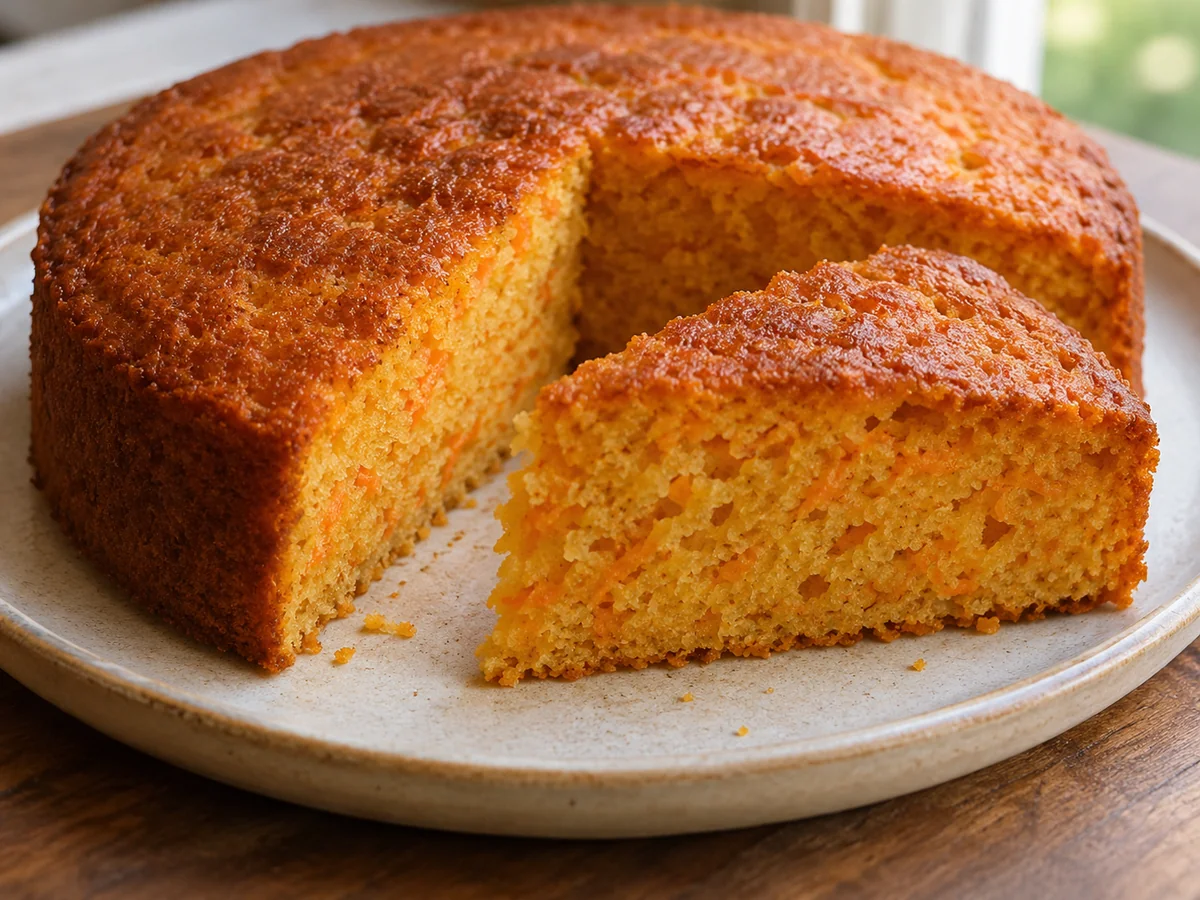
Ingredients
- 220 g finely grated carrots
- 170 g food-grade cassava flour
- 3 eggs
- 80 g sugar
- 60 ml neutral oil
- 100 ml semi-skimmed milk
- 8 g baking powder
- 1 orange
- 1 g salt
Preparation
Preheat the fan-assisted oven to 175 °C and place the rack in the middle. Take 5 ml from the measured 60 ml of oil and brush it over the base and sides of a 22 cm cake pan. Reserve the remaining 55 ml for the batter. This thin layer helps release the cake without adding butter or exceeding the listed amount of oil.
In a large bowl, whisk the three whole eggs with the 80 g of sugar for about three minutes at medium speed until the mixture whitens, becomes foamy and forms a ribbon that falls back slowly on itself when the whisk is lifted, a sign of sufficient air incorporation for the lightness of the crumb.
Pour the 55 ml of neutral oil in a continuous stream while continuing to whisk at low speed to create a stable emulsion, then add the 100 ml of semi-skimmed milk and the fine zest of half an orange grated using a microplane grater without reaching the bitter white pith, mix just enough to homogenize the liquid.
Sift together the 170 g of food-grade cassava flour, the 8 g of baking powder and the gram of salt over a fine sieve directly onto the liquid mixture, in two batches, folding with a flexible spatula using envelope movements from bottom to top so as not to deflate the batter and preserve the air bubbles.
Incorporate the 220 g of finely grated carrots in three additions, folding gently each time until the orange filaments are evenly distributed in the batter without traces of dry flour, the batter then becoming thick, shiny and slightly sticky to the touch.
Pour the batter into the prepared pan, smooth the surface with an offset spatula to obtain an even thickness, tap the pan lightly on the work surface to chase out large residual air bubbles, then bake immediately in the center of the oven preheated to 175 °C.
Bake for forty to fifty minutes without opening the door before thirty-five minutes; at forty minutes, insert a probe to the core at the center of the cake: the temperature must reach at least 71 °C and the skewer must come out dry, without trace of raw batter or shiny moisture, confirming the coagulation of egg proteins and the cooking of the starch.
Upon removal from the oven, let the cake rest for twenty minutes in its pan placed on a pastry rack so that the internal steam redistributes and the crumb stabilizes, then run a thin blade between the edge and the pan, turn out gently onto the rack for complete cooling before slicing.
Introduction
This carrot cake with cassava flour offers a dense and melting texture, obtained thanks to the combination of finely grated carrots and a commercial food-grade cassava flour, selected for its purity and absence of coarse fibers. Cassava flour, unlike tapioca starch or raw grated cassava, provides a consistent structure without excessive elasticity, which allows the cake to hold its shape when sliced while retaining a moist crumb. The carrots, chosen firm and sweet, are grated very finely to melt into the batter and release their vegetable water during baking, thus contributing to the hydration of the flour without weighing down the whole. The preparation follows a classic batter method: first cream the whole eggs with the sugar until the mixture whitens and almost doubles in volume, then incorporate the neutral oil in a thin stream to emulsify, followed by the semi-skimmed milk. The powders, cassava flour, baking powder and salt, are sifted together before being folded in gently with a spatula so as not to drive out the trapped air. The zest of half an orange, finely grated without the bitter white pith, perfumes the batter without excessive acidity; the juice is not necessary because the moisture from the carrots is sufficient. The 22 cm diameter mold, oiled on its entire internal surface, receives the batter which will be smoothed before entering the oven preheated to 175 °C. The baking of forty to fifty minutes aims for a core temperature of at least 71 °C and a skewer inserted in the center that comes out dry, guaranteeing the complete coagulation of the eggs and the gelatinization of the cassava starch. A rest of twenty minutes in the mold on a rack allows the steam to redistribute before the final unmolding.
Cultural context
Contemporary creation for the Côte d'Ivoire collection of RecettesAfricaines.com, without claim of traditional heritage. General references for composition and food safety: https://www.fao.org/infoods/infoods/tables-and-databases/faoinfoods-databases/en/ ; https://www.who.int/teams/nutrition-and-food-safety/multisectoral-actions-in-food-systems/five-keys-to-safer-food-poster ; https://www.foodsafety.gov/food-safety-charts/safe-minimum-internal-temperatures. No nutritional calculation has been performed.
Tips
Grate the carrots just before incorporation to limit oxidation and water loss; if prepared in advance, wring them out in a clean cloth to remove excess moisture that would unbalance the liquid/dry ratio of the batter.
Use a certified food-grade cassava flour, white, fine and without fermented odor; avoid uncontrolled artisanal flour or tapioca starch which would give a gelatinous and sticky texture incompatible with the cake's structure.
If the oven runs hot at the top, cover the cake with a slightly domed sheet of aluminum foil after thirty minutes of baking to prevent excessive browning of the crust before the center reaches 71 °C.
The cake keeps for three days at room temperature under a cloche or plastic wrap, and up to five days in the refrigerator; reheating for ten minutes at 150 °C restores moisture without drying out the crumb thanks to the cassava starch which retrogrades slowly.
Nutrition notes
Carbohydrates come in part from cassava. Protein is supplied in part by eggs and dairy. Fats come in part from oil. Allergens to flag in the listed ingredients: eggs and milk. These notes describe the ingredients rather than a calculated nutritional analysis of the dish. Actual composition varies with the products chosen, their water content and the way the food is divided among four plates. Evaporation changes serving weight without establishing calories per portion. Added salt must also be considered alongside any salt in packaged ingredients. Check their labels and possible allergen contact on equipment. The stated proportions are for preparing the recipe; they do not define a suitable dietary portion for every person. Garnishes or side dishes served separately should be considered separately because they are not included in this formulation.
Conclusion
This carrot cake with cassava flour is enjoyed warm or at room temperature, plain or accompanied by a lightly sweetened fromage blanc to contrast with the density of the crumb. Clean slicing is facilitated by a thin-bladed knife dipped in hot water between each slice. Leftovers keep in the fridge in an airtight container; for longer storage, slice then freeze the portions separated by parchment paper, thaw at room temperature for one hour before serving. Respect the cold chain for portions containing cooked eggs if they are not consumed within two hours of leaving the oven.
Enjoy your meal
Bon appétit