Pineapple Compote with Mango and Lime
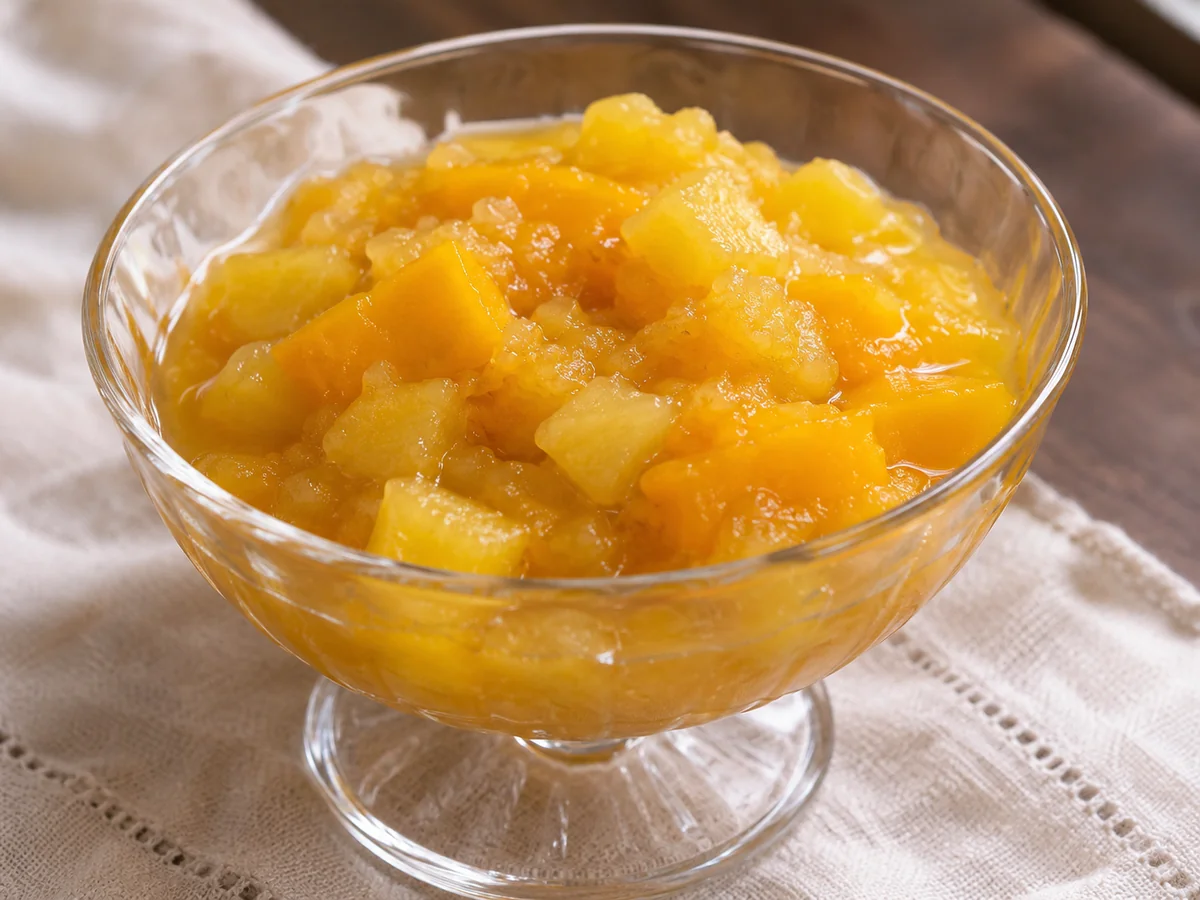
Fruity compote of pineapple and ripe mango, lightly sweetened, scented with lime. Prepared in 25 minutes, served chilled after one hour of refrigeration. Light dessert for four people.
Ingredients
- 600 g pineapple flesh
- 400 g mango flesh
- 30 g sugar
- 100 ml water
- 1 lime
Preparation
Dice the pineapple flesh into small regular cubes of about one centimeter per side, taking care to remove the hard, fibrous central core thoroughly. Place the cubes in a heavy-bottomed saucepan, add the 100 ml of water and the 30 g of sugar. Place over medium heat, bring to a gentle boil while stirring to dissolve the sugar, then lower the intensity to maintain a simmer. Cover partially with an offset lid and cook for 15 minutes, stirring halfway through, until the pineapple pieces become tender but retain their shape, and the liquid reduces slightly into a clear syrup.
While the pineapple cooks, peel the mango, remove the stone and dice the flesh into cubes of comparable size to those of the pineapple. Choose a firm but very ripe mango, which yields slightly under thumb pressure without being mushy, so that it holds up to the brief cooking. Set the cubes aside in a separate bowl. Wash the lime under running water, dry it, then roll it firmly on the work surface to soften the pulp before cutting it in half and extracting the juice using a citrus press; strain to remove the seeds.
At the end of the 15 minutes of pineapple cooking, immediately incorporate the mango cubes into the saucepan. Mix gently with a wooden spoon to avoid crushing the fruits, then continue cooking over low heat for 8 to 10 minutes, uncovered, monitoring the texture. The mango must become very tender and begin to break apart in places, while the pineapple remains identifiable. Do not add additional water; the juice released by the mango is sufficient to maintain the necessary moisture.
Remove the saucepan from the heat. Using a potato masher or the back of a fork, partially mash the mixture: the goal is to obtain a compote with pieces still visible, neither a smooth puree nor an intact fruit salad. Press the equivalent of half the lime juice prepared previously directly onto the hot compote, mix one last time to distribute the acidity. Taste and, if necessary, add the remaining juice according to personal preference.
Pour the compote into a large shallow dish or a glass or ceramic salad bowl, spread in an even layer to promote rapid and homogeneous cooling. Let warm to room temperature for 20 to 30 minutes maximum, without covering, stirring once halfway through to avoid the formation of a skin on the surface. This step limits bacterial growth before refrigeration.
Cover the dish with plastic wrap in direct contact or an airtight lid and place in the refrigerator at 4 °C or below for at least one hour. Complete cooling sets the sugar-acid balance, firms the whole and allows the aromas of pineapple, mango and lime to meld without excessive oxidation. Do not freeze at this stage.
At serving time, stir the very cold compote lightly to distribute the syrup. Divide into four individual ramekins or small bowls. The texture should be creamy with melting pieces, the taste balanced between fruity sweetness and a tangy note. No addition of sugar, cream or ice cream is intended; the recipe is designed to be enjoyed as is.
Store remaining portions in the refrigerator, well covered, and consume within 48 hours. Beyond that, the mango oxidizes, the pineapple loses its shape and the lime aroma fades. Do not reheat. Discard any leftovers presenting an unusual odor, visible fermentation or color alteration.
Introduction
This contemporary compote combines the fragrant flesh of pineapple with the creamy sweetness of very ripe mango, enhanced by the lively acidity of lime. The result is a fruity, light and refreshing dessert, with no added cream, milk or heavy spices, which showcases the intrinsic quality of the fresh fruits. The brief cooking of the pineapple in a light syrup made from water and sugar tenderizes the pieces while preserving their shape, then the incorporation of the mango at the end of cooking preserves its melting texture and vivid color. The preparation follows a simple logic: peeling and regular dicing, step-by-step cooking, partial mashing to obtain a consistency between compote and fruit salad, then rapid cooling before refrigeration. This recipe claims no traditional or historical origin; it is a contemporary creation integrated into a Côte d'Ivoire collection for the site RecettesAfricaines.com. The important distinction lies in the precise dosage of sugar — only 30 g for one kilo of fruit — and in the addition of lime juice off the heat to preserve its volatile aroma. Service is very chilled, after at least one hour in the refrigerator, which allows the flavors to harmonize without prolonged maceration.
Cultural context
Contemporary creation for the Côte d'Ivoire collection of RecettesAfricaines.com, with no claim of traditional origin. General references for composition and food safety: https://www.fao.org/infoods/infoods/tables-and-databases/faoinfoods-databases/en/ ; https://www.who.int/teams/nutrition-and-food-safety/multisectoral-actions-in-food-systems/five-keys-to-safer-food-poster ; https://www.foodsafety.gov/food-safety-charts/safe-minimum-internal-temperatures. No nutritional calculation has been performed.
Tips
Choose a very ripe pineapple, heavy for its size, whose scales detach easily at the base; a green fruit will yield an acidic and fibrous compote even after cooking.
If the mango is very ripe, reduce its cooking to 5 minutes and mash more lightly to avoid an overly liquid texture.
Prepare the compote the day before: the flavors are even more harmonious after 12 hours of refrigeration, but do not exceed 24 hours before serving.
Use a lime with thin, shiny skin, a sign of abundant juice; rolling it firmly before extraction maximizes yield without effort.
Nutrition notes
Carbohydrates come in part from fruit and added sugar. These notes describe the ingredients rather than a calculated nutritional analysis of the dish. Actual composition varies with the products chosen, their water content and the way the food is divided among four plates. Evaporation changes serving weight without establishing calories per portion. Added salt must also be considered alongside any salt in packaged ingredients. Check their labels and possible allergen contact on equipment. The stated proportions are for preparing the recipe; they do not define a suitable dietary portion for every person. Garnishes or side dishes served separately should be considered separately because they are not included in this formulation.
Conclusion
Serve the compote very chilled in individual ramekins, optionally accompanied by a dry biscuit or a spoonful of plain yogurt to vary textures. Leftovers keep for a maximum of 48 hours in the refrigerator in an airtight container; beyond that, organoleptic quality degrades rapidly. Do not reheat or freeze after preparation. Respect the cold chain throughout service to guarantee food safety.
Enjoy your meal
Bon appétit !