Oven-roasted cassava with sesame and lime sauce
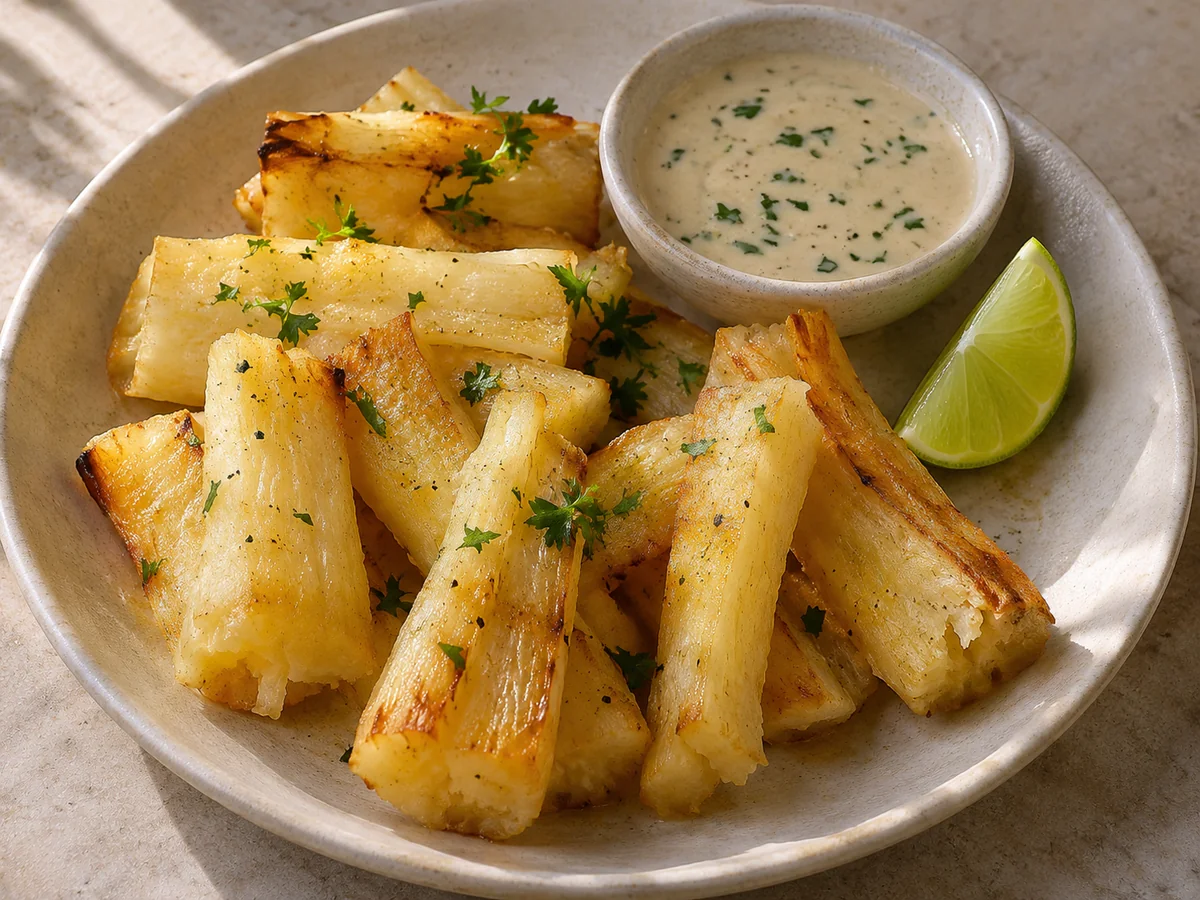
Food-grade cassava roasted in the oven, coated in a creamy tahini, lime and parsley sauce. Vegan, gluten-free side dish, ready in one hour.
Ingredients
- 900 g peeled food-grade cassava
- 60 g non-sweetened sesame paste
- 25 ml oil
- 1 lime
- 100 ml warm water for the sauce
- 10 g parsley
- 4 g salt
- 1 g pepper
- abundant water for cassava pre-cooking
Preparation
Bring a large pot of abundant unsalted water to a boil, plunge in the peeled cassava batons stripped of their fibrous core, maintain a steady simmer for twenty-five to thirty minutes until the tip of a knife penetrates the thickest center without resistance, then drain immediately in a stainless steel colander shaking gently to remove surface water without crushing the flesh.
Preheat the oven to two hundred ten degrees Celsius in convection mode, line a baking sheet with parchment paper, arrange the drained cassava sections in a single layer without overlapping, brush each side with the twenty-five milliliters of vegetable oil measured with a pastry brush, bake at mid-height for twenty to twenty-five minutes turning the pieces halfway through cooking using flat tongs to obtain an even golden color and a slightly crisp skin.
While the cassava cooks, pour the sixty grams of non-sweetened sesame paste into a stainless steel bowl, add the juice of half the lime pressed by hand without seeds, whisk vigorously with a hand whisk: the paste will first thicken and become grainy, a normal sign of the emulsion forming, continue whisking without stopping.
Then incorporate the one hundred milliliters of warm water in a very fine stream, while whisking constantly, until the sauce lightens, becomes smooth, glossy and coats the back of a spoon without running too quickly, then distribute the four grams of salt and the one gram of pepper between the sauce and the cassava according to your taste, keeping the majority of the salt for the sauce.
Finely chop the ten grams of flat-leaf parsley washed, spun in a clean kitchen towel and dried on paper towels, incorporate three quarters of the parsley into the warm sauce mixing gently with a flexible spatula so as not to break the emulsion, reserve the rest for final plating.
Remove the baking sheet from the oven, check the cassava tenderness by inserting a metal skewer into the center of the largest piece: it must slide in effortlessly, then transfer the hot batons onto a preheated serving dish, drizzle generously with sesame-lime sauce distributing it with a spoon over each side.
Sprinkle the remaining parsley over the whole, squeeze the remaining half lime over the dish for a final touch of acidity adjusted to taste, serve immediately while the cassava retains its contrast between crisp skin and melting heart.
Unused sauce keeps for a maximum of forty-eight hours in the refrigerator in an airtight glass jar, reheat very gently in a bain-marie while whisking to restore the emulsion; cooked cassava keeps for twenty-four hours in the fridge and reheats in the oven at one hundred eighty degrees for ten minutes to regain its crispness.
Introduction
This contemporary recipe showcases food-grade cassava, specifically selected for its white, firm flesh devoid of bitterness, an essential condition for obtaining a meltingly tender center and a slightly crisp surface after oven roasting. Heavy roots with intact brown skin are preferred, which are peeled generously to remove all traces of bark and the central fibrous cord, tough and indigestible, which is systematically removed with a paring knife after cutting the sections into regular batons three to four centimeters thick. The workflow clearly separates the aqueous pre-cooking, which tenderizes the starch without waterlogging it, from the dry oven finish, which develops roasted notes and a golden skin thanks to a drizzle of neutral vegetable oil brushed onto each side. The sauce, meanwhile, rests on a non-sweetened, food-grade sesame paste, emulsified cold with the juice of a freshly squeezed lime, then loosened gradually with one hundred milliliters of warm water poured in a thin stream while whisking vigorously to obtain a coating, glossy and stable consistency, without phase separation. Flat-leaf parsley, finely chopped at the last moment, adds a lively herbal touch that balances the fatty richness of the tahini and the sharp acidity of the citrus. This preparation never reuses the cassava cooking water, too loaded with residual starch, and contains no animal-derived ingredients, making it suitable for vegan and gluten-free diets, while clearly signaling the presence of sesame, a declared major allergen.
Cultural context
Contemporary creation for the Ivory Coast collection of RecettesAfricaines.com, without claim of traditional origin. General food composition and safety references: https://www.fao.org/infoods/infoods/tables-and-databases/faoinfoods-databases/en/ ; https://www.who.int/teams/nutrition-and-food-safety/multisectoral-actions-in-food-systems/five-keys-to-safer-food-poster ; https://www.foodsafety.gov/food-safety-charts/safe-minimum-internal-temperatures. No nutritional calculation has been carried out for this recipe.
Tips
Choose a so-called "sweet" cassava certified food-grade, heavy for its size, with smooth skin without mold; reject any root that is light, cracked or with yellowish flesh which indicates a bitter variety unfit for consumption even after prolonged cooking.
For a perfectly stable sauce, use a fresh, well-homogeneous sesame paste, without oil floating on top; if the tahini is old, blend it with an immersion blender with a teaspoon of warm water before adding the lime juice.
The aqueous pre-cooking can be done the day before: drain, spread on a tray, cover with cling film in contact and refrigerate; the next day, brush with oil and bake directly without bringing to room temperature.
Never reuse the cassava cooking water for the sauce: its excess starch would make it pasty and cloudy; systematically discard this water and use only the fresh warm water provided for this purpose.
Nutrition notes
Carbohydrates come in part from cassava. Fats come in part from sesame and oil. Allergens to flag in the listed ingredients: sesame. These notes describe the ingredients rather than a calculated nutritional analysis of the dish. Actual composition varies with the products chosen, their water content and the way the food is divided among four plates. Evaporation changes serving weight without establishing calories per portion. Added salt must also be considered alongside any salt in packaged ingredients. Check their labels and possible allergen contact on equipment. The stated proportions are for preparing the recipe; they do not define a suitable dietary portion for every person. Garnishes or side dishes served separately should be considered separately because they are not included in this formulation.
Conclusion
Serve this roasted cassava piping hot as an accompaniment to a grilled protein or a simmered legume to compose a complete dish. Leftover cassava keeps for twenty-four hours in the refrigerator in an airtight container; reheat in the oven at one hundred eighty degrees Celsius for ten minutes to restore crispness, avoiding the microwave which softens the skin. The sesame sauce keeps for forty-eight hours in the fridge in a closed glass jar; reheat very gently in a bain-marie while whisking to re-emulsify, without bringing to a boil. Discard any portion left at room temperature for more than two hours. Do not refreeze after thawing.
Enjoy your meal
Bon appétit