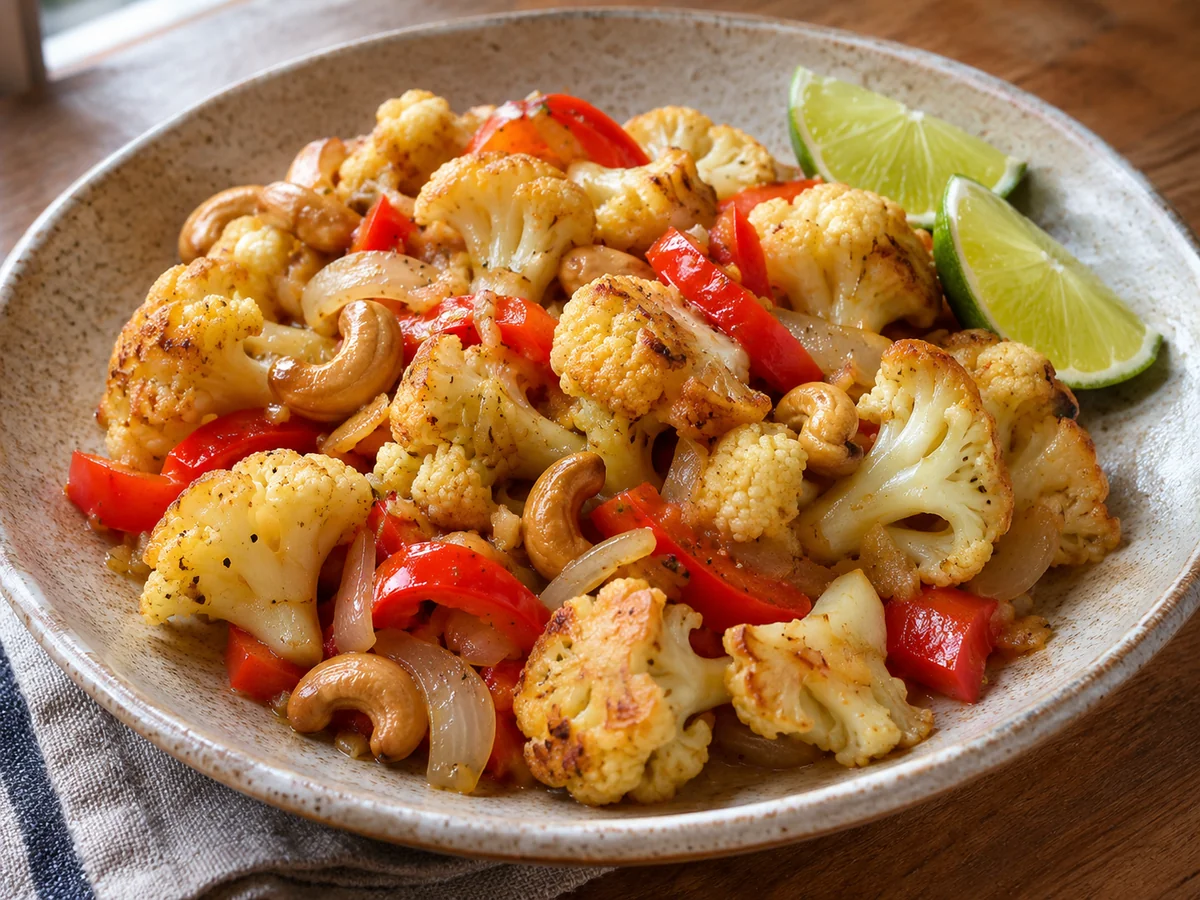
Pan-seared cauliflower with cashews and lime
Tender golden pan-seared cauliflower, enhanced with fresh ginger, red bell pepper and toasted cashews, finished with lime for a tangy touch.
Ingredients
- 800 g cauliflower florets
- 200 g red bell pepper
- 120 g onion
- 70 g roasted unsalted cashews
- 20 ml oil
- 120 ml water
- 15 g ginger
- 1 lime
- 4 g salt
- 1 g pepper
Preparation
Bring a large pot of unsalted water to a rolling boil. Plunge the eight hundred grams of cauliflower florets, three-centimeter size, and blanch them for exactly four to five minutes: they should lighten slightly, remain firm under the knife tip and not collapse. Drain immediately in a stainless steel colander, shake to remove residual water and spread on a clean cloth to stop cooking and dry the surface, an essential condition for obtaining a golden color later.
While the cauliflower drains, peel one hundred twenty grams of yellow onion and mince it finely into regular half-moons. Wash the red bell pepper, remove the stem, white membranes and seeds, then cut the flesh into five-millimeter-wide strips. Peel fifteen grams of fresh ginger with a spoon, grate it finely over a bowl to recover the juice. With these preparations ready, you will proceed without delay.
Heat a wide, thick-bottomed pan — stainless steel or enameled cast iron — over medium-high heat. Pour in the twenty milliliters of neutral oil, heat until shimmering but not smoking. Add the minced onion, stir constantly for three minutes until it becomes translucent and fragrant. Add the bell pepper strips and grated ginger, continue cooking for two to three minutes: the pepper should soften without losing its structure, the ginger releases its aroma without browning.
Incorporate the blanched and dried cauliflower florets into the pan. Spread them in a single layer, let them sear without moving for one minute to form a golden crust on the edges. Stir gently with a wooden spatula, repeat the operation twice over five minutes total: the edges caramelize, the cores remain intact. Sprinkle the four grams of fine salt and the gram of freshly ground black pepper, mix.
Pour one hundred twenty milliliters of cold water along the side of the pan to deglaze the fond without splashing. Cover immediately with a tight-fitting lid, reduce to low heat and cook for five minutes: the steam finishes the tenderness of the cores without melting them. Check with a knife tip at the center of a floret; it should slide without resistance but the structure holds.
Remove the lid, increase the heat slightly to evaporate any excess liquid if it remains, one to two minutes while stirring. The bottom of the pan should be almost dry, the vegetables shiny, not swimming. Taste, adjust seasoning if necessary, but without adding salt beyond the four grams planned.
Off the heat, add the seventy grams of already roasted unsalted cashews. Mix just once to coat them with the residual heat without roasting them further: their buttery crunch must remain intact, their golden color unchanged. Any further cooking would make them bitter and brittle.
Press the whole lime over the pan, strain out the seeds. Stir vigorously to distribute the acidity over every floret. The juice sets the green color, lifts the whole and cuts the richness of the nuts. Serve immediately in a preheated dish, without waiting, to preserve texture and temperature.
Introduction
This pan-seared cauliflower with cashews and lime offers a colorful, crunchy and fragrant vegetable side dish, designed for four diners without claiming to be a complete protein. The recipe relies on a fresh, good-sized cauliflower, cut into regular florets of about three centimeters to ensure even cooking: the cores become tender without falling apart, the edges caramelize slightly on contact with the pan. The red bell pepper, cut into thin strips, brings a fruity sweetness and a discreet smoky note that balances the cauliflower's natural bitterness. The minced onion melts in the oil to create an aromatic base, while the freshly grated ginger, measured at fifteen grams, releases its fresh heat without dominating the whole. The cashews, already roasted and unsalted, are incorporated at the very end of cooking to preserve their buttery crunch and prevent them from burning on contact with residual heat. The lime juice, pressed off the heat, awakens the flavors with its lively acidity and sets the green color of the florets. The three-step organization — short blanching, controlled sauté, cold finish — guarantees a controlled texture and a clean flavor, without excess fat or prolonged cooking that would soften the vegetable. This contemporary creation is part of a modern Ivorian collection, without claiming traditional roots or therapeutic virtues.
Cultural context
Contemporary creation for the Côte d'Ivoire collection of RecettesAfricaines.com, without traditional roots or historical claim. General composition and food safety references: https://www.fao.org/infoods/infoods/tables-and-databases/faoinfoods-databases/en/ ; https://www.who.int/teams/nutrition-and-food-safety/multisectoral-actions-in-food-systems/five-keys-to-safer-food-poster ; https://www.foodsafety.gov/food-safety-charts/safe-minimum-internal-temperatures. No nutritional analysis has been performed on this recipe.
Tips
Blanch the cauliflower the day before, drain, dry, store in the refrigerator in an airtight container: saves ten minutes on the day and better coloration thanks to a drier surface.
Use a mandoline for the onion and bell pepper: identical sizes, even cooking, time saving. Grate the ginger on a microplane directly over the pan to lose no aromatic juice.
If you don't have a tight-fitting lid, cover with a sheet of parchment paper placed on the vegetables then the pot lid: steam circulates better, cores cook without excess water.
Buy roasted unsalted cashews in bulk, store in the freezer in a zip bag: they keep crunch and freshness for three months. Take out the exact dose at the last moment, no thawing needed.
Nutrition notes
Carbohydrates come in part from vegetables. Fats come in part from cashews and oil. Allergens to flag in the listed ingredients: cashews. These notes describe the ingredients rather than a calculated nutritional analysis of the dish. Actual composition varies with the products chosen, their water content and the way the food is divided among four plates. Evaporation changes serving weight without establishing calories per portion. Added salt must also be considered alongside any salt in packaged ingredients. Check their labels and possible allergen contact on equipment. The stated proportions are for preparing the recipe; they do not define a suitable dietary portion for every person. Garnishes or side dishes served separately should be considered separately because they are not included in this formulation.
Conclusion
Serve this pan-seared cauliflower hot as an accompaniment to grilled fish, roasted poultry or a simmered legume to compose a complete meal. Leftovers keep for a maximum of forty-eight hours in the refrigerator in an airtight container, after rapid cooling at room temperature for less than two hours. Reheat in a pan over low heat with a tablespoon of water to revive the texture, or in the microwave at medium power for one minute. Avoid freezing: cauliflower becomes spongy, nuts lose their crunch. Discard any portion left more than two hours at room temperature.
Enjoy your meal
Bon appétit !