Ivorian Lentil Stew with Butternut Squash and Peanut Paste
Contemporary Ivorian stew of green lentils, butternut squash, and unsweetened peanut paste, simmered in a single pot for four people.
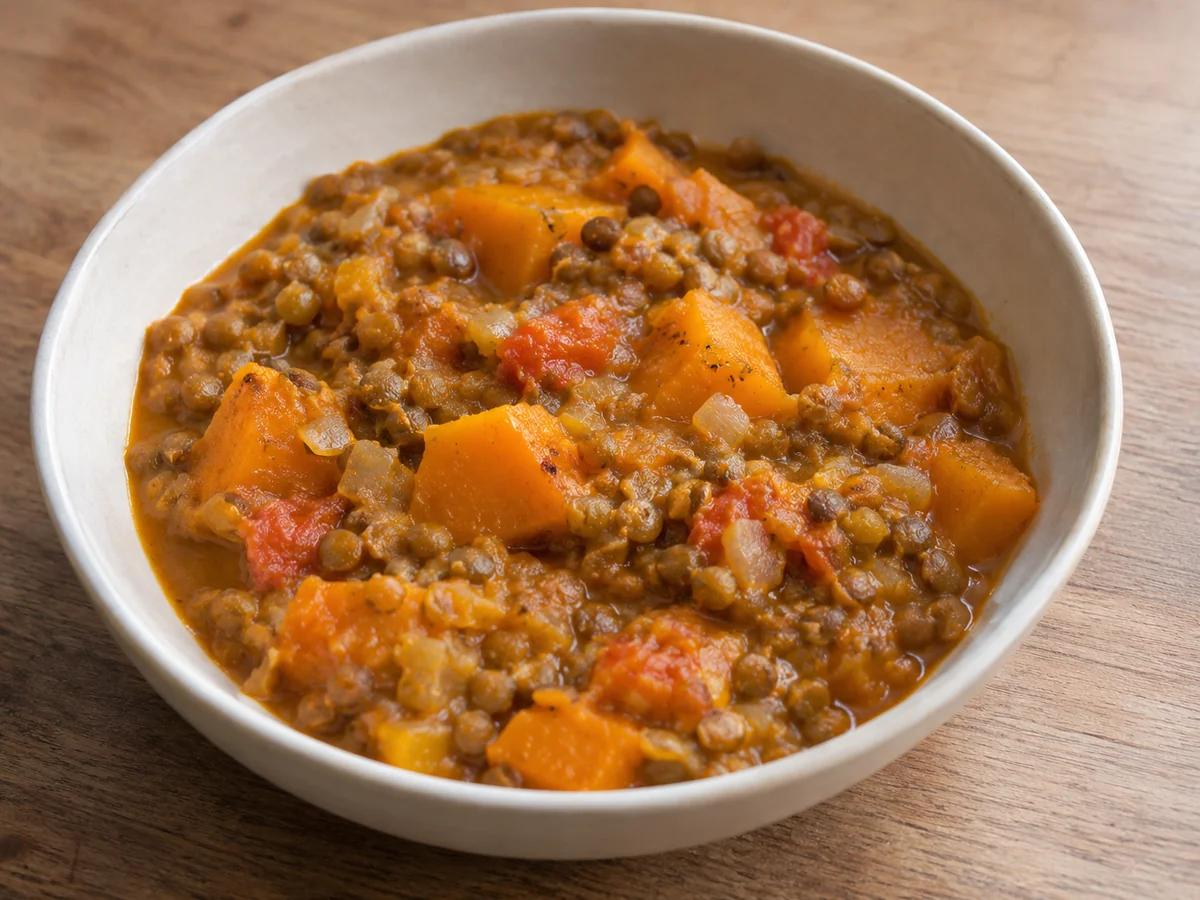
Ingredients
- 220 g dried green lentils
- 650 g peeled butternut squash
- 350 g tomatoes
- 50 g unsweetened peanut paste
- 120 g onion
- 15 g ginger
- 20 ml oil
- 1 liter water, adjust to lentils
- 4 g salt
- 1 g pepper
Preparation
Rinse the two hundred twenty grams of dried green lentils under running water in a fine sieve, remove any impurities, then pour them into a saucepan of sufficient capacity with seven hundred milliliters of cold unsalted water; bring to a gentle boil, skim if necessary, then maintain a steady simmer for twenty to twenty-five minutes monitoring the texture: the lentils must be tender to the bite without crushing, then turn off the heat and let them rest in their cooking liquid which will serve as broth.
While the lentils cook, peel one hundred twenty grams of onion and mince it finely; peel fifteen grams of fresh ginger and grate it; wash three hundred fifty grams of tomatoes and crush them coarsely retaining their juice; peel six hundred fifty grams of butternut squash, remove the seeds and central filaments, then cut the flesh into regular two-centimeter cubes for even cooking.
In a large Dutch oven or heavy-bottomed sauté pan, heat twenty milliliters of oil over medium heat; add the minced onion and grated ginger, sweat for three to four minutes stirring until the onion becomes translucent without coloring, then incorporate the crushed tomatoes with their juice and let reduce for five minutes stirring to prevent sticking.
Add the butternut squash cubes to the pot, pour in three hundred milliliters of water, bring to a simmer, cover partially and cook for twenty minutes over low-medium heat checking at mid-cook that the squash softens without falling apart; if the liquid evaporates too quickly, add a tablespoon of water.
While the squash cooks, take a ladle of warm lentil broth in a bowl, incorporate fifty grams of unsweetened peanut paste and whisk vigorously until a smooth lump-free cream is obtained; this off-heat step prevents separation of the peanut oils.
Pour the thinned peanut cream into the pot containing the squash and tomato-onion base, mix gently to homogenize the sauce, then incorporate the cooked lentils with the entirety of their reserved cooking liquid; bring back to a very gentle simmer.
Let the whole simmer eight to ten minutes over very low heat, uncovered, stirring every two minutes with a wooden spoon to prevent the lentils from sticking to the bottom; the sauce must thicken slightly and coat the squash cubes without becoming pasty.
Taste and adjust seasoning with four grams of fine salt and one gram of freshly ground black pepper, taking into account the already salty flavor of the peanut paste; remove from heat, cover and let rest three minutes before serving so the flavors stabilize.
Introduction
This contemporary stew combines the firm texture of green lentils with the melting sweetness of butternut squash, all bound by an unsweetened peanut paste that adds body without heaviness. The recipe was designed for single-pot cooking after a separate pre-cooking of the lentils, which allows control of their texture and prevents them from breaking down during prolonged contact with the acidity of the tomatoes. The lentils are rinsed then cooked in approximately seven hundred milliliters of unsalted water for twenty to twenty-five minutes according to package directions, until tender but still whole; their cooking liquid is entirely retained to become the base broth of the stew, preserving minerals and avoiding the addition of an industrial stock. Meanwhile, an aromatic base is built by sweating the minced onion and grated ginger in oil, then incorporating the crushed tomatoes and squash cubes with three hundred milliliters of water for a twenty-minute cook that tenderizes the squash without reducing it to a puree. The peanut paste is then thinned off the heat with a ladle of warm broth to avoid lumps, then reincorporated into the squash-tomato mixture before adding the drained lentils with their liquid. The whole simmers eight to ten minutes over low heat, the time for flavors to harmonize and the sauce to thicken slightly. Salt is added at the very end to account for the natural salinity of the peanut paste, and pepper completes the seasoning. This vegetarian main dish, gluten-free and dairy-free, is suitable for a family lunch or a make-ahead meal.
Cultural context
Contemporary creation for the Côte d'Ivoire collection of RecettesAfricaines.com, without claim of traditional origin. General composition and food safety references: https://www.fao.org/infoods/infoods/tables-and-databases/faoinfoods-databases/en/ ; https://www.who.int/teams/nutrition-and-food-safety/multisectoral-actions-in-food-systems/five-keys-to-safer-food-poster ; https://www.foodsafety.gov/food-safety-charts/safe-minimum-internal-temperatures. No nutritional calculation has been performed.
Tips
Cook the lentils the day before and keep them refrigerated in their broth in an airtight container; they will reheat faster and keep an ideal texture.
Prepare the onion-ginger-tomato base in advance and store it separately; on the day, only the squash cooking and binding with peanut paste will remain.
If the peanut paste is very thick, thin with a little more warm broth before incorporating; avoid cold water which congeals the oils.
For a creamier version, blend a small portion of the cooked squash before adding the lentils, then return everything to the pot.
Nutrition notes
Carbohydrates come in part from legumes. Protein is supplied in part by legumes. Fats come in part from peanuts and oil. Allergens to flag in the listed ingredients: peanuts. These notes describe the ingredients rather than a calculated nutritional analysis of the dish. Actual composition varies with the products chosen, their water content and the way the food is divided among four plates. Evaporation changes serving weight without establishing calories per portion. Added salt must also be considered alongside any salt in packaged ingredients. Check their labels and possible allergen contact on equipment. The stated proportions are for preparing the recipe; they do not define a suitable dietary portion for every person. Garnishes or side dishes served separately should be considered separately because they are not included in this formulation.
Conclusion
Serve the stew piping hot in deep bowls, accompanied by plain white rice cooked according to package directions, cooled quickly and refrigerated within two hours if leftovers are planned. Uneaten portions keep forty-eight hours in the refrigerator in an airtight container; reheat gently adding a tablespoon of water if the sauce has thickened too much. Avoid leaving the dish at room temperature for more than two hours. Optionally freeze in individual portions up to three months; thaw in the refrigerator before reheating.
Enjoy your meal
Bon appétit